Think of a contractor finishing a job in somebody else’s kitchen. The work is done. The customer is ready. Getting paid ought to be the easy part. Yet the invoice, the customer record and the card reader can each live somewhere different. Talus is building its business around that small, expensive gap between completing the work and collecting the money.
- Talus connects payment acceptance with the software merchants use to run their businesses.
- Buying Jobox and Clarus added field-service tools and B2B expertise.
- ReadyPoint puts checkout on Samsung devices, with a dedicated merchant account and human support.
The interesting part is how it got there. A payments processor can compete on the price of a transaction. Or it can get closer to the circumstances that produce the transaction. Talus has been pursuing the second route, acquiring capabilities and then putting them into products that travel with the merchant.
A card swipe has a working day attached
Talus serves small and midsize businesses, including retailers, restaurants, healthcare practices and field-service operators. Its September 2026 announcement reports more than 22,000 merchants across North America, 65 million annual transactions and over $12 billion in annual charge volume. That last number measures money moving through the system. It is not Talus’s revenue.
Money processed for merchants, not money earned by Talus.
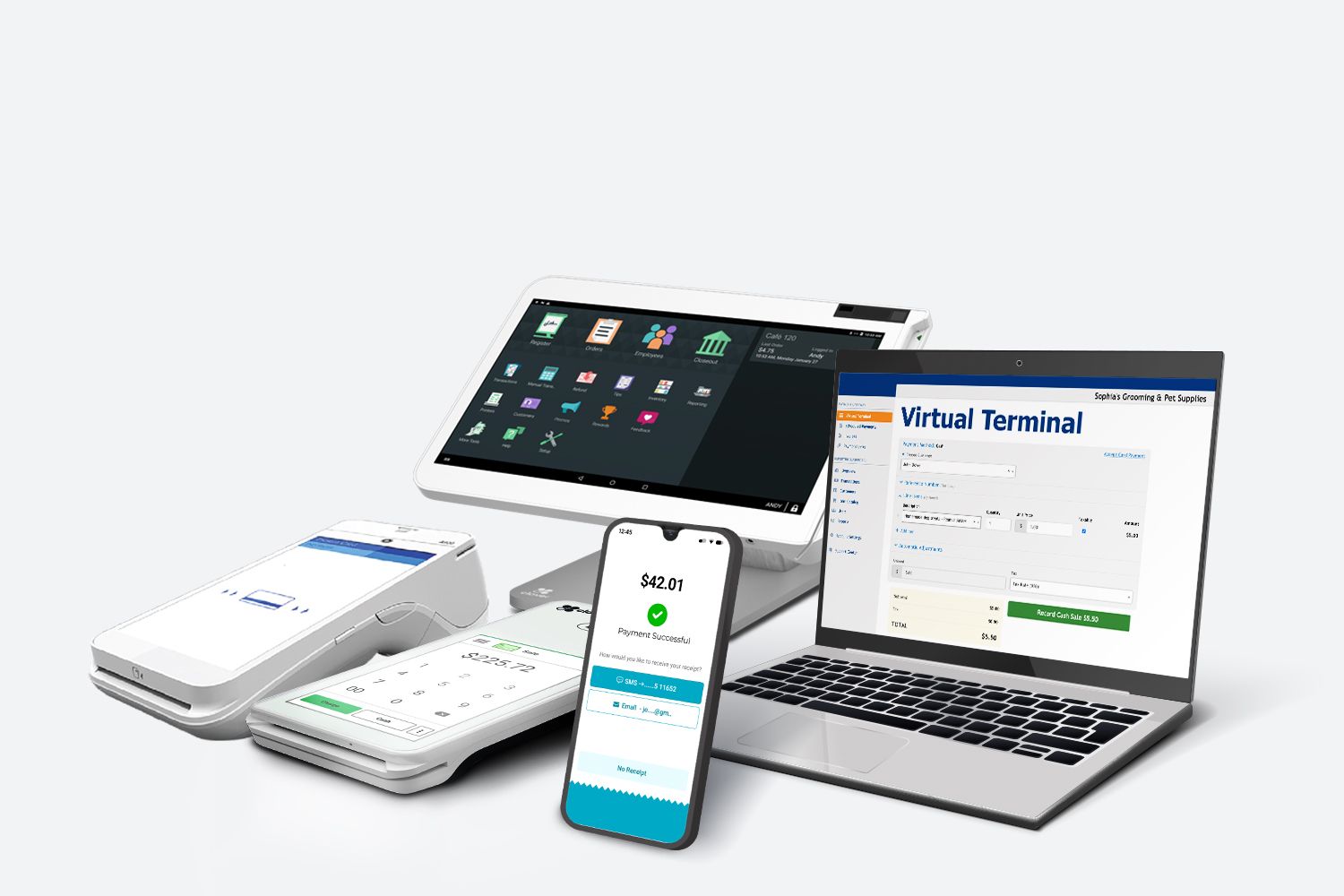
There are several customers hiding inside that description. A shop needs to accept a card. A software company wants payments inside its application. A reseller wants a product it can sell, support and earn recurring income from. Talus supplies merchant onboarding, payment gateways, equipment, settlement, reporting and support across those relationships.
Two purchases, one revealing name change
The business dates to 2006. Its history runs through Crescent Processing and Future Payment Technologies; Crescent founder David Kesler describes selling that business to private equity in 2016. Talus subsequently grew through acquisitions. In September 2018, it announced the purchase of Prolific Business Solutions and an additional $250 million of acquisition capital committed by A&M Capital Partners.
That was capital for buying businesses, rather than a disclosed venture funding round. It helps explain the method: purchase capabilities and distribution, then combine them. The more revealing purchases arrived in the announcement of January 2024: Jobox.ai and Clarus Merchant Services.
Jobox brought software for home-service professionals: job matching, scheduling, payments, customer communications and inventory in a mobile app. Clarus brought B2B payment experience, including relationships with credit unions, wholesale distributors and building-materials businesses. The purchase prices were undisclosed. Jobox’s Shay Bloch became chief strategy officer; Kaushik Pendurthi became chief technology officer.
By April, Talus Pay had shortened the corporate brand to Talus. Jobox would take the Talus Pay sub-brand. Read together, the purchases and the naming decision suggest a strategic shift: payment processing was becoming part of a broader software business. In May, the company announced ETA’s 2024 Independent Sales Organization of the Year award.
- 01 / AcquireJobox workflow
Clarus B2B expertise - 02 / ConnectPayments, software
and merchant accounts - 03 / DistributeSoftware partners
and resellers

The counter becomes optional
In December 2025, Talus announced a SoftPOS partnership with Ingenico. In January 2026, Samsung joined a three-company mobile business operating solution. By September, the offer had a product name: ReadyPoint. The sequence matters because it brings together three different jobs: Samsung supplies the device, Ingenico supplies contactless acceptance technology, and Talus supplies the business software and payments service.
ReadyPoint combines inventory, customer management and business insights with payment acceptance on compatible Galaxy phones and tablets. Customers can tap a contactless card, use a payment link or QR code, or have card details entered manually. Camera barcode scanning adds another everyday shopkeeping task to the same device.
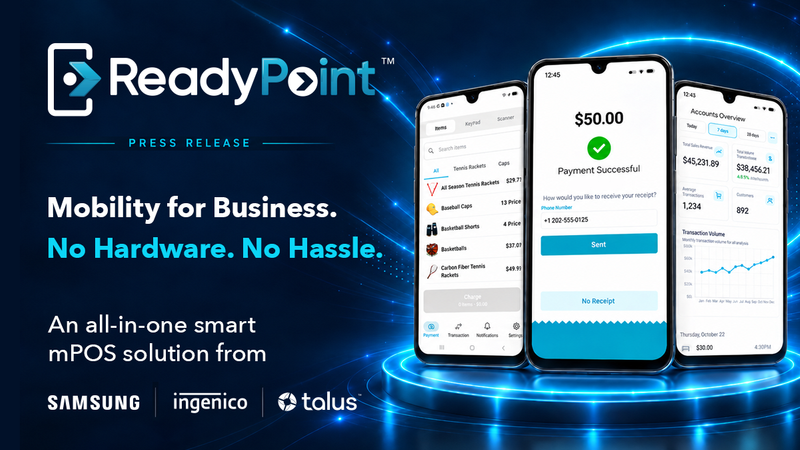
For a contractor or boutique, the appeal is practical: fewer handoffs between doing the job, recording it and getting paid. A merchant whose work already happens at a fixed counter may gain less from mobility. The useful test is whether the phone removes a real step from the working day.
The $49.99 question
ReadyPoint’s website advertises a starting package of $49.99 a month, including a Galaxy A37 device rental, unlimited mobile talk, text and data, and software. An active merchant account is required. Processing fees are additional, and device choice changes the price.
Talus says its broader processing prices depend on the customer’s risk profile. A merchant should therefore compare the complete proposal: processing charges, connectivity, device costs and the work saved. A monthly bundle price alone cannot settle that calculation.
The account behind the app
Talus’s competitive pitch extends beneath the screen. It emphasizes dedicated merchant accounts, rather than pooled merchant aggregation, alongside U.S.-based support available around the clock. In the ReadyPoint announcement, CEO Kim Fitzsimmons says, “Dedicated merchant accounts and first-class support set ReadyPoint apart.” That is the company’s positioning, not a promise that disputes or account holds disappear.
“Dedicated merchant accounts and first-class support set ReadyPoint apart.”
Kim Fitzsimmons · ReadyPoint launch, September 2026
For software companies, Talus Connect is the other important product: a proprietary gateway with APIs for embedding payments, recurring billing and other acceptance methods. Talus offers revenue sharing while handling payment operations. For B2B merchants, it also supports Level II and III transaction data, which can qualify eligible commercial-card transactions for lower interchange rates. Savings depend on the transactions and their qualification.
Square, Stripe and Clover are relevant alternatives when a merchant compares acceptance, embedded payments or point-of-sale options. Talus’s argument centers on combining those needs with underwriting and service. Its model earns from processing and related services, while partners can participate in transaction revenue.
Copy the handoff, then remove it
The lesson for another business is concrete: examine what happens immediately before and after your product gets used. Talus bought scheduling and inventory capabilities because payment happens inside a larger job. That approach becomes less persuasive when the added software duplicates tools a customer already likes, or when a device cannot support the required workflow.
For a prospective merchant, start with one ordinary sale and follow it through invoicing, acceptance and reporting. Ask Talus to demonstrate that journey with your actual requirements. The most useful checkout is the one that leaves less work behind.