Consider the last few inches of a sale. A customer holds out a card. A merchant reaches for a phone. Tap, confirmation, done. Kurv’s product imagery makes this exchange look almost weightless. Yet behind that tiny gesture sits a much longer sequence: an application, an approval, an account, a price, a settlement. Kurv’s interesting bet is that the whole sequence deserves the same attention as the tap.
- Formerly Electronic Merchant Systems, Kurv combines merchant processing with business software.
- Its phone app serves merchants; its newer agent portal serves the people bringing them aboard.
- The buying decision comes down to workflow, total fees and the agreement you sign.
That makes this Cleveland business worth examining beyond its fresh name. In a market where Square, Stripe and Clover offer familiar alternatives, a payment button alone gives a merchant little reason to change providers. Kurv’s pitch connects acceptance with the less glamorous jobs surrounding it. Someone still has to reconcile the sale. Someone still has to answer when the payment goes wrong.
01 A new name with a long receipt
Jim Weiland founded Electronic Merchant Systems in 1988. It began as a three-person sales office. By August 2024, EMS reported serving 25,000 merchants and processing approximately $6 billion in transaction volume. That figure describes money moving through its systems, not company revenue. The distinction matters: a payments company can handle an enormous sum while keeping only a small portion.
Afshin Yazdian arrived as CEO and executive chairman in 2023. BharCap Partners announced a majority investment the following August, with Weiland retaining a minority stake and board seat. The sequence offered a familiar business a different set of ambitions. Reporting in Venture Nashville described Yazdian’s aim as turning a slower-growing business into a scalable technology platform. Existing distribution would give the software somewhere to go.
Acquisitions supplied capabilities. Total Touch POS had brought restaurant software into the group in 2018. PaymentCloud followed in January 2024. EMS had already made a majority investment in Paysley in 2022; in August 2025, Kurv completed the acquisition, making it wholly owned while preserving its independent brand. The public rebrand announcement came in November. The name followed a substantial rearrangement of the business.
02 The checkout leaves the counter
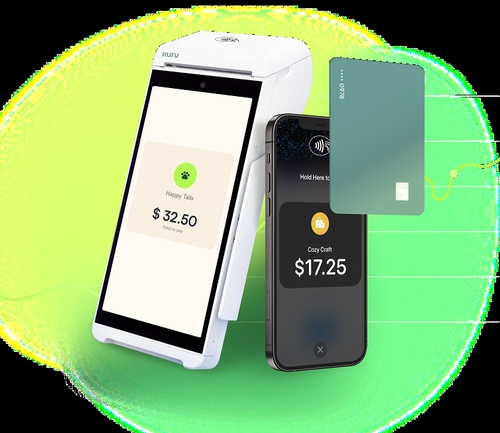
In December 2025, Kurv announced its Merchant App with Tap to Pay on Android, joining its iPhone offering. A supported phone could accept contactless payments without a separate reader. For a mobile seller, that removes a piece of equipment from the trip. It also changes where a sale can finish: beside the work, rather than back at a fixed counter.
The app announcement also described invoices, custom QR codes, payment links, inventory tracking and campaign tools. Those functions belong to different moments in a merchant’s day. A link can collect a remote payment; an invoice records an amount due; inventory connects the sale to what remains on the shelf. Putting them together offers a practical answer to a familiar nuisance: entering related information into separate systems.
Kurv serves U.S. businesses across retail, eCommerce, restaurants, field services and other industries. Software companies are another audience. Its embedded-payments offering supplies APIs, webhooks, onboarding support and white-label options, allowing a platform to put payments inside its own product. That creates a second route to the merchant, through software the business already uses. Kurv’s market position combines that technical route with direct sales and independent agents.
The portal’s published plans show how that software relationship can expand. Start supplies the basic dashboard and payment tools. Build adds functions including invoices and recurring billing. Scale introduces inventory and employee management; Perform reaches multi-location operations and accounting connections. A merchant can buy more capability as its work changes. The sensible starting point is the smallest set that covers the job, followed by a check of the extra transaction charges attached to the chosen plan.
03 The other checkout is an application
For an independent sales agent, a signed-up merchant is the beginning of a working relationship. Applications, signatures and underwriting can interrupt the handoff. Kurv’s July 2026 launch of Kurv Agent addressed that sequence with digital applications from any device, electronic signatures and automatic routing to underwriting. Portfolio monitoring and residual reporting then help agents see the accounts they have brought in.
“agents asked for a better, faster way to drive efficiency and scale.”Afshin Yazdian, on the Kurv Agent launch
- 01Apply
- 02Sign
- 03Underwrite
- 04Track
One connected workflow. Approval still depends on underwriting.
The company says agents helped shape the design. That is the useful lesson for another operator: map the delay between two people’s tasks, then build the handoff into the product. An application that automatically reaches the next decision-maker can matter as much as a polished dashboard. Kurv’s claim to differentiation rests partly here, in serving the distribution network alongside the merchant.
04 Follow the fee
Kurv earns through processing, software and hardware. Its advertised flat rates distinguish swiped transactions from keyed and online payments. Interchange-plus is another option. The software portal has separate feature tiers, so the practical comparison is a complete month of activity, including the tools a business needs.
Calculated from 2.50% + $0.10 and 2.90% + $0.25. Illustrations exclude other applicable charges. Rates are conditional and may change.
The advertised zero-cost option shifts a 3.95% charge to the cardholder. Whether customers accept that tradeoff is part of the buying decision. Kurv’s FAQ also specifies an automatically renewable 24-month agreement. A merchant should compare its written terms with the sales pitch and price its actual mix of transactions before switching.
05 The human part still has a job
Kurv pairs its tools with 24/7 U.S.-based support. Its people-centered messaging has a concrete local expression, too: employees and family members have helped collect toys with the Cleveland Browns. A September 2026 partnership announcement described that work alongside a renewed sponsorship. Behind the national payments platform remains a company with a recognizable hometown.
For a prospective merchant, the test is wonderfully ordinary. Try the workflow you actually use: collect an invoice, accept a tap, check the report, ask for help. A business needing different device support, contract flexibility or a different fee structure may prefer another provider. Kurv’s proposition becomes persuasive when its connected tools remove a real piece of work. The useful measure is how much easier tomorrow’s business becomes after today’s payment.