Imagine selling a merchant a payment service, then sending that merchant to a dashboard bearing somebody else’s name. The sale belongs to you. The login belongs to another company. When something goes wrong, the merchant has a surprisingly reasonable question: who, exactly, am I doing business with?
That small confusion sits near the center of Maverick Payments. The California payment provider lets other businesses put their names on its technology. Behind that borrowed identity are merchant applications, payment processing, reporting, disputes, and support. Maverick’s proposition is that a partner should be able to own the customer relationship without assembling every operational department behind it.
- Your brand: a customizable dashboard or payments inside your own software.
- The machinery: card and ACH processing, underwriting, reporting, and dispute tools.
- The audience: payment resellers, software vendors, and referral banks serving U.S. merchants.
The sales office that built the back office
Alan Griefer is Maverick’s founder and chief executive. His son Ben, now president and chief operating officer, describes joining at the beginning, when the business operated as a sales office. In a September 2026 interview, Ben recalled the awkward consequence of trying to serve every opportunity: accumulating processing relationships, portals, and operational chores.
The difficulty was coordination. Different merchants needed different arrangements. Adding another provider might solve the immediate placement problem while leaving the sales organization with another system to administer. Branding became inconsistent. Onboarding was cumbersome. The people trying to sell payments were spending time managing the machinery of payments.
Maverick changed its position in that chain. It became a full-service provider, bringing underwriting, risk management, onboarding, and support in-house. Its dashboard became a common entrance to infrastructure with several banks and processing connections behind it. The company had discovered a product in the work that had been getting in its own way.


A business designed to wear your name
Its customers come in layers. Independent sales organizations, or ISOs, sell merchant services. Independent software vendors, or ISVs, want payment acceptance inside the software their customers already use. Banks can refer business customers into a branded payments offering. The merchant at the end might run a shop, an online subscription business, or a company in a specialty market.
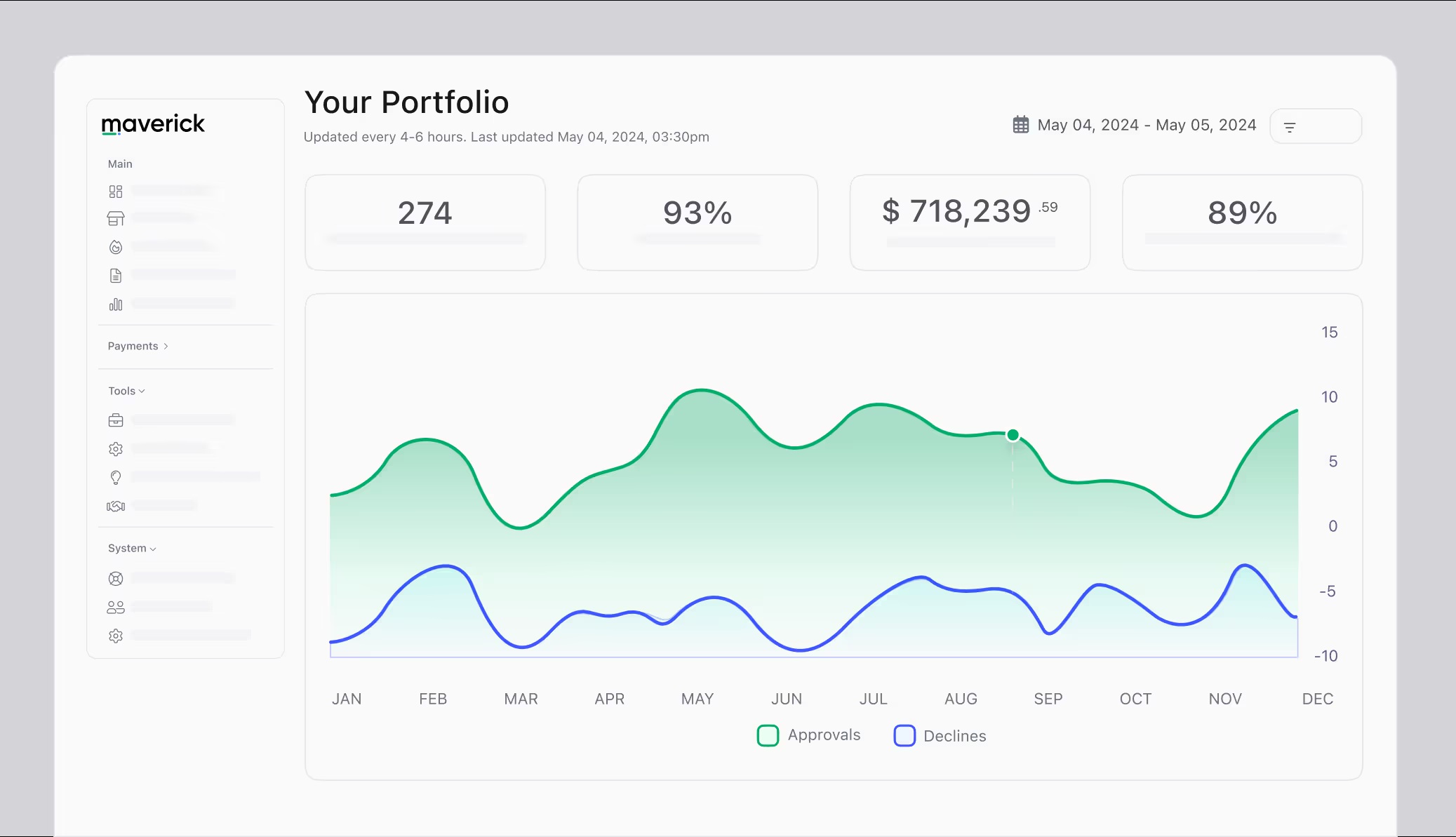
For a reseller, Maverick supplies a dashboard that can carry the reseller’s identity, with permissions for employees and downstream agents. Applications use digital signatures. Reporting covers transactions, chargebacks, and residuals, the continuing income partners receive from their merchant portfolios. Support tickets live in the same environment.
For a software company, the route can be more deeply integrated. Maverick’s API supports onboarding and payment operations inside an existing interface. Its 2023 Connect release added a way for merchants to authorize certified third-party integrations and manage access. The aim is to make adding a service less like handing over the keys to the entire building.
One entrance. Several routes for the money.
Maverick’s website lists five sponsor banks: Avidia, Axiom, FFB, Georgia Banking Company, and Westamerica. These relationships matter because payment acceptance involves more than displaying a form. A business must be evaluated, transactions processed, and financial exposure managed. A uniform screen can conceal several different arrangements.
Conceptual service map, not a settlement diagram.
The gateway supplies hosted payment forms, a virtual terminal, tokenization, recurring billing, and account updates for stored cards. ACH adds bank-account payments. In-person options include terminals and point-of-sale equipment. A merchant can use the platform to collect money; a partner can use it to run a portfolio of merchants.
Specialty underwriting is another part of the pitch. Maverick names travel, supplements, tobacco and vape, and other businesses that can be harder to place. That breadth is useful when a reseller’s next customer falls outside a routine retail profile. It is still an underwriting business: a supported industry does not make every applicant acceptable.
The price of a simpler front end
The commercial model combines merchant payment services with partner revenue sharing. Maverick promotes customized arrangements rather than a single public checkout price. It advertises free unlimited downstream sub-agent management and no additional charge for the digital-signature onboarding feature. Those specific inclusions should not be mistaken for free payment processing.
For a prospective partner, the practical homework is to compare the complete offer: processing costs, revenue share, funding terms, equipment, and responsibility when an account needs attention. A branded dashboard cannot rescue unfavorable economics. Nor does outsourcing the infrastructure remove the work of integrating software, explaining the service, and looking after customers.
That puts Maverick among embedded-payment providers and ISO platforms, with alternatives such as NMI and Finix. Its distinguishing proposition is the combination of partner branding, multiple banking relationships, and operational service. A business needing only a simple way to take an occasional payment has less reason to value that combination than a reseller coordinating hundreds of merchant accounts.
The next product is already someone’s headache
In August 2026, Maverick integrated Findustry AI’s Chargeback Agent. The announced workflow collects evidence, interprets dispute requirements, prepares rebuttals, and submits responses. The logic follows the earlier dashboard: move another recurring administrative task into the environment where the merchant already works.
“What you cannot vibe code is infrastructure.”
Ben Griefer · June 2026 interview
Griefer’s argument is that software becomes easier to create while banking connections and operational expertise remain necessary. Maverick’s stated culture emphasizes ownership, fast decisions, curiosity, and lasting relationships. Its approach to AI, he has said, is to equip staff rather than replace the human support merchants need when money is at issue.
There is a useful lesson here for businesses far outside payments. Notice the chores your customers repeat between products. Give those chores one owner. Make the handoffs legible. Maverick built its offer around that coordination problem. The logo in the corner belongs to somebody else; the work underneath is the reason the product exists.
Go a little deeper
WATCH THE CONVERSATIONS
▶Payments Infrastructure DefinedBen Griefer · Leaders in Payments · September 2026↗▶How ISOs Stay CompetitiveBen Griefer · Merchant Sales Podcast · May 2026↗