In Lucas County, Ohio, paying a tax bill once meant mailing money or visiting the treasury office. Employees kept carbon copies and entered payments by hand. A processor eventually brought more options, along with fees and customer service the county disliked. The problem had changed shape: accepting electronic payments was possible, but living with the system was still a nuisance.
- CSG Forte handles cards, bank payments and the work around them.
- Its sweet spot is recurring bills: rent, taxes, utilities and insurance.
- For buyers, fees, funding and support deserve the same attention as checkout.
CSG Forte’s account of the county’s switch offers a modest, revealing compliment. Cash management supervisor Gina Hughes called the transition “pretty seamless.” Over the first six years, annual transaction counts grew more than 280%, according to the company’s case study. That does not establish what caused the growth. It does suggest why a treasury office might judge payments technology by fewer posting problems and fewer complaints.
The bank transfer hiding in plain sight
Forte’s roots are in ACH, the network used to move money between bank accounts. Founder Jeff Thorness started the business as ACH Direct in 1998. In a 2016 interview, he described seeing considerable potential in the network and primitive usability around it. His opportunity was to make an existing financial mechanism easier for merchants and developers to use.
As the business added other payment methods, the old name became cramped. It became Forte in 2013. Even the former curly-brace logo carried a programmer’s joke: braces could suggest a set, a collection of payment strengths. The origin helps explain the present product. Rent and utility bills create repeated, often substantial transfers. The machinery behind those payments deserves attention.
Money processed through the platform. This is payment volume, not Forte’s revenue.
Today, Forte’s offering spans cards, digital wallets, online checkout, payment terminals, telephone payments and text-to-pay. Customers include government agencies, healthcare organizations, insurers, utilities and property managers. Software companies can put those capabilities inside their own applications. The common thread is a bill that needs collecting and an organization that needs to account for it.
The screen after the sale
A successful authorization answers one question. An operations team has several more. Which customer paid? What happened to the returned bank debit? Which transaction belongs in today’s reconciliation? Dex, Forte’s cloud-based management platform, brings transactions, customers, payment schedules and disputes into a working interface. Its audience includes the person who has to explain the numbers tomorrow morning.
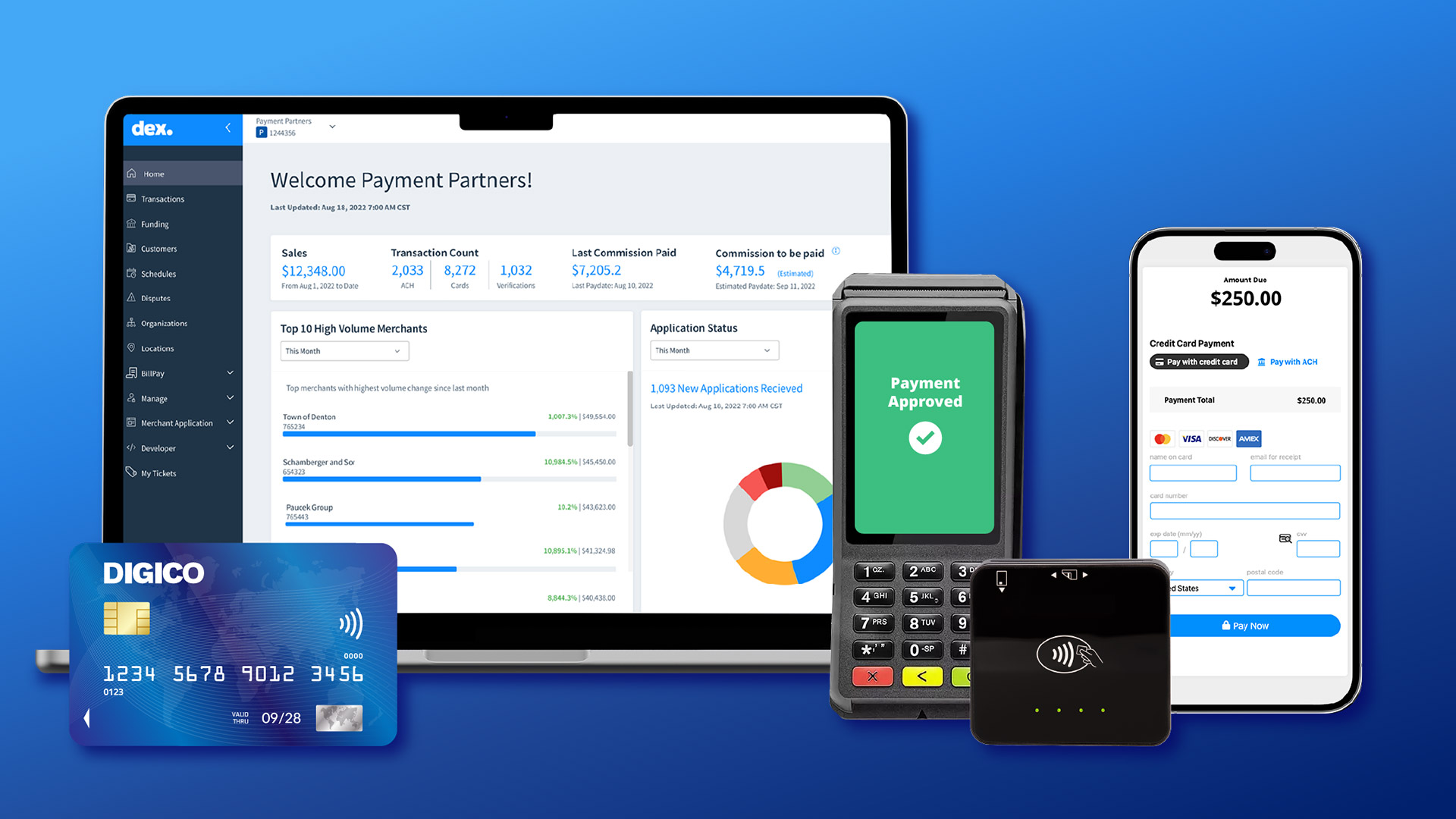
Other products work before or after the transfer. Validate checks bank-account details; Authenticate addresses account ownership. Those are related questions with different jobs. Direct Fund Recovery handles eligible failed ACH and eCheck payments through automated re-presentment. A returned payment becomes a managed exception, rather than another loose task for someone’s inbox.
- 01 Check account
- 02 Accept payment
- 03 Track transaction
- 04 Resolve exceptions
The price of a payment
Consider a $1,500 collection. Forte’s published U.S. Zoho partner schedule lists ACH debits at 0.60% plus $0.25, and Visa, Mastercard and Discover payments at 2.90% plus $0.31. Applied to that amount, the transaction charges come to $9.25 and $43.81 respectively. This is one channel’s schedule, with monthly, validation and other charges outside the comparison.
*Visa, Mastercard or Discover. Published Zoho U.S. transaction rates only; excludes monthly and additional fees.
This is why a processing quote needs a real example from the customer’s business. A property manager and a shop selling small items can see different economics, even with identical headline rates. Payment size, method and frequency change the calculation. The sensible comparison includes the staff time spent fixing errors, as well as the money charged to move funds.
The arithmetic clarifies Buildium’s choice. Its property-management customers needed high-value rent payments without high percentage fees. Forte’s case study describes a customized ACH solution and implementation support. It also reports nearly 35% growth in transaction count and 39% growth in dollars processed between 2016 and 2017. Those measures describe payment activity; they should not be mistaken for Buildium’s revenue growth.
“Having the same person on our account from nearly the beginning of the relationship has made a huge impact.”
Dimitris Georgakopoulos / Buildium cofounder
Cheap collection and fast access to cash are separate considerations. Forte’s funding documentation describes transaction review holds and faster-funding options subject to eligibility and pricing. Earlier access does not guarantee that a customer’s payment will clear. A buyer comparing processors needs a cash-flow conversation as well as a rate quote.
Integration also has boundaries. Forte’s onboarding guidance requires business and financial information, followed by validation and underwriting. Approval is not automatic. Its Canadian guidance distinguishes local banking requirements and says U.S. and Canadian ACH transactions cannot use the same merchant and location identifiers. A working domestic integration should not be treated as a passport to every market.
Software takes a cut
For a software vendor, payments can become part of the business model. Forte offers referral and reseller relationships alongside payment facilitation as a service. Partners can use buy-rate markups, revenue sharing or a hybrid. They can also choose different levels of operational involvement. The commercial question becomes how much payment work they want to own.
Developers get REST APIs, Forte.js and checkout tools; merchants get the payment experience inside the software they already use. Stripe, Adyen and Nuvei are among the alternatives buyers consider. Forte’s clearest pitch, in my reading of its products and customer cases, is familiarity with recurring collections and their exceptions. A prospective customer should test that claim against actual workflows.
For an evaluation, ask for a demonstration using a failed payment, a refund and a month-end reconciliation. A polished checkout shows the beginning of the relationship. These less photogenic exercises reveal how the daily work will feel.
Bigger owners, smaller details
CSG bought Forte in October 2018 for approximately $85 million excluding acquired cash, with potential earn-outs. In 2024, CSG added iCG Pay for $17 million upfront. NEC completed its acquisition of CSG in May 2026, putting the parent’s operations and integration under Netcracker. The ownership chain has grown considerably since ACH Direct.
The useful product news is more granular. CSG launched PaymentsProtection.ai in February 2026. A June integration summary documented PayPal support in checkout and REST. October’s BillPay update allowed multiple payment schedules against one bill when enabled by the merchant. Each change concerns an ordinary obstacle: fraud, payment preference or the timing of a bill.
The lesson readers can borrow is practical. Price a representative transaction. Follow it through settlement. Ask who handles its return. Confirm the geography, underwriting requirements and funding terms before committing. A payment system earns its place when both the payer and the person closing the books can get on with their day.