Open Dental’s instructions contain a tiny clue to a much larger business. To take a payment, staff open the payment window and click “Global Payments Integrated.” There is no grand technological ceremony. The payment option sits inside the application already used to run the practice. That ordinary placement is the point. The useful innovation happens where the patient’s bill meets the record of the patient’s payment.
- It sells payment capabilities through business software partners.
- The target is the handoff: acceptance, posting, reporting and reconciliation.
- The legacy brand now lives within Global Payments for Platforms.
Imagine the alternative: an amount on one screen, a terminal on the counter, then a person telling the software what happened. Each handoff creates another opportunity to mistype, forget or investigate. Global Payments Integrated’s proposition is to connect those steps. The customer buys a payment service. The person at the desk gets a less fragmented job.
The customer behind the customer
The company operates one level behind the familiar merchant relationship. Its partners build software for businesses; those businesses accept money from their own customers. Put payment acceptance inside the software and the vendor gains another capability to sell. The merchant can keep more of the transaction inside an existing workflow. This is the distribution logic of embedded payments.
Its history helps explain that approach. OpenEdge brought together capabilities from PayPros and Accelerated Payment Technologies under a common name in 2014. After Global Payments combined with TSYS in 2019, their integrated-payments operations came together. By January 2020, the combined business was publicly described as Global Payments Integrated.
Company-reported footprint, January 2020. A historical snapshot of the combined business.
Those numbers describe a distribution network, rather than a collection of shoppers downloading a wallet. A software integration can carry the processor into a particular profession. The company’s expertise therefore has to include the payment and the circumstances around it: which screen someone uses, which terminal works, and where the result belongs.
The small failure that makes the case
Consider an expired card. The customer still wants the service. The business still expects the next payment. But the credentials saved months earlier can interrupt that perfectly ordinary arrangement. Decline Minimizer, an OpenEdge service, automatically updates saved card details for recurring transactions, including changed expiration dates. It addresses a specific administrative problem rather than promising to cure every decline.
EdgeExpress is the integration layer associated with this product family. Its documented capabilities include in-person and remote payments, recurring payment support and customized device prompts. EdgeShield adds a security bundle, including encryption, tokenization and compliance assistance. A software vendor can assemble payment behavior without writing every underlying component itself.
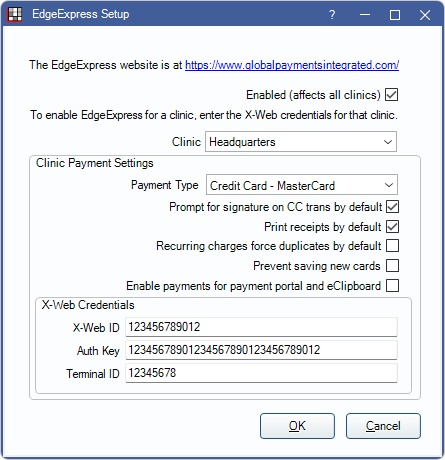
The screenshot rewards a close look. A signature prompt is a setting. So is receipt printing. These are small decisions, but they determine what happens at a busy counter. A feature list might say “integrated payments.” The implementation has to decide what the receptionist sees next.
A dealership puts the idea to work
The automotive example is particularly clear. In June 2021, CDK Global introduced CDK OnePay, powered by Global Payments. It connected payment requests and invoicing with the CDK Drive dealership management system through Fortellis. Customers could receive a request by text or email, or pay in person, using options including cards and digital wallets.
CDK described the intended benefits as shorter waits, fewer cashiering errors from reentering data and simpler end-of-day reconciliation. Notice the destination of that argument: the accounting work after checkout. A successful authorization is useful; a payment correctly connected to an invoice is useful to the whole business.
- 01InvoiceBusiness software sets the amount
- 02PaymentConnected service processes it
- 03RecordThe result returns to the workflow
The launch also supplied a useful cost detail. CDK offered OnePay without upfront or recurring subscription fees from CDK. That is a statement about CDK’s software charges, not a promise of free card processing. The distinction matters whenever an embedded payment offer arrives with an attractive first number.
Buy the plumbing, keep the workflow
A published company case study describes a chiropractic software vendor choosing between becoming a payment facilitator and working with a partner. Customers were already encountering errors and wasted time without integrated payments. The vendor chose Global Payments Integrated because building payment operations would bring complexity, investment and risk. Keeping customers inside its own interface was a central requirement.
That decision captures the business model. Merchants pay for processing and associated services; software partners can participate in revenue sharing. The vendor can deepen its product while relying on a payments specialist. The processor gains distribution through a product the merchant already uses.
“understands our industry and our customers”
Dewitt Blankenship, Dolphin software development manager, on Global Payments Integrated
Stripe Connect competes for the same broad platform opportunity, with onboarding, embedded components and monetization tools. Global Payments’ published partner offer emphasizes integration specialists, workflow certification and implementation assistance. Those services make sense when the hard part is fitting payments into an established business application. The company’s phone support also received J.D. Power recognition announced in January 2020.
The demo should include the awkward bits
There are practical boundaries. Open Dental documents different deployment requirements for EdgeExpress and XCharge, including restrictions on using both for ordinary patient payments. Compatibility is something to verify in the actual software environment. An API’s existence alone does not establish that the required workflow works.
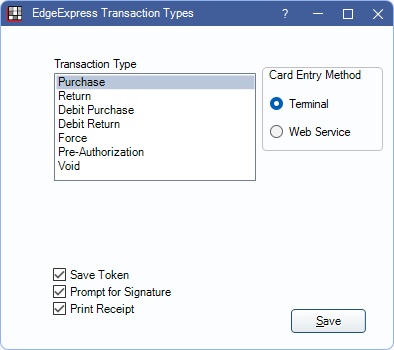
The copyable lesson is simple: evaluate the complete job. Run a payment, a refund, a failed recurring charge and the reconciliation that follows. Compare the full commercial agreement, including equipment and service charges. A partner-led arrangement fits poorly if its supported devices, operating responsibilities or economics do not fit the business.
Today, the old website directs visitors to Global Payments for Platforms. Its transition notice says existing integrations, contracts and support continue. The name on the door has changed. The useful test remains wonderfully mundane: when somebody gets paid, how much work is left?