Consider the small embarrassment at the end of a sale. A customer has sent a bank transfer. The shop assistant cannot see the bank account. The manager must be called. Everyone waits. In its account of launching Virtual Terminal, Paystack described this familiar Nigerian retail problem: money had moved, but permission to leave with the purchase had not. There was a business opportunity inside that pause.
- Paystack helps African businesses collect payments online and across the counter.
- Its advantage rests on local payment methods, developer tools and the work after checkout.
- Its next chapter includes consumer transfers, rebuilt merchant software and a proposed new parent company.
Paystack sells the machinery that lets a business get paid. A software team can embed its checkout. A small seller can share a hosted Payment Page. A retailer can use in-person tools. Transaction records and payouts turn those individual payments into something a business can manage. The customers on its website include MTN, Bolt and Domino’s Pizza. The same underlying problem reaches surprisingly different businesses.
The button was the easy part
Shola Akinlade and Ezra Olubi founded Paystack in Lagos in 2015. They were software developers and longtime friends. The company became the first Nigerian startup accepted into Y Combinator, according to its history, then launched publicly in January 2016. The appealing idea was to make accepting an online payment less of a project.
But a neat form cannot repair a broken payment route. Paystack describes direct integrations with banks, intelligent routing among processors and suggestions for alternative payment methods when an attempt fails. Its expertise sits beneath the interface: connecting institutions, choosing routes and helping a willing buyer complete a transaction.
That is also why “African payments” can be a misleadingly tidy phrase. In Paystack’s 2023 checkout data, mobile money accounted for 98% of transactions in Ghana. Cards accounted for 93% in South Africa. These are figures from Paystack’s own business, not national market shares. Even so, they make a useful point: copying the same card form everywhere would miss how customers already behave.
The payment method people picked
A receipt in your pocket
The queue at the counter required a different intervention. Virtual Terminal, introduced in October 2023, let businesses assign virtual bank accounts to staff and send successful-payment notifications through WhatsApp. The assistant could confirm a sale without seeing the company’s entire financial life. One carefully limited piece of information removed a chain of interruptions.
Paystack had already introduced physical terminals in November 2022. The virtual version removed the need to deploy another device. Its current documentation describes QR payment pages and local payment details: dedicated accounts in Nigeria, M-Pesa Paybills in Kenya and USSD codes in Ghana. The familiar phone became part of the merchant’s payment system.
Here is a lesson worth borrowing: look for the person who must ask someone else whether the task is finished. Sometimes the next useful feature is a confirmation sent to the right employee. A faster transfer alone does not finish the job if the person serving the customer cannot verify it.
The arithmetic of a sale
Paystack earns transaction fees. On its published Nigerian local online schedule, a payment costs 1.5% plus ₦100. The fixed charge disappears below ₦2,500, and total fees are capped at ₦2,000. A ₦10,000 transaction therefore costs ₦250 under that schedule. International online payments have a separate rate of 3.9% plus ₦100. Country and channel matter.
Illustration using the published schedule checked October 25, 2026.
Flutterwave offers another route into African payment acceptance; bank acquiring and Interswitch also enter the buying decision in Nigeria. Paystack’s case rests on its combination of payment channels, integrations and operating tools. A merchant should compare the particular method customers need, settlement arrangements and support. A feature list cannot establish whose service will work better for a specific business.
There are practical limits. Payment methods vary by market. Merchant eligibility and verification apply. Recurring billing supports cards and Nigerian Direct Debit, and the documentation says failed subscription charges are not retried automatically. A business that delivers service before collecting payment needs to think about that gap. “Recurring” does not mean someone else has solved every collection problem.
When the merchants outgrew the app
In September 2026, Paystack acknowledged a smaller version of its original challenge. Its merchant app let people monitor their businesses, but had not kept pace with the jobs they were doing on phones. Thousands still used it. Continued use had concealed an expanding mismatch.
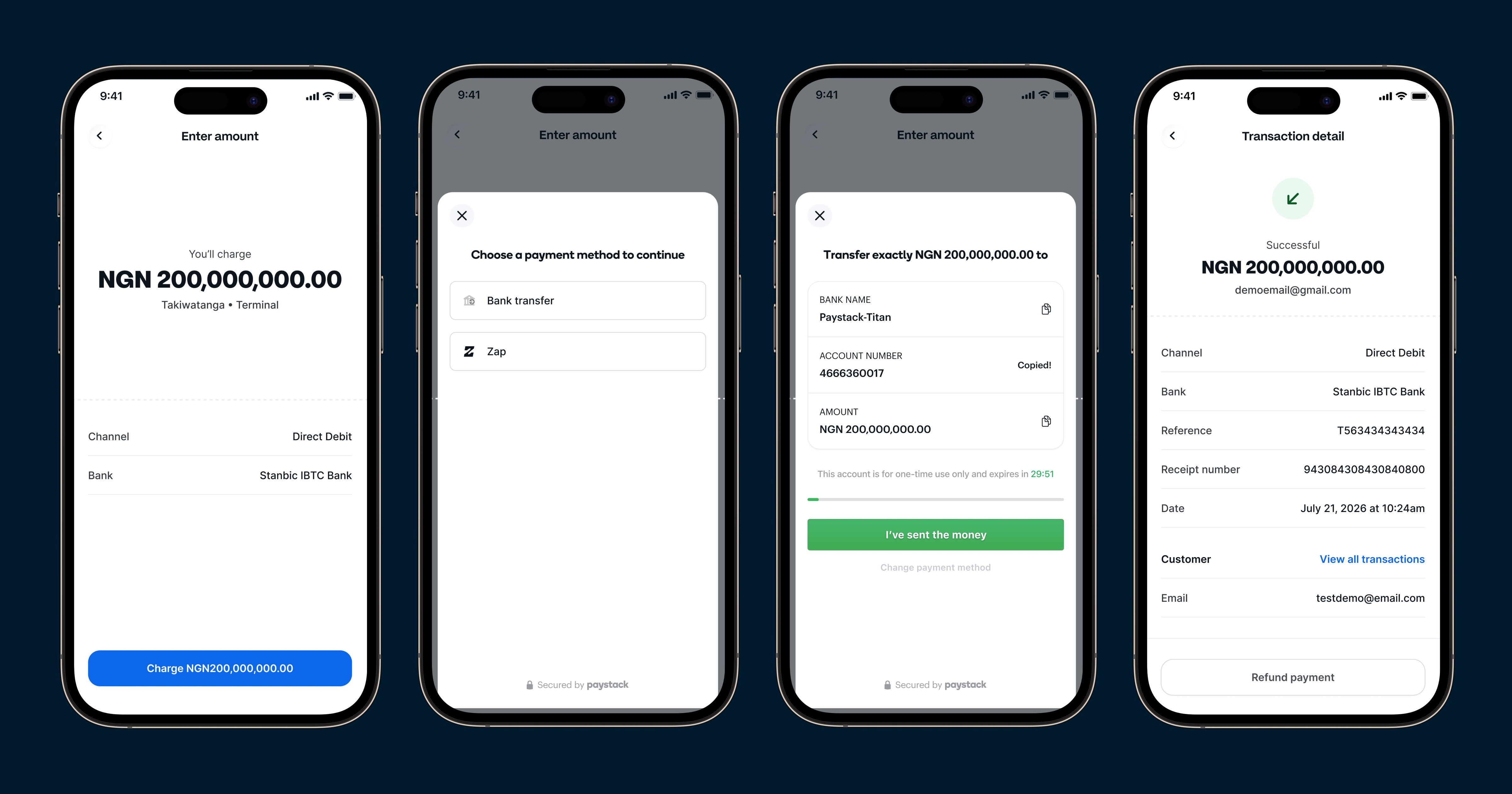
The rebuilt app added in-person collection, passkeys and broader currency views. At launch, in-person payments covered Ghana, Kenya and Nigeria, with South Africa planned. A merchant could enter an amount, request payment and see confirmation. The product lesson is uncomfortable and useful: customers continuing to use your software does not prove it still fits their work.
After the acquisition, another beginning
Expansion needed capital. Paystack announced a $1.3 million seed round in 2016 and an $8 million Series A led by Stripe in 2018. Stripe acquired it in 2020; the price was reported at more than $200 million. Akinlade’s explanation emphasized how working together could speed up the mission.
“Building a business is hard. Getting paid shouldn’t be.”
Paystack’s own proposition
The company describes a culture of curiosity and transparency. Its employees are called Stacks. By January 2026, it reported more than 300,000 businesses and group profitability, and announced The Stack Group as a new parent, with an ownership structure pending regulatory approvals. The proposed family separates merchant payments, consumer app Zap, banking and experimental products.
That broader ambition will be judged in smaller encounters: a payment accepted, a refund found, a customer free to leave the counter. Paystack’s useful insight remains available to any founder watching closely. Follow a transaction past the part your software already handles. Find the next person waiting.