Imagine a customer in Lagos buying from a business that wants to sell across Africa. The customer sees a price and a payment button. The business sees something less charming: banks, currencies, mobile wallets, settlement schedules, and a new collection of arrangements whenever it enters another country. Commerce travels with luggage. Someone must carry it.
- Connect local payment networks through a common integration.
- Give merchants checkout, payment links, stores, and payouts.
- Close Barter and concentrate on enterprise and remittances.
- Move deeper into account data, banking, and settlement.
Flutterwave’s founding proposition in 2016 was to carry that luggage. Olugbenga Agboola, Iyinoluwa Aboyeji, and Adeleke Adekoya helped build a company around the connections between systems. Its headquarters are in San Francisco; its central commercial problem is African. A continent of distinct payment markets cannot be served merely by translating the words on a checkout screen.
The company connected banks, card schemes, mobile money, and alternative payment methods behind an API. Developers could integrate with Flutterwave instead of constructing every connection themselves. This is the less photogenic side of financial technology: a great deal of work goes into making the customer notice very little.
Sell the integration, collect the fee
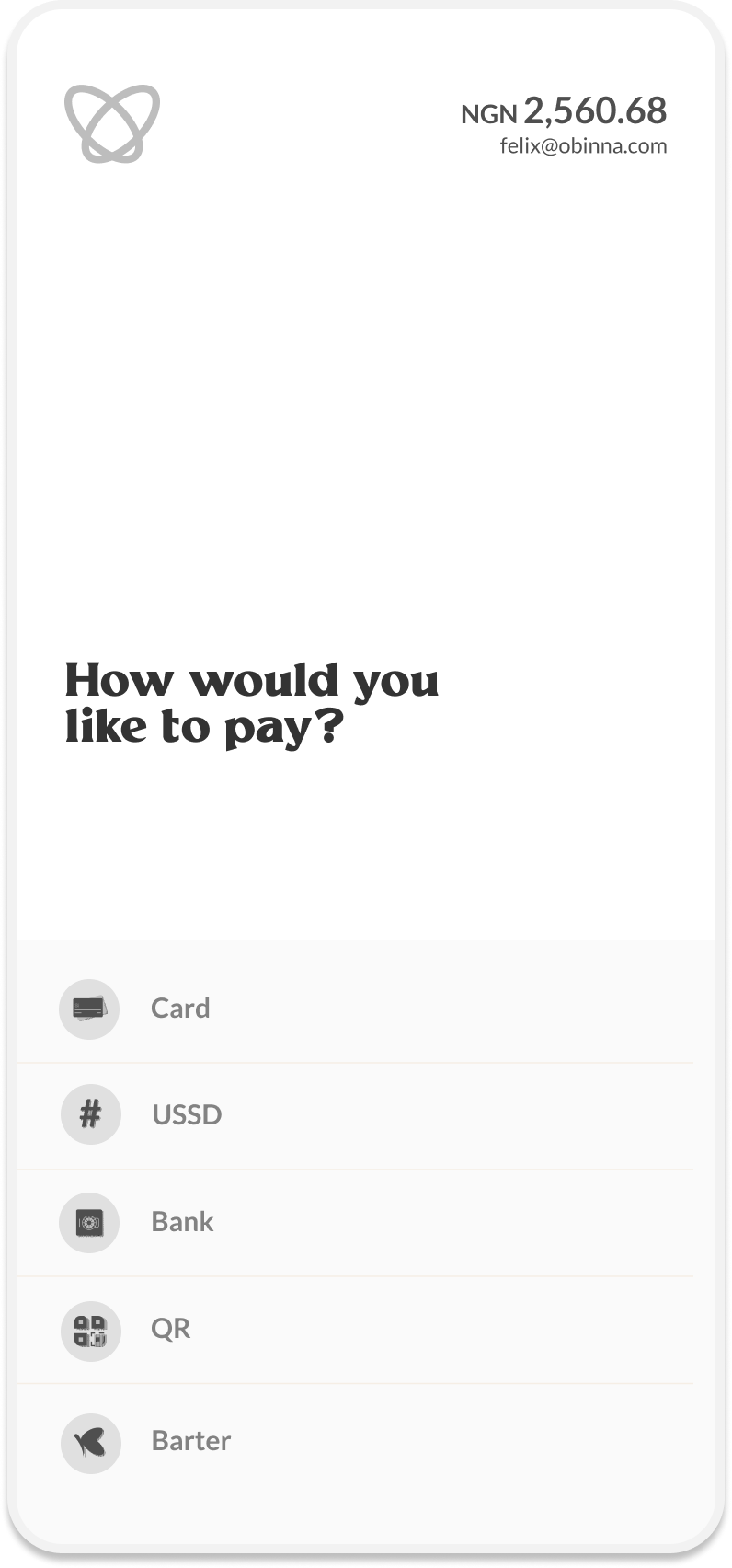
For a merchant, Flutterwave can be a hosted checkout. For a seller operating through social media, it can be a payment link. Invoices, a no-code Store, and point-of-sale devices extend the same business into different settings. An enterprise can make bulk payouts from the dashboard or use APIs to embed payments within its own software.
The distinction is useful. Flutterwave sells to the company that needs to accept money and the platform that needs to move it onward. Its public customer list includes Uber, Microsoft, MTN, PiggyVest, and Air Peace. Small merchants share infrastructure with organisations whose payment operations would overwhelm a spreadsheet.
Conceptual flow. Actual partners and timing vary by market.
Its competitive argument rests on those local connections. Paystack, DPO Pay, banks, and other processors offer alternatives; an international merchant may also consider Stripe or Adyen where supported. The sensible comparison concerns the countries, methods, and settlement arrangements a business actually needs. A long list of markets is useful only if the relevant route works.
The business model is transaction-based. Flutterwave’s published Nigerian collection pricing is 2% for local payments and 4.8% for international payments. The local rate combines a 1.4% transaction fee with a 0.6% platform fee. Transaction fees attract 7.5% VAT. Other countries and products have their own schedules, and large customers can discuss custom pricing.
Before applicable VAT. Fees checked October 2026; this is not a global tariff.
A published customer example makes the abstraction easier to grasp. In its 2025 review, Flutterwave said Selar had expanded from naira-only payments to more than twelve countries and processed over 1.4 million transactions on its infrastructure. Those are supplier-reported figures, but the problem is recognisable: a digital seller can find an audience abroad before it has a practical way to collect from that audience.
The app that had to go
The expensive part of this story was building the network. Flutterwave raised $170 million in its 2021 Series C and $250 million in its 2022 Series D. The latter valued the company above $3 billion. These figures describe capital raised and investor valuation. They do not describe what merchants earned, or what Flutterwave kept.
Expansion also produced a consumer experiment called Barter, associated with virtual cards and everyday payments. Flutterwave announced its closure in March 2024. The company’s explanation was a renewed focus on enterprise and remittances, alongside a lesson about simpler products. Ambition had accumulated features; the business needed to choose.
The retreat had a human price. In June 2024, Flutterwave confirmed layoffs affecting about 30 people, roughly 3% of its workforce at the time. Enterprise and remittances were described as its biggest revenue drivers. The decision makes the strategy tangible: concentrating resources sometimes means retiring a product and removing roles attached to the old direction.
There were regulatory costs, too. Kenyan proceedings froze company-linked funds beginning in 2022. TechCabal reported the release of a remaining $3 million in February 2024 after the relevant case was withdrawn. That episode makes licensing and compliance visible as operating requirements. An elegant integration still needs permission to operate.
Buy the machinery behind the button
By 2026, Flutterwave was reaching further into the process. January brought the acquisition of Mono, whose open-banking technology supplies financial data access, identity verification, and account-to-account payments. Mono would continue operating independently. The deal addressed questions that arise before money moves: which account is involved, and can the connection be authenticated?
“Financial infrastructure now has to stay up.”Olugbenga Agboola · January 2026
In March, Agboola announced a Nigerian microfinance banking licence. He described the limits of building on other institutions’ infrastructure, particularly around settlement and control of the customer experience. The announced direction included accounts, virtual accounts, merchant finance, and financial tools. Availability remains a product-and-market question, rather than a universal promise.
June brought Ripple’s participation in Series E at a stated $3.2 billion valuation. The announced integration involved RLUSD, Ripple Payments, and the XRP Ledger for settlement and remittance infrastructure. Flutterwave also reported more than a billion lifetime transactions and over $50 billion in processed value. Those are company-reported throughput figures, not audited revenue.
There is also a workforce maintaining these connections. Flutterwave calls its employees Wavers. In May 2026, Agboola reported more than 100 promotions, a one-time economic relief payment for staff globally, and additional tax and cost-of-living support in Nigeria. The company described promotion decisions in terms of contribution, peer feedback, and greater ownership. These are management’s statements about its culture, but they give a concrete view of how it says it rewards the people doing the maintenance.
Copy the focus, check the corridor
The useful founder lesson is to make the product’s job legible. Flutterwave’s 2024 explanation of Send App emphasised sending money home rather than piling on wallets and virtual cards. Reusing infrastructure for related products can save development work. The customer gets a clearer task; the company gets fewer competing promises to maintain.
A merchant can copy something equally practical: start with the simplest collection tool that fits, then add integration when operations demand it. Check onboarding eligibility, supported destinations, total fees, currency conversion, and settlement timing before committing. If a required country or method is unavailable, or margins cannot absorb the charges, the proposition weakens. Flutterwave’s story rewards attention to the boring details. They are where the money arrives.