Company Profile / Fintech / Payments
The Australian Who Built a British Card-Killer - Then Sold It Back to Australia
Banked spent eight years trying to build a payments network cheaper than cards. In May 2026 National Australia Bank bought the whole thing - and pointed it at home.
Every few years a startup stands up and says it will replace Visa and Mastercard. Almost all of them fizzle. Banked got further than most: it signed Bank of America, put its technology inside Amazon Australia's checkout, and raised more than $50 million from some of the biggest names in banking. Then, on 14 May 2026, it did the thing that quietly ends most fintech stories - it got acquired. The buyer was National Australia Bank, a company that had already been an investor, and then a customer, before it decided to just own the whole thing.
The founder is Brad Goodall, an Australian who built the company not in Sydney but in London, on Wardour Street in Soho. That detail turns out to matter. Banked's arc runs from a British seed round to a US expansion to an Australian acquisition - an Aussie founder, a British company, American backers, and an Australian bank closing the loop. Payments is a global business. Ownership, in the end, went home.
01 / What it doesSkipping the middlemen
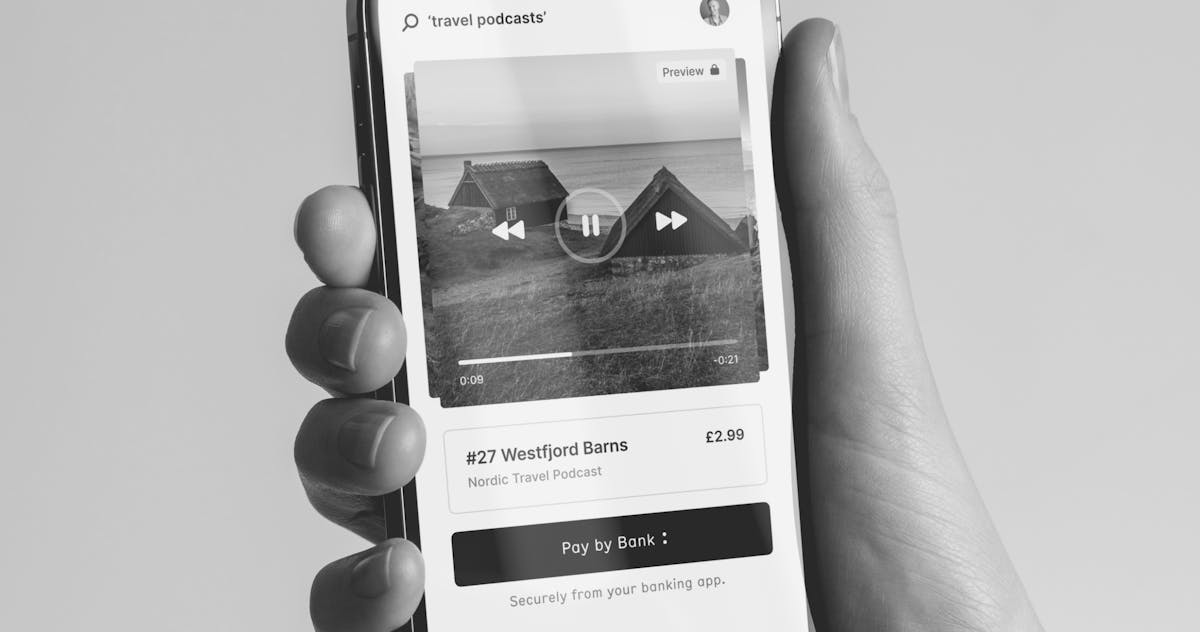
Banked builds what the industry calls account-to-account payments, or A2A, and sells it under a friendlier name: Pay by Bank. The idea is simple to describe and hard to build. When you buy something online, a card payment travels through a chain of intermediaries - the card network, the issuing bank, the acquiring bank - each taking a slice. Banked's checkout skips that chain. You choose Pay by Bank, your banking app opens, you approve with a fingerprint or face scan, and the money moves directly from your account to the merchant's. No card number typed, no 16 digits to steal.
For merchants, the pitch is money. Card processing typically costs somewhere between 1% and 4% of a transaction. Banked argued it could move the same money for a fraction of that, with settlement in near real time instead of days, and with far fewer chargebacks because there is no card to dispute.
02 / The peopleFrom core banking to a card fight
Goodall did not arrive at payments cold. Before Banked he co-founded 10x Future Technologies, a core-banking company started with former Barclays chief executive Antony Jenkins. That job meant years spent inside the plumbing of how banks actually move money - useful preparation for a company whose entire premise is that the plumbing is expensive and slow. He founded Banked in 2018 with a small group of co-founders including Neil Ambler, who became COO.
"Pay-by-bank is not about killing cards or anything like that. It's really about offering more choice."
Brad Goodall, Founder & CEOThat quote is worth pausing on, because it marks a shift in how Banked talked about itself. Early on, the framing was combative: build a branded network to rival Visa and Mastercard. Over time the pitch softened into something merchants and banks found easier to say yes to - not a replacement for cards, but a cheaper option sitting next to them at checkout. The mission stayed the same. The marketing grew up.
03 / The money$50 million and a very patient investor
Banked raised across four rounds. A £1.5M seed led by Backed VC in 2018, a £2.35M extension in 2020, and then the round that changed its trajectory: a $20M Series A in February 2022 co-led by Bank of America and Edenred. Having one of the largest banks in the world as both an investor and a distribution partner is not a normal outcome for a company trying to route around banks. Later that year came a $15M+ extension led by Insight Partners, with Citi, Rapyd, and - crucially - NAB Ventures joining in.
That NAB Ventures cheque is the thread to pull. National Australia Bank invested in 2022, followed on in later rounds, and by 2024 was deploying Banked's technology commercially for its own business customers. The company you eventually buy is a lot less risky when you have watched it work inside your own operations for two years. Banked's exit is a clean case study in how incumbents de-risk innovation: watch it, back it small, deploy it, then own it.
04 / The customersWhere the money actually flowed
Banked's most visible win was Australian. Working with NAB, it put PayTo-enabled Pay by Bank live on Amazon Australia in early 2025 - real-time bank payments at the checkout of one of the country's biggest storefronts, reaching roughly 95% of Australian retail bank accounts. It reached that market partly by buying its way in: in October 2024 Banked acquired the Australian fintech Waave, inheriting a partnership with pharmacy giant Chemist Warehouse.
In the US, Banked partnered with financial-technology firm FIS in 2024 to widen access to pay-by-bank, and Goodall relocated from London to Palo Alto to lead the push. His argument for America was specific: the country still runs on cheques, and interchange fees are higher than almost anywhere else - two problems account-to-account payments are well suited to solve.
Underneath all of it is a straightforward business model. Banked charged merchants and partner banks a processing fee on each account-to-account transaction - a fraction of card interchange - and made the pitch stack up through lower fraud, fewer chargebacks, instant settlement and cleaner reconciliation. For a partner bank, there was a second draw: as interchange income slowly erodes across the industry, a Pay by Bank rail is a way to earn on payments the bank would otherwise just process. That alignment is why a company built to route around banks kept ending up in bed with them.
"Moving money and data together is an untapped source of innovation and will change how we buy things."
Brad Goodall05 / The fieldA crowded, quietly consolidating market
Banked was never alone. The open-banking payments space is busy - Trustly, GoCardless, Volt, TrueLayer, Yapily, Token.io, Tink (now owned by Visa), and Plaid all chase versions of the same idea. There is even some irony baked in: parts of Banked's own stack reportedly ran on Plaid, one of its competitors. Banked's differentiator was posture. Rather than fight banks, it partnered with them - Bank of America, Citi, NAB - and built its network on the assumption that the incumbents would rather ride the shift than resist it. The endgame validated the strategy. A bank bought it.
06 / The messy partA deal that fell through, then a deal that didn't
Startup stories are rarely clean, and Banked's final chapter proves it. In early 2026, before NAB stepped in, Banked had a proposed acquisition of UK fintech VibePay that reportedly collapsed during due diligence. Months later Banked was itself the acquisition target. Reporting around the NAB deal also suggests the platform will retreat from the UK and US to focus entirely on Australia - a global network, folded into a single country's bank. Sometimes the exit rewrites the mission.
07 / What you can take from itThe lesson under the logo
There is a usable playbook here for anyone building in a market dominated by incumbents. Banked did not try to burn the house down; it sold the incumbents a cheaper way to do what they already do, then let the biggest believer buy the company. If you are a founder, the move to copy is the alliance-first go-to-market: make your fiercest potential competitor your distribution channel and your investor. If you are an operator at a big company, the move to copy is NAB's - a minority stake as a call option on a technology you can test in production before you commit.
The honest caveat is that this outcome is not an IPO, and account-to-account payments did not dethrone cards. Banked's own softened messaging admits as much. But eight years in, it had a working network, marquee partners, and a buyer willing to bet its business customers on the technology. For a company that set out to compete with Visa, being absorbed by a bank that wants to run your rails is not a failure. It is the version of winning that this market actually hands out.