user-research
(39)
Listen Labs and the Question After the Answer
A customer can say “fine” and mean almost anything. Listen Labs built a research business around the next question - and made it possible to ask that question thousands of times.

Michael Winnick Put Research in Everyone's Pocket. Now He Wants It to Keep Up.
The Dscout founder spent years turning private moments into useful evidence. His new problem is faster and stranger: how to preserve human judgment when machines make answers cheap.

Mary Ann Brody and the Quiet Art of Making Systems Listen
Before Mary Ann Brody led experience at Devoted Health, she watched people collide with government forms. Her career has been a patient argument for listening first - then rebuilding the system around what people actually do.

Adam Christiansen Designs for the Moment Before the Click
His portfolio is a study in useful friction: find the awkward moment, test it with real people, and make the next move feel obvious.

Product Design: the first version is a question
LaSoft’s product design practice turns business processes into web and mobile software. Its work for OutSail shows why a working first version can be the beginning of the argument.
Next Step knows when fewer leads are better
A behavioral design agency finds growth in the details companies overlook: the wrong prospect, the intimidating message, the feature nobody asked for.

Alon Blum designs the route from looking to doing
Flowers, fitness dashboards and a summer playlist reveal the range of Independent Consultant, Alon Blum’s design practice. The connecting thread is the path a person takes through a digital product.

Pepperplane Makes Software Teams Answer the Expensive Question First
This small, remote design studio has shipped more than 350 projects by insisting that the costly part of software is not the screen. It is the untested assumption underneath it.
Solirius Reply and the hard work behind a simple public service
A court notification can hide a surprisingly large job. Inside the consultancy that helps government teams untangle the work, test the service and make it usable.

Dscout Spent 15 Years Bottling Human Context. Now It Has to Keep AI From Watering It Down.
Dscout escaped the focus-group room by putting a research diary in people’s pockets. Its next trick is harder: using AI to make research faster without turning lived experience into beige summaries.
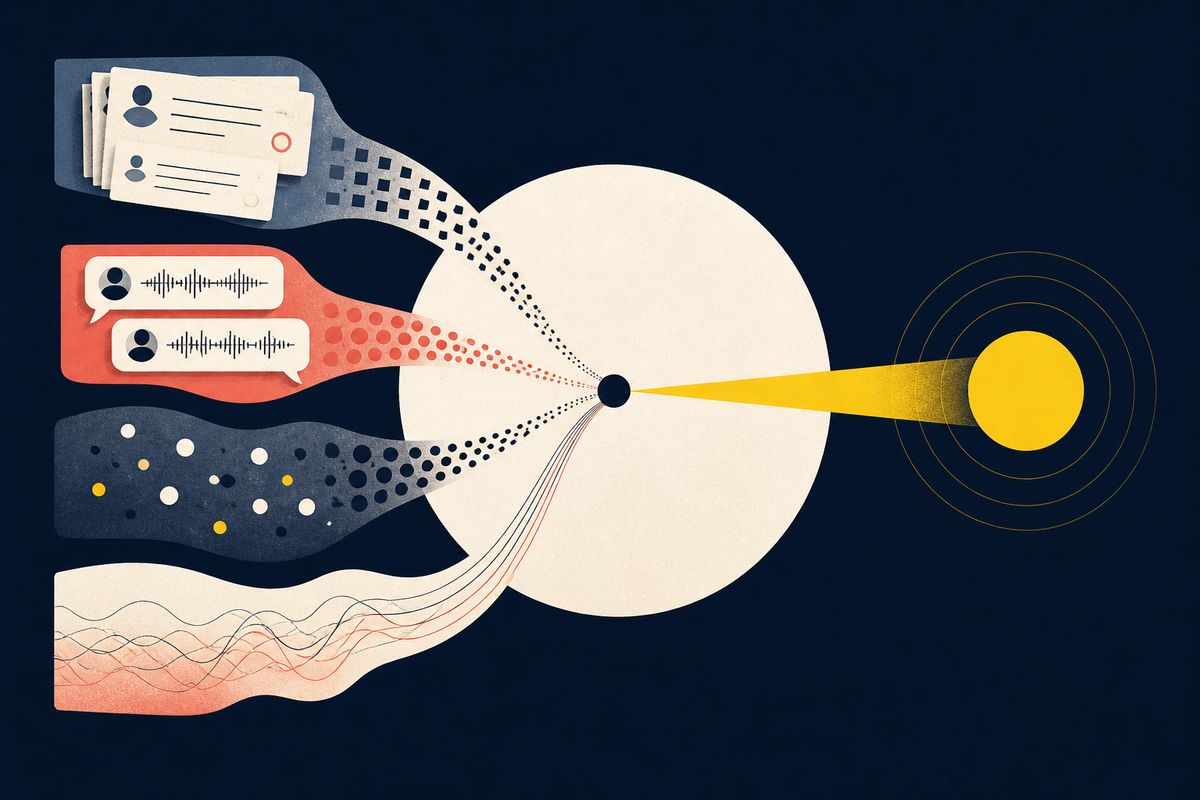
Your Feedback Stack Is Making the Questions Harder
Mopinion, Dovetail, Lyssna and PostHog each remove a different kind of research friction. The right choice depends less on feature count than on where evidence enters your team, who must find it and what decision comes next.

John Goleby Quit University, Shipped Dozens of Duds, and Found a $22 Million Question
Before the funding round, the global offices and the AI platform, there were QUiT T-shirts, a sugar-packet patent and dozens of products that went nowhere. John Goleby’s useful habit was learning which idea to leave behind.
Sprig vs airfocus Is a Choice Between Evidence and Execution
Sprig helps teams gather and synthesize customer evidence. airfocus helps them turn that signal into priorities, roadmaps and accountable product decisions.
Six User Feedback Tools for Six Different Jobs
Survox, Sprig, Typeform, Zonka Feedback, Lyssna and Qualtrics all collect answers, but they solve different research problems. The useful question is not which tool wins - it is where the evidence needs to appear.
Four Feedback Tools, Four Very Different Jobs
Nicereply, UserTesting, Zoho Survey and Jotform all collect feedback. The useful difference is when to use each one - and what kind of truth each can actually reveal.
Eight Feedback Tools and the Questions They Actually Answer
Customer feedback software is not one category but a chain of evidence. Here is where UserTesting, Simplesat, Contentsquare, Voxco, Jotform, Formstack, Qualtrics and Zoho Survey fit - and where they do not.

Four Ways Software Tries to Hear Your Users
Mopinion, Lyssna, Dovetail and PostHog all promise to tell you what your customers think. They just disagree, deeply, on how to find out.
Product Feedback Tools Are Racing to Read Your Users' Minds
Six companies - ProductLift, Survicate, Productboard, Unwrap, Sprig and unitQ - are all chasing the same prize: turning the messy river of user complaints into a product roadmap. Here is how they differ, and who wins which fight.

Survicate
Survey and listen to your customers across every channel, automatically identify key themes, and rally teams around feedback - all in Survicate's platform.

Refiner
In-app surveys that integrate with your product and data stack.
UserTesting
How a two-person idea about watching strangers click around a website turned into a $1.3 billion research empire that now sits between companies and the customers they can no longer afford to guess about.
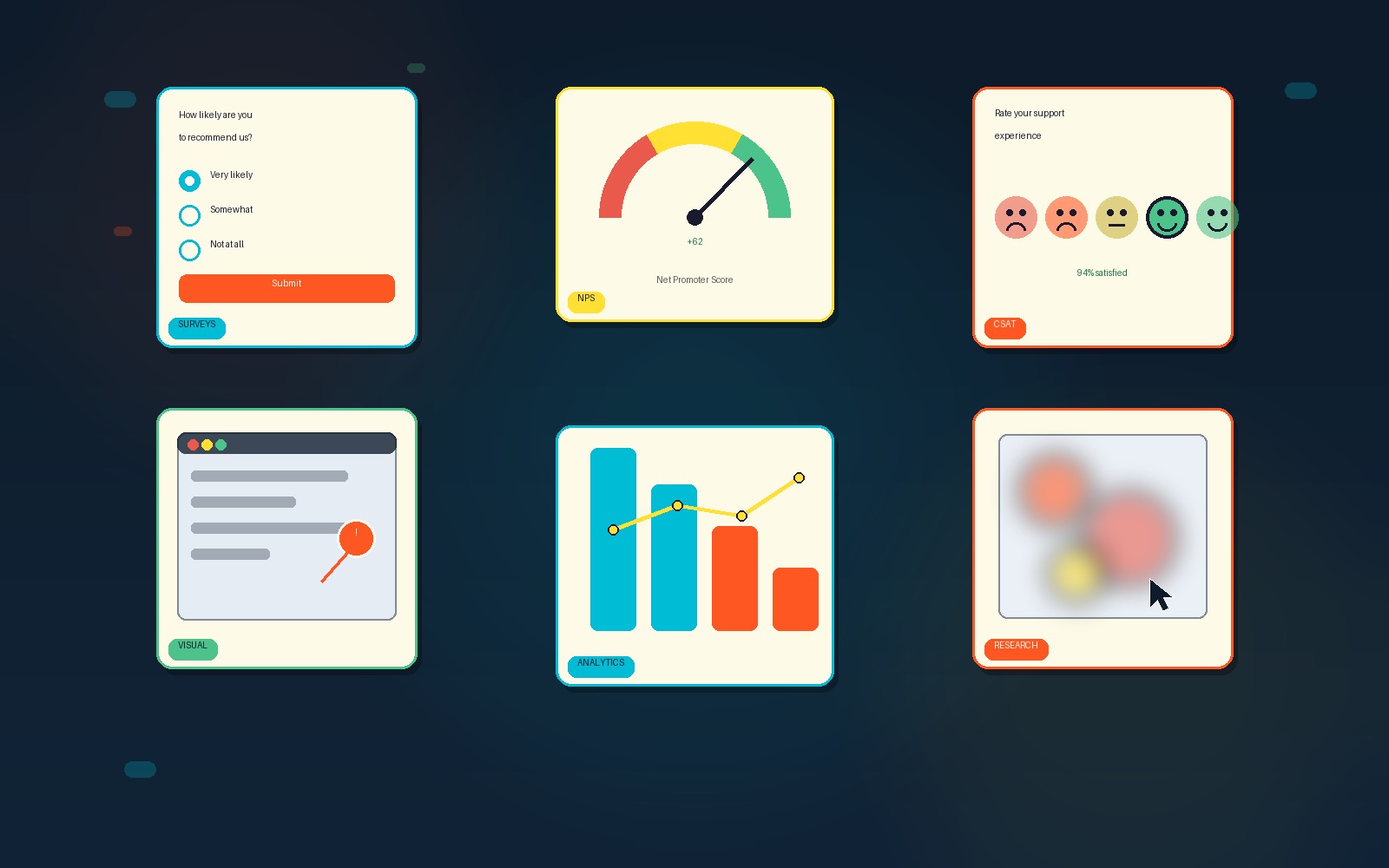
How Six Feedback Tools Turn Your Gripes Into Roadmaps
SurveyMonkey, PostHog, Lyssna and a cluster of smaller rivals have built a quiet industry around one question: what do you actually think? Here is how six of them make money from your opinions, and what each does differently.

Usersnap Turned the Annotated Screenshot Into a Business
The Austrian feedback tool grew from a bug-reporting widget into a platform used by more than 1,300 companies by betting people would rather draw on a screen than fill out a form. Now it is pitching product teams a simpler path than the enterprise CX suites like InMoment.
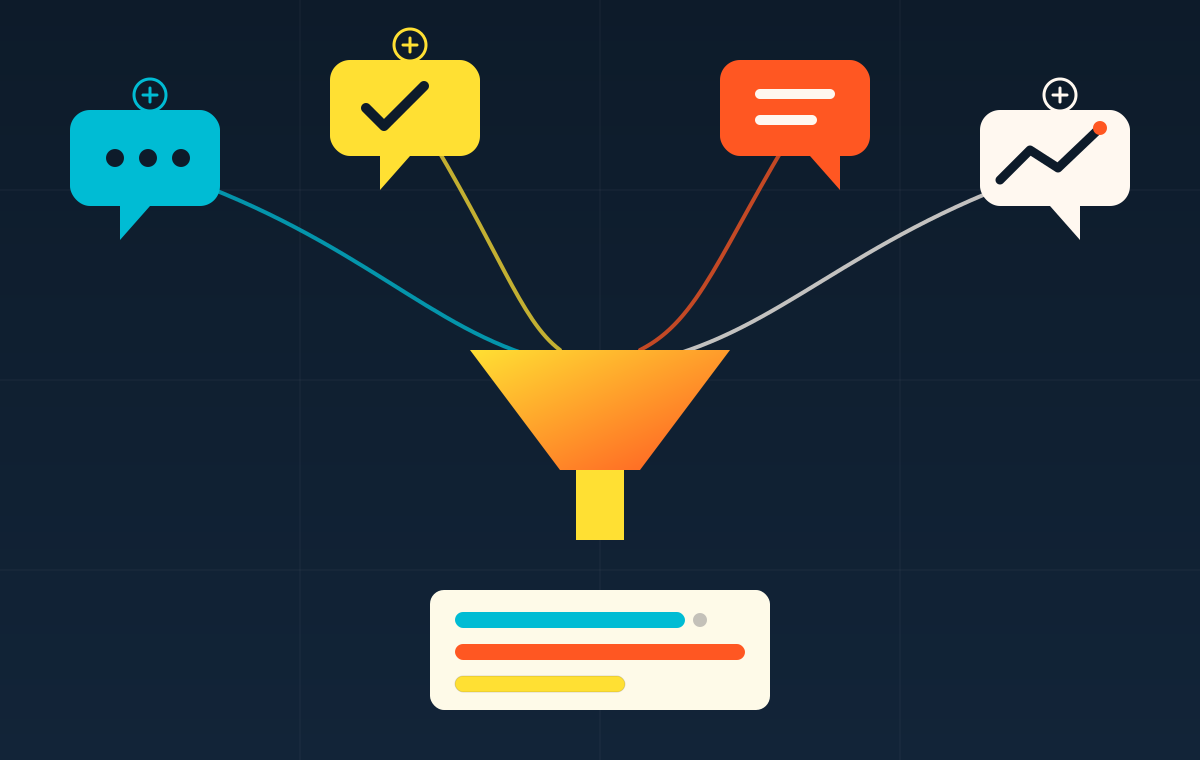
Four Customer Feedback Tools, Three Just Got Bought
airfocus, UserVoice, Mopinion and Contentsquare all promise to turn user gripes into product decisions. In the space of a year most of them stopped being independent companies - and that tells you where the whole category is heading.
Condens
Bring all your customer knowledge together, analyze it fast, and surface evidence-backed insights your team and AI agents can both act on.
Aurelius
A research repository built by two UX veterans in a Minneapolis basement, Aurelius helps product teams turn piles of interview notes into searchable, shareable insights - without losing a single finding to a forgotten spreadsheet.

Bharat Singh Shekhawat
Bharat Singh Shekhawat is a co-founder and Head of Engineering at Entropik, the Bengaluru-based human insights company he helped start in 2016. He builds the systems that turn signals from faces, voices, and eye movement into measurable read-outs of how people feel and decide, and has spent more than fifteen years designing data-intensive platforms and turning research ideas into shipping products.

Poth Labs
Poth Labs is a San Francisco startup building an AI-native customer research platform. Poth connects to a company's scattered customer data - analytics, call transcripts, support tickets, surveys, CRM notes - and unifies it into a searchable model of the customer. It then generates hypotheses about why users behave the way they do, and validates them using existing data plus adaptive interviews that adjust to each response. The goal is to move product, growth, and leadership teams past knowing what users did toward understanding why. Founded in 2026 by ex-Palantir engineer Matthew Wong and ex-Tietoevry engineer Mojmir Horvath, Poth Labs is part of Y Combinator's Summer 2026 batch.

Dovetail
Dovetail is a Sydney-founded customer intelligence platform that pulls scattered customer signals - sales calls, support tickets, surveys, app reviews, usability tests - into one searchable place and uses AI to turn them into themes, dashboards and decisions. Started in 2017 by two ex-Atlassian employees, Benjamin Humphrey and Bradley Ayers, it began life as a repository for user researchers and grew into an organisation-wide intelligence layer used by roughly 40% of the Fortune 500, including AWS, Visa, Atlassian, Canva and Johns Hopkins. Accel led a US$63M Series A in January 2022 at a valuation north of US$700 million.

Rally UXR
Rally UXR is a New York-based user research CRM that helps enterprise product and research teams talk to their users at scale. It replaces spreadsheets and disconnected tools by unifying participant management, recruitment, scheduling, incentives and governance in a single platform, letting teams run more research safely and in compliance. Founded in 2021 by Oren Friedman and Alec Robins, Rally is a Y Combinator (W22) company that raised an $11M Series A in June 2025 and has supported research with more than 10 million users across customers like Sonos, Adobe, GitLab, MongoDB and Webflow.