In 2015, a designer at Atlassian sat in on a diary study. Someone had asked a group of customers to log their frustrations for a fortnight, and the researcher running the project was now doing what researchers had always done with that material: reading it, colour-coding it, moving quotes into a spreadsheet, and slowly assembling a slide deck that a handful of people would skim once. It took weeks. The designer, Benjamin Humphrey, watched the process and had the specific, slightly irritable thought that starts a lot of software companies. There has to be a faster way.
He did not quit immediately. He built the first version in his spare time, paying an outside developer with roughly AU$10,000 he put on a personal credit card. In 2017 he and Bradley Ayers, an Atlassian software architect, incorporated the thing as Dovetail. Their first outside money was not venture capital but a AU$25,000 MVP grant from the New South Wales Department of Industry, earmarked for sentiment analysis features.
Nine years later, Dovetail says its software is used inside roughly 40% of the Fortune 500 - AWS, Visa, Atlassian, Canva, Breville, Qantas and Johns Hopkins among the named customers - and Accel valued the company north of US$700 million when it led a US$63 million Series A in January 2022.
The pile nobody reads
Start with the problem, because it is unglamorous and enormous. A mid-sized software company generates customer signal constantly and from every direction. Support tickets. Sales call recordings. NPS free-text responses. App store reviews. Usability sessions. Community threads. Churn interviews. Almost all of it gets collected, because collecting is cheap and every SaaS tool now does it by default. Almost none of it gets read as a body of evidence.
So the actual decision - what do we build next - gets made in a room where someone senior says "customers hate the onboarding" and nobody in the room can say how many customers, or which ones, or when they said it. Dovetail's homepage compresses this into four words: build with facts, not vibes. The launch page for its 2026 release closes with a blunter version: the best never guess.
Dovetail's answer is a single place where all of that material lands, gets tagged, gets counted, and can be interrogated. The unfashionable half of the product is plumbing: 30-plus native integrations pulling from Salesforce, Qualtrics, Pendo, PostHog, Snowflake, Gong and Zendesk. The visible half is analysis - AI that classifies incoming feedback into themes, plots them on dashboards, tracks whether a complaint is getting louder or quieter quarter over quarter, and answers plain-language questions about the whole corpus.
The company's own figures put the payoff at around 30 hours saved per user per week and 66% faster shipping. Treat vendor numbers as directional rather than audited. The underlying claim is harder to argue with: reading what customers already told you costs less than building the wrong thing and rebuilding it.
“Engineers have GitHub and designers have Figma. User researchers need their own software.”
Benjamin Humphrey, Co-founder & CEO — TechCrunch, January 2022That sentence did an unreasonable amount of work in Dovetail's early years. It does not describe the product. It puts a buyer in a room they already understand and points at the empty chair. Accel's partners, when the Series A closed, used a phrase from the same family: Dovetail was becoming the system of record for user research.
From repository to intelligence layer
For its first six or seven years, Dovetail sold to researchers. That was the wedge, and it was a small one - user research was a job title many companies did not yet have a budget line for. The product was a repository: a place to store interviews, transcribe them, highlight passages, apply tags, and find the thing you half-remembered somebody saying in March.
The repositioning came in October 2024, when Dovetail announced an AI customer insights hub and started describing itself as a customer intelligence platform rather than a research tool. The distinction matters commercially. A repository is bought by a research team and priced against a research team's budget. An intelligence layer is bought by an organisation, and its users are product managers, support leads, sales, and executives who never intended to open a research tool at all.
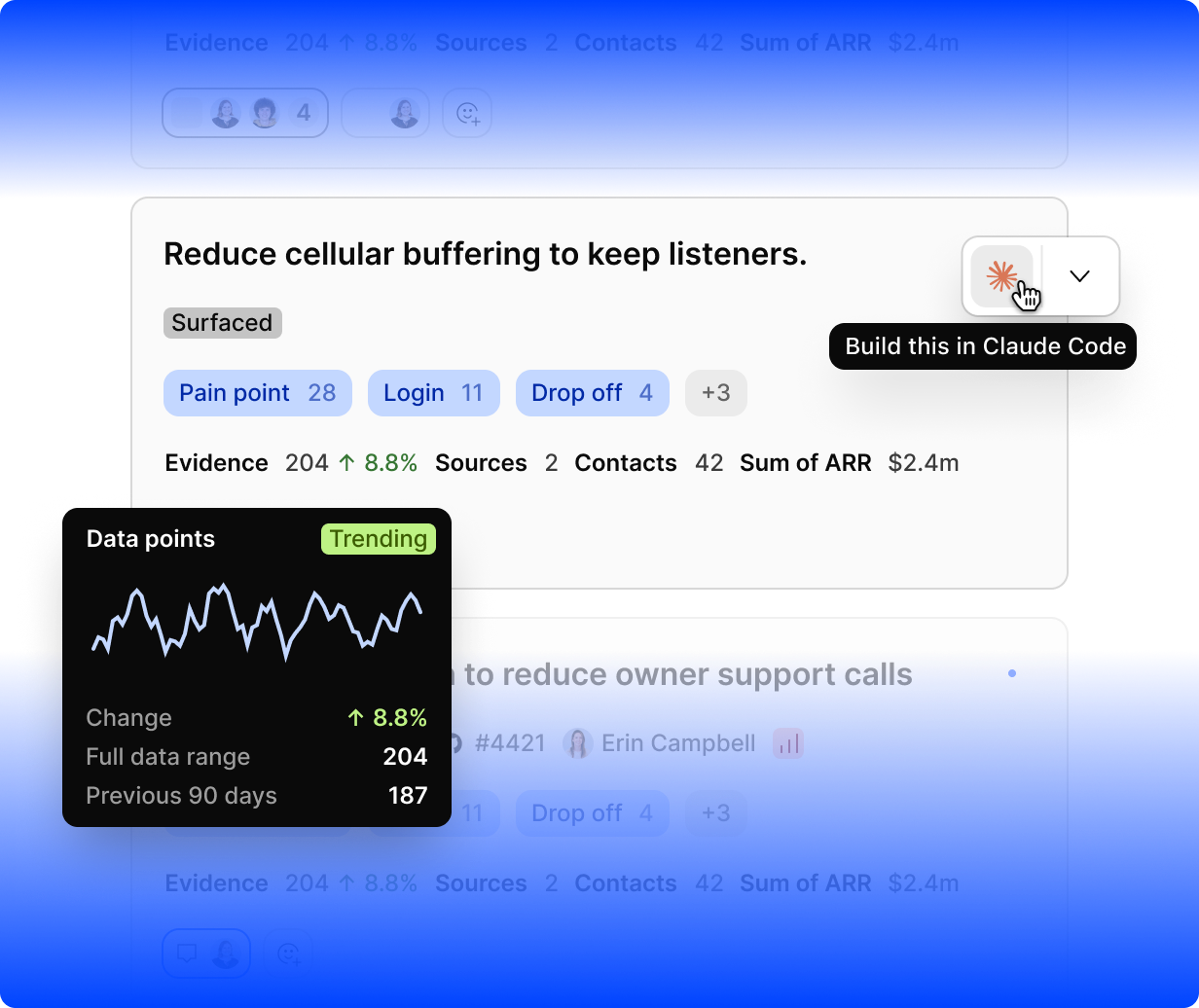
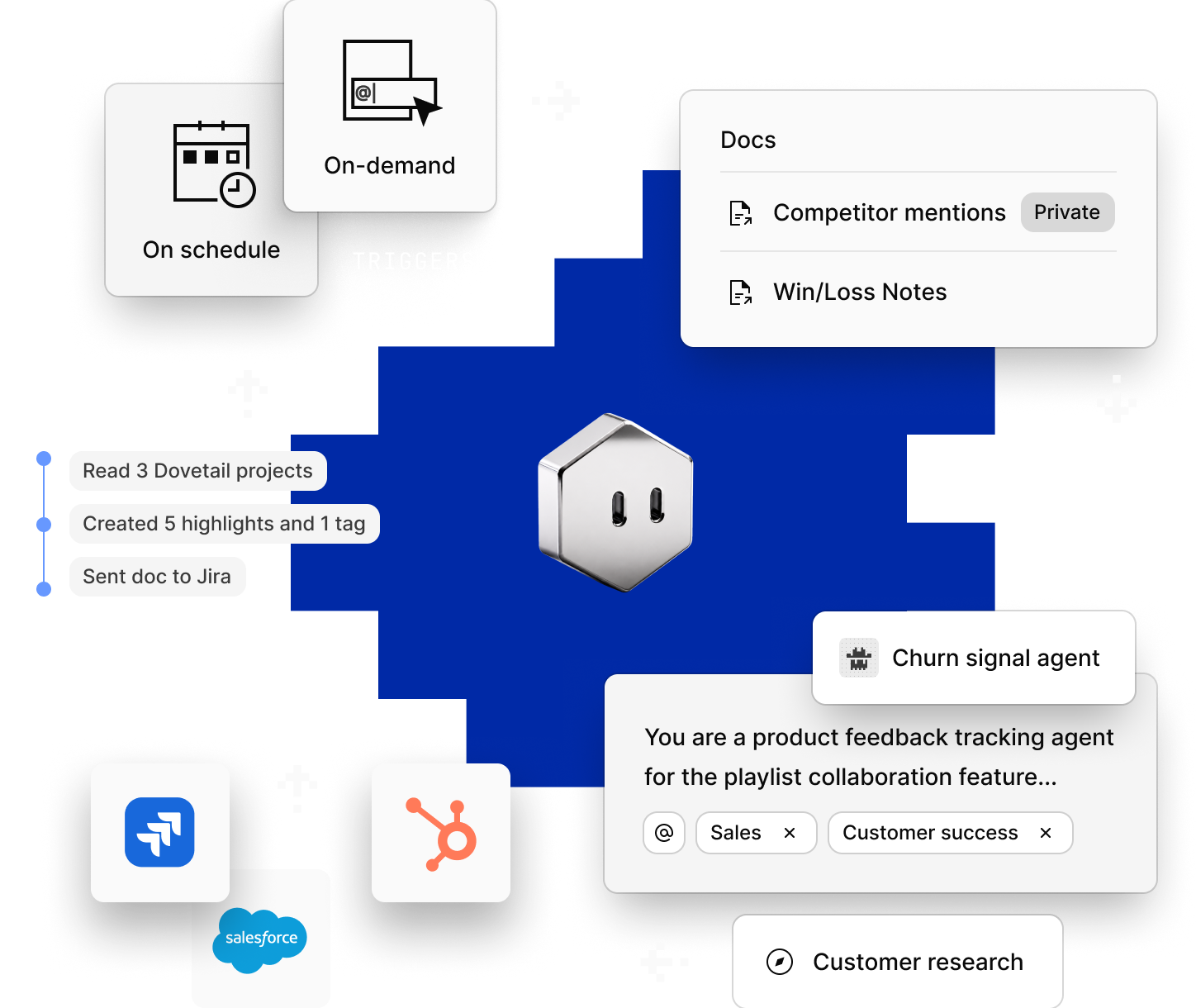
The July 2026 release - branded, with some geographic cheek from a company headquartered in a city that is 12 degrees and raining in July, the "Sun's Out Summer Launch" - pushed the idea further. Agents went generally available: autonomous processes that watch incoming signal, raise alerts and generate documents without anyone asking. Channels 2.0 entered closed beta. MCP connectors landed for Claude, Microsoft Copilot, Slack and Linear, so the evidence can be queried from wherever the work already happens. AI redaction arrived for text, audio and video, and the company added ISO 42001, the management standard specific to AI systems, on top of existing SOC 2 Type II, ISO 27001, HIPAA and GDPR compliance.
Jess, Ana and Trav
The most conversation-starting item in that launch was digital twins: AI-generated customer personas built from a company's real feedback, given first names, and designed to be pulled into a meeting and argued with.

It is easy to be sceptical, and scepticism is warranted - a synthetic customer is a model of your evidence, not a customer. But look at what it replaces. Every roadmap meeting already contains a fake customer: the most confident person in the room saying "well, I think users would want." The twin is not competing with a real interview. It is competing with a guess. That is a lower bar, and a considerably larger market.
“AI didn’t solve the problem of understanding your customers, it made it more painful.”
Benjamin Humphrey — Launch announcement, 14 July 2026That is an odd thing for an AI company's CEO to say, and it is also the most defensible thing in the release. AI made transcription free and summarisation instant, so organisations now hold more customer material than ever and are no closer to a shared answer about what it means. The bottleneck moved from capture to synthesis. Dovetail's bet is that it moved into a seat the company already occupies.
Where the money came from, and how slowly
Dovetail's funding history is unusual in the least exciting and most instructive way: it was profitable before it was funded. By around 2019 the company had roughly US$500,000 in annual recurring revenue with six people, no sales team, and a purely self-serve signup flow. When Blackbird Ventures led a AU$4 million seed in February 2020, the press release led with the word profitable, which is not a thing seed announcements usually need to advertise.
Capital raised, 2017–2026
Bars scaled to USD equivalent · sources: PRNewswire, BusinessWire, TechCrunch
By the time Accel arrived in January 2022 - with Blackbird, Felicis and Mike Cannon-Brookes' Grok Ventures joining - Dovetail had 2,600-plus paying customers, 65 staff, a 3,500-member community Slack, and had burned only about half the venture money it had already taken. The Series A did not create the business. It bought speed on a business that already worked, and funded a San Francisco office and the enterprise sales motion that a self-serve company needs before it can sell to Visa.
The business model, simplified to two words
Pricing today is about as compressed as B2B pricing gets. There is Free - one channel, one project, one dashboard, basic AI chat and summaries, no card required - and there is Enterprise, priced per seat on request, which unlocks unlimited agents, channels, projects and docs, semantic search, AI redaction, folders and global tags, granular access control, priority support and a dedicated customer success manager. HIPAA compliance is a paid add-on. Billing is USD only. The Enterprise tier's icon, for anyone who enjoys a design detail, is a chess queen.
The shape of that pricing tells you who Dovetail thinks the buyer is now. Free is a land-grab aimed at the individual product manager who wants to try it on a Tuesday. Enterprise is where the revenue lives. There is deliberately very little in between, which is a change from the per-editor tiers third-party comparison sites still quote.
The competitive field
Dovetail sits in a crowded and confusingly-bordered market. Directly, it competes with research repositories: Condens, favoured by small teams and solo researchers for its session-analysis interface; Marvin, which has taken the accessible-free-tier position; Notably; Aurelius; Looppanel; and EnjoyHQ, now owned by UserTesting. Reviewers generally place Dovetail as the option for large teams with complex tagging needs and the one that scales furthest, while noting that its seat-based pricing adds up quickly once cross-functional users pile in.
| Category | Who else is there | Dovetail’s angle |
|---|---|---|
| Research repositories | Condens, Marvin, Notably, EnjoyHQ, Aurelius, Looppanel | Depth of tagging and analysis; built for large, multi-team practices |
| Experience management | Qualtrics, Medallia, Sprig | Handles unstructured qualitative data, not just survey instruments |
| Conversation intelligence | Gong, Chorus | Integrates with them rather than replacing them; adds non-sales signal |
| Feedback to roadmap | Productboard | Evidence layer sits upstream of the roadmap, not inside it |
| The status quo | Spreadsheets, Miro boards, Notion, slide decks | The real incumbent, and the hardest to displace |
The genuinely difficult competitor is the last row. Most companies are not choosing between Dovetail and Condens. They are choosing between Dovetail and a Miro board that three people maintain and nobody revisits. That is why Dovetail spends money on things like Insight Out, its own annual conference - the 2025 edition put 1,000 people into Fort Mason in San Francisco and 20,000-plus online, with usability researcher Jakob Nielsen on the bill. You do not run a conference to close deals. You run one to make a category feel inevitable.
Expertise, and a Sydney accent
Dovetail's institutional knowledge is narrow and deep: how researchers actually work, and how qualitative evidence turns into something a finance-minded executive will accept. That comes partly from origin - both founders came out of Atlassian, a company with an unusually strong internal research practice - and partly from a decade of running one of the larger communities in the discipline.
The culture is stated in five lines: put the customer first, stay humble, do the thing, if we do it we nail it, open by default. The Sydney team works from Surry Hills four days a week; the US team is remote-first with an optional San Francisco workspace near Union Square. Everyone gets equity. There are 20 weeks of primary and 12 weeks of secondary parental leave, four weeks a year of work-from-anywhere, a four-week sabbatical at four years, employee resource groups called Doveclubs, and dogs in the office. Headcount has gone from 65 at the Series A to somewhere around 200.
Bradley Ayers, the co-founder and CTO, moved to an individual-contributor engineering role in 2023 and left the company in January 2024. Humphrey remains CEO.
Where it fits
The broader bet is that "customer intelligence" becomes a permanent line item the way CRM and product analytics did - a system of record that companies assume they need rather than one they have to be argued into. Dovetail has been making that argument since 2017, which is long enough to look either prescient or stubborn depending on where the market lands.
What is not in doubt is the specific gap it aims at. Organisations have never had more customer data or less shared understanding of it. Every AI tool added in the last three years has widened that gap by producing more material. Whoever closes it owns a genuinely useful position, and Dovetail got there before the problem had a name.
Read, watch, follow
Video: demos and interviews
❧