Story · Software · Voice of Customer
How Six Feedback Tools Turn Your Gripes Into Roadmaps
SurveyMonkey, PostHog, Lyssna and a cluster of smaller rivals have built a quiet industry around one question: what do you actually think? Here is how six of them make money from your opinions, and what each does differently.
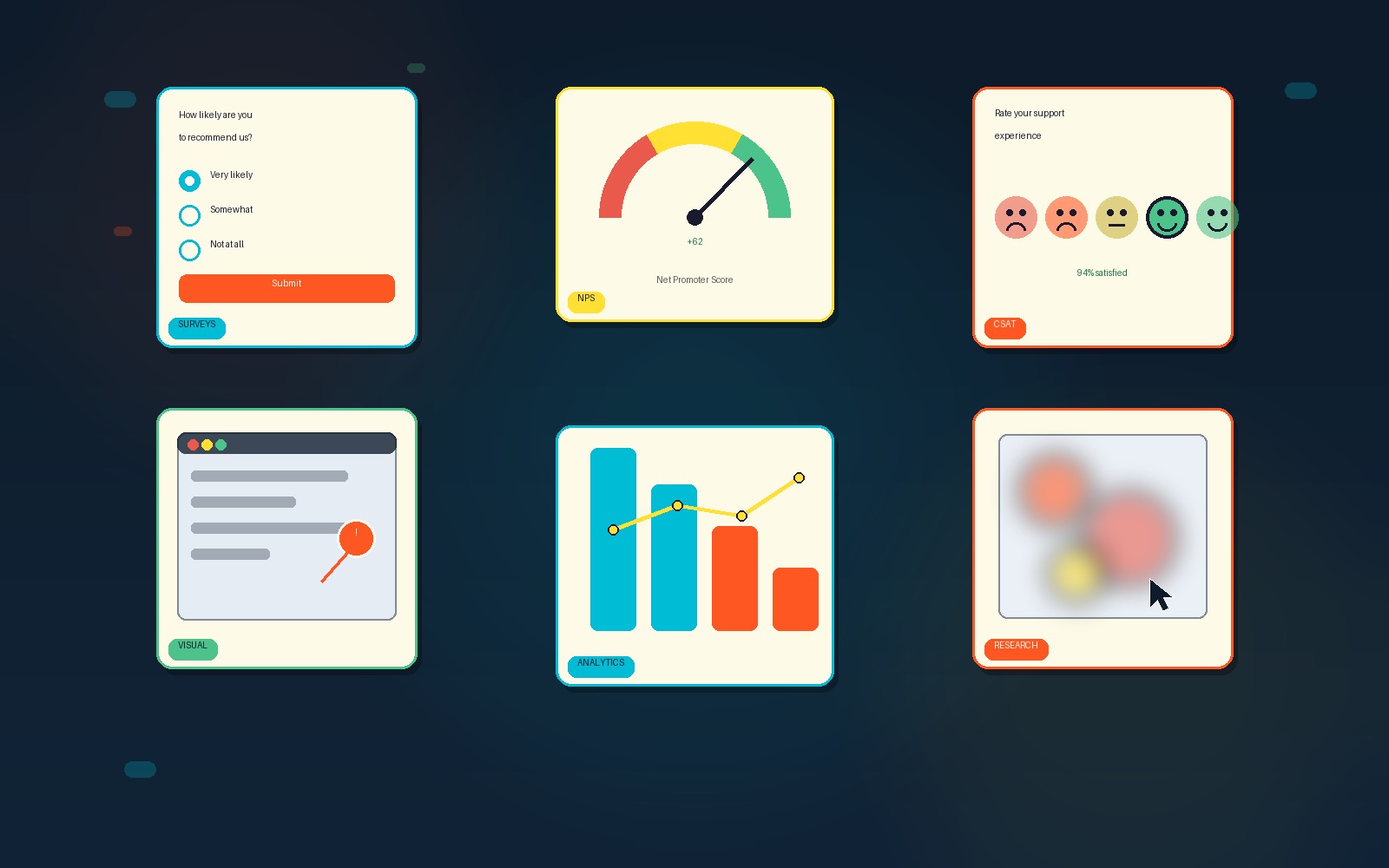
Somewhere in the last decade, the pop-up won. Open almost any app and, sooner or later, a small card slides in from the corner and asks, politely, how likely you are to recommend it to a friend. You close it, or you answer it. Either way a number moves on a dashboard you will never see. That dashboard belongs to a software company, and that software company belongs to an industry - a large, quietly profitable one - built on the single act of asking you what you think.
This is a map of six of those companies. SurveyMonkey, AskNicely, Nicereply, Usersnap, PostHog and Lyssna almost never appear in the same sentence, because on paper they do different jobs. Look closer and they are all answering one question in six different accents: what does the customer actually feel, and can we catch it before they leave?
Six tools, six theories of happy
The first thing to understand is that "customer feedback" is not one category. It splintered years ago into distinct jobs, and each of these tools planted its flag on one of them. There is the broad survey you send to a list. There is loyalty scoring, where a single 0-to-10 question stands in for a relationship. There is support satisfaction, measured one ticket at a time. There is the annotated screenshot from a user who found a bug. There is the product-analytics view of what people did, not just what they said. And there is usability research, run before a feature ships at all.
Those jobs map to three acronyms that get thrown around as if they mean the same thing. They do not. NPS, the Net Promoter Score, asks how likely you are to recommend a product and treats the answer as a proxy for loyalty. CSAT, customer satisfaction, asks how a single interaction went. CES, customer effort score, asks how hard it was to get something done. Pick the wrong one and you will measure the wrong feeling with real precision.
SurveyMonkey, the survivor
Start with the elephant. SurveyMonkey was founded in 1999 by brothers Ryan and Chris Finley, and it is the reason a certain kind of grey web form is burned into everyone's memory. By 2009 it was valued at around a billion dollars. In 2018 its parent, SVMK Inc., went public on Nasdaq. In 2021 that parent rebranded to Momentive to signal ambitions beyond surveys, and Zendesk announced a deal worth roughly $4.1 billion to buy it. Zendesk's own shareholders voted the deal down, and it collapsed in early 2022.
Then in 2023, the private-equity firm Symphony Technology Group took the whole thing private again for about $1.5 billion and quietly restored the SurveyMonkey name. Private, public, private, all inside five years. It is a useful reminder that "let people ask other people questions" is a business durable enough to survive several changes of owner and one very public near-death experience.
AskNicely and the Uber idea
AskNicely started in Auckland in 2014, built by Aaron Ward and Jon Ballinger around a simple observation: Uber had trained a generation to rate an experience the moment it ended. Why couldn't a plumber, a cleaner or a car dealership get the same instant, honest read on how they were doing? The company turned that loop into a Net Promoter platform aimed squarely at frontline, service-heavy businesses, then wrapped coaching tools around it so managers could act on the scores rather than frame them.
The bet worked well enough that AskNicely moved its headquarters to Portland, Oregon around 2019 while keeping its New Zealand roots, and raised a US$32 million Series B led by Five Elms Capital in 2022, part of roughly $53.7 million raised in total. It is the clearest example in this group of a tool built for a specific worker rather than a specific dashboard.
Nicereply, inside the ticket
Nicereply, founded in 2012 and based in Bratislava, made the opposite choice from SurveyMonkey. Instead of a standalone survey you distribute, it embeds one-click ratings directly into the support workflow - the CSAT face or CES scale that appears at the bottom of a helpdesk reply. The feedback is collected at the exact second a customer's problem is resolved, when the memory is sharp, and it flows straight back to the agent who handled it.
It is a smaller, focused company with clear subscription pricing - tiers that run from a Starter plan up to a Business plan billed annually - and a customer list that has included support teams at Microsoft, Lenovo and HubSpot. The lesson Nicereply encodes is that where you ask matters as much as what you ask. A survey in an inbox a week later measures memory; a rating inside the ticket measures the moment.
Usersnap: just circle the bug
Usersnap, out of Linz, Austria and also dating to around 2012, attacks a very human problem: describing a bug is hard and boring. Its whole pitch is to let a user, tester or teammate circle the thing on screen, annotate a screenshot, or record what went wrong, and turn that into a structured report a developer can act on. It grew to roughly 1,500 customers on a largely revenue-funded basis - no growth-at-all-costs venture treadmill - before being acquired by saas.group in September 2023.
The interesting move here is friction reduction as a whole product. Usersnap's advantage is not a cleverer question; it is removing the effort between "something is wrong" and "the right person now knows." That is a recurring theme across this entire market. The winner is often whoever asks the least of the person doing the reporting.
PostHog: give it away, charge by the answer
PostHog is the newest and the strangest of the six. Founded in 2020 by James Hawkins and Tim Glaser and shaped in Y Combinator's Winter 2020 batch, it started as open-source product analytics and kept bolting on tools: session replay, feature flags, and, yes, in-app surveys. It is self-hostable, which means a company can run it on its own infrastructure so customer data never leaves the building - a nice-to-have for some teams and a non-negotiable for others in regulated industries.
Its pricing tells you how it thinks. Most of the product is free until you cross generous usage limits. Surveys are free up to 1,500 responses a month, then cost $0.10 each. Analytics events and session recordings are billed fractions of a cent apiece. Where SurveyMonkey sells seats and AskNicely negotiates enterprise contracts, PostHog meters consumption and lets the free tier do the marketing. It is the developer-first answer to a market that grew up selling to marketers.
Flat subscription
Predictable monthly tiers, priced by plan. Easy to budget, less elastic as you scale.
e.g. Nicereply, LyssnaQuote-based
Enterprise contracts sized to seats, volume and support. Powerful, opaque, sales-led.
e.g. AskNicely, SurveyMonkey teamsUsage-based
Large free tier, then pay per event, recording or response. Grows with what you use.
e.g. PostHogLyssna: the art of listening
Lyssna is the oldest idea wearing the newest name. It began in 2008 as fivesecondtest.com, a single tiny experiment built by Mateja Milosavljevic: show someone a design for five seconds, then ask what they remember. That grew into UsabilityHub, a suite of first-click tests, preference tests and surveys, and in October 2023 the company rebranded to Lyssna - Swedish for "to listen" - and added interview studies and its own participant panel.
Where the other five mostly catch feedback after something ships, Lyssna sits before the launch. Its job is to test a design on real people while it is still cheap to change. Fifteen years from a five-second test to a full research platform is a quiet argument for a small idea done well, and for the notion that listening is a skill you build, not a box you check.
So which one should you actually use?
The honest answer is that the question is wrong. These tools are not really competing for the same slot; they are competing for a share of attention inside teams that have not decided what they want to learn. If you are shipping software and need to know what people do, PostHog and Usersnap live closest to the product. If you run a service business and want a loyalty number your frontline can act on, AskNicely is built for exactly that. If your battleground is the support queue, Nicereply meets customers inside the ticket. If you are testing a design before launch, Lyssna is the room for it. And if you just need to send a good old survey to a list, SurveyMonkey has been doing that longer than most of the internet.
The trap is buying one, watching a dashboard go up and to the right, and mistaking a measured number for an understood customer. A rising NPS with no closed loop is a vanity metric. A pile of session replays nobody watches is storage. The tools are cheap; the discipline of acting on what they surface is the expensive part, and no pricing page sells it.
That is the real story of the feedback economy. Six companies, six philosophies, one shared premise - that the gap between what a customer experiences and what a product team hears is a problem worth a business. Every pop-up you have ever dismissed is a small bet that you might, this time, answer. Enough of you do that the bet keeps paying off.
Visit the six tools
Questions people actually ask
What is the difference between NPS, CSAT and CES?
NPS (Net Promoter Score) asks how likely you are to recommend a product on a 0-10 scale and measures loyalty. CSAT (Customer Satisfaction) asks how satisfied you were with a specific interaction. CES (Customer Effort Score) asks how hard it was to get something done. AskNicely leads with NPS; Nicereply leads with CSAT and CES.
Which of these tools is best for product teams building software?
PostHog and Usersnap sit closest to the product itself - PostHog for in-app analytics, session replay and surveys, Usersnap for visual bug reports. Lyssna is aimed at pre-launch user research and usability testing. SurveyMonkey is more general-purpose.
Are any of these customer feedback tools open source?
PostHog is the notable open-source, self-hostable option, which means a company can keep all feedback and analytics data on its own infrastructure. The others are closed, hosted SaaS products.
How do these tools make money?
Models vary. Nicereply and Lyssna use flat monthly subscription tiers. AskNicely and enterprise SurveyMonkey lean on quote-based pricing. PostHog is usage-based with a large free tier, charging per event, recording or survey response.
Why are there so many separate feedback tools instead of one?
Because "listening to customers" splits into distinct jobs - broad surveys, loyalty scoring, support satisfaction, bug capture, product analytics and usability research. Each job has its own moment, audience and interface, which is why specialists coexist rather than one platform winning outright.