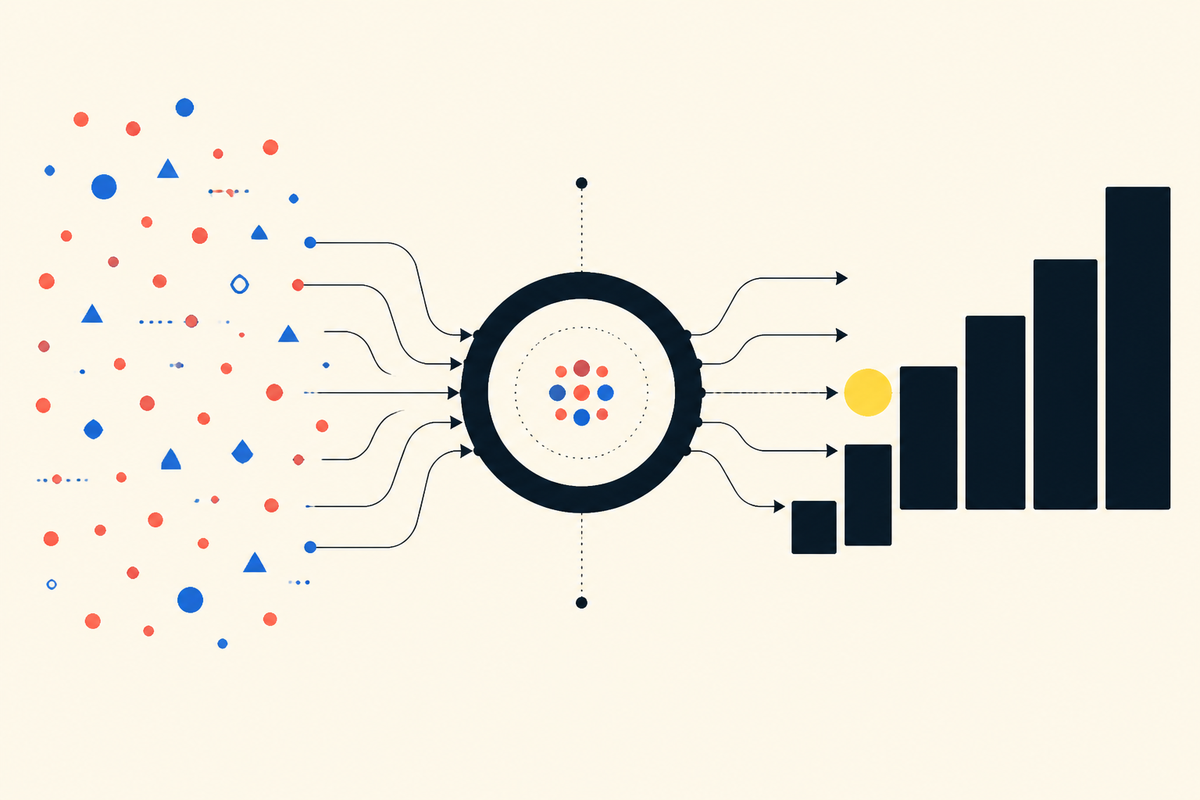
A product team can be surrounded by feedback and still have no idea what to build. Survey answers sit in one tool. Support tickets sit in another. A quarterly roadmap arrives with suspiciously clean colors and no visible trail back to the customers whose problems supposedly shaped it. Sprig and airfocus both sell a way out of this mess, but they enter through different doors. Sprig starts with the question: how do we collect reliable evidence quickly? airfocus starts later: how do we turn the evidence we have into a decision the organization can understand, challenge and execute?
That distinction matters because the two platforms now use similar language. Both talk about customer signal, AI agents, connected context and faster decisions. Both can bring data into the AI tools a team already uses. On a software shortlist, the overlap can make them look interchangeable. In practice, each has a different center of gravity. Sprig is research infrastructure. airfocus is product operating infrastructure.
Begin with the broken moment
The easiest way to choose is to ignore the feature grid for a minute and replay the last expensive product decision. Where did confidence fail? Perhaps researchers spent days programming a survey, struggled to reach the right users, then lost another week turning open text into a defensible report. That is Sprig territory. Its platform covers long-form and in-product surveys, feedback, prototype testing, session replay and heatmaps. Its current pitch is narrower and more ambitious at once: enterprise surveys powered by agents across design, fieldwork and synthesis.
Sprig's Design Agent turns research briefs or questionnaires into programmed studies. Field Agent adapts follow-up questions based on respondent context and answers. Synthesize Agent produces themes, comparisons and reports while retaining links to underlying responses. The value is not merely a faster summary. It is a shorter trip from a research question to inspectable evidence.
Now consider a different failure. The research was good. Sales calls, support tickets and surveys all pointed toward the same pain. Yet the finding reached the roadmap as a vague feature request, detached from the evidence and from the objective it was meant to serve. Teams debated by volume. Leadership received a deck that was out of date before the meeting ended. This is the seam airfocus is designed to repair.
Sprig
- Design and program studies
- Field contextual and adaptive surveys
- Connect answers with behavior
- Synthesize findings with traceable support
airfocus
- Centralize and triage feedback
- Connect insights to strategy and OKRs
- Score priorities and expose trade-offs
- Maintain roadmaps and portfolio views
What Sprig is built to do
Sprig grew out of founder Ryan Glasgow's frustration as a product manager making consequential calls without enough user evidence. The company says research should happen in the moment, connect to actual behavior and run continuously rather than as an occasional project. Its infrastructure claims help explain the enterprise posture: more than 1.3 trillion events processed, 72 billion visitor attributes stored and more than one billion visitors tracked per month. Those are company-reported operating figures, not an external benchmark, but they signal the scale Sprig wants buyers to evaluate.
A team can use Sprig to trigger an in-product study after onboarding friction, run a broader market survey through a link or email, test a prototype, and compare themes across segments. The platform also offers free and starter routes for smaller programs, while its enterprise setup adds governance, access controls and security features. Pricing at scale depends on response volume, capabilities and deployment environments rather than a simple public per-seat number.
The caveat is methodological. An agent can program logic and spot patterns, but it can also make a weak question look polished. Sampling, framing, bias, privacy and the difference between directional evidence and decision-ready evidence still require a researcher. Sprig itself makes this boundary plain on its Synthesize Agent page: AI assists analysis, while judgment remains with the user.
What airfocus is built to do
airfocus was founded in Hamburg in 2017 by Malte Scholz, Christian Hoffmeister and Valentin Firak. Its original idea was practical: replace messy roadmaps, gut decisions and overgrown spreadsheets with a modular product-management system. The product now connects feedback, strategy, objectives, prioritization, roadmaps, portfolio views and delivery integrations in one data model.
That architecture gives airfocus a broader organizational job. Feedback from tickets, calls and surveys can become linked insights. Teams can score work with RICE, weighted scoring or custom criteria, then place selected initiatives into roadmap views for different audiences. Portfolio rollups show dependencies and capacity across product lines. Integrations keep planned work connected with Jira, Azure DevOps, Trello, Shortcut and other delivery tools.
Lucid Software acquired airfocus in April 2025 for an undisclosed amount. The fit is legible: Lucidspark supports open-ended ideation, Lucidchart supports visual mapping, and airfocus supplies the structure between ideas and delivery. airfocus kept its brand and team, according to its announcement. The acquisition also gives it a place inside a wider collaboration suite rather than leaving it as a stand-alone roadmapping vendor.
The chain worth protecting
airfocus's 2026 product update moves beyond static roadmaps. Its Insights agent analyzes incoming feedback and links patterns back to sources. Autofill suggests fields, labels and owners. The airfocus agent works across roadmap and strategy data, while drift detection is designed to flag work that no longer supports stated objectives. Its MCP server offers permission-aware, bidirectional access so compatible assistants can query and act on approved product context.
Keep the claims in proportion. Features such as agentic synthesis, drift detection and automated triage are described by the vendors. Public product pages establish availability and intended use, but they do not prove accuracy in every dataset or organization. A serious evaluation should test source traceability, permissions, false positives and correction workflows.
The overlap is the handoff
Customer feedback is where the products meet. Sprig is better positioned to create structured evidence through studies and contextual research. airfocus can ingest feedback from multiple channels, find themes and connect those themes to opportunities, goals and roadmap items. A small product team may stretch either product toward the other job. A mature research and product operation is more likely to care about the handoff.
That handoff should preserve four things: the original source, the population represented, the confidence of the finding and the owner of the resulting decision. If a summarized theme travels from Sprig into airfocus without sample context, it may acquire more certainty than the research deserves. If every raw comment travels across, the destination becomes another noisy inbox. The integration design matters as much as the licenses.
Both companies now treat Model Context Protocol as part of that connective tissue. Sprig promotes access to studies, responses, themes and segments from tools such as ChatGPT, Claude and Gemini. airfocus exposes feedback, priorities, objectives and roadmap context to compatible assistants, with read and write actions governed by workspace permissions. MCP can reduce exporting and copying. It does not automatically create a sound evidence model.
How to make the choice
Choose Sprig when the bottleneck is research operations: studies take too long to launch, in-product moments are hard to reach, qualitative feedback is expensive to synthesize, or research artifacts are scattered. It is also the more natural choice when UX researchers need control over study logic, respondent context and evidence review.
Choose airfocus when the bottleneck is organizational memory and commitment: customer inputs pile up without ownership, strategy lives apart from delivery, prioritization debates repeat, or leaders lack a live view across product lines. It fits product managers, product operations and portfolio leaders who need the rationale behind work to remain visible after planning.
Use both when research quality and decision operations are independently mature enough to justify two systems. Name the handoff owner. Decide which findings move, in what format and with which metadata. Then test one consequential workflow from research brief to shipped outcome. If the pilot cannot show fewer manual steps, better traceability or a clearer decision, adding software has only added another place to look.
There is also a defensible choice to buy neither. A team with low research volume, a simple roadmap and disciplined documentation may be better served by existing survey, analytics and delivery tools. The cost of a platform is not just subscription spend. It is taxonomy, permissions, migration, training and the weekly habit required to keep the data credible.
The real prize is a product loop that remembers why. Sprig can strengthen the evidence entering that loop. airfocus can strengthen the decisions and coordination that follow. Their shared promise is speed, but speed is useful only when each automated step leaves a trail a human can inspect.
Frequently asked questions
What is the main difference between Sprig and airfocus?
Sprig centers on designing research, collecting customer evidence and synthesizing findings. airfocus centers on connecting feedback with strategy, prioritization, roadmaps, portfolios and delivery.
Can Sprig replace airfocus?
Not as a complete product-management system. Sprig supports discovery and evidence gathering, while airfocus provides deeper OKR, prioritization, roadmap and portfolio workflows.
Can airfocus replace Sprig?
Not for a team that needs dedicated study design, adaptive surveys, behavioral research context and research-focused synthesis. airfocus collects and triages feedback, but its core job is operationalizing product decisions.
Do both products use AI agents?
Yes. Sprig describes Design, Field and Synthesize agents. airfocus describes agents for feedback insights, triage, workspace assistance and roadmap context.
Who owns airfocus?
Lucid Software acquired airfocus in April 2025. The purchase price was not disclosed, and the product continues under the airfocus by Lucid name.