Story · Product & SaaS
Four Customer Feedback Tools, Three Just Got Bought
airfocus, UserVoice, Mopinion and Contentsquare all promise to turn user gripes into product decisions. In the space of a year most of them stopped being independent companies - and that tells you where the whole category is heading.
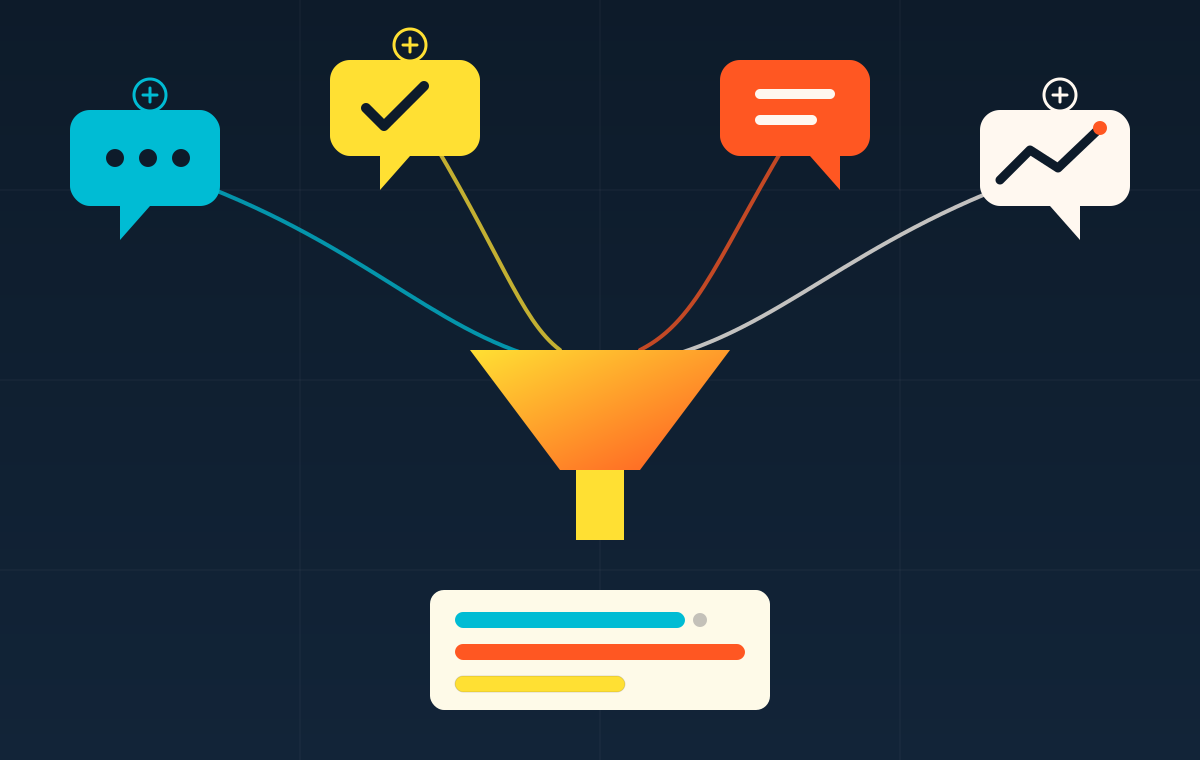
Every product team says the same thing in the same meeting: we should listen to our customers more. Then someone opens a spreadsheet of feature requests, a folder of support tickets, an NPS export and a heatmap, and the room goes quiet. Listening is easy to agree on and hard to operationalize. That gap - between wanting feedback and doing something with it - is the entire reason airfocus, UserVoice, Mopinion and Contentsquare exist.
They are usually presented as competitors on the same comparison page. They are not, quite. Each one attacks the feedback problem from a different starting point, and the starting point tells you almost everything about who the tool is for. But there is a second story running underneath the feature comparison, and it is the more interesting one. In roughly a year, three of these four companies stopped being independent. If you are choosing a feedback platform in 2026, the org chart matters as much as the feature list.
Same problem, four front doors
Where the feedback enters the building
The cleanest way to tell these tools apart is to ask a single question: where does the feedback physically enter your company? Answer that, and the right tool usually picks itself.
- Starts at the roadmap
- Prioritization frameworks
- Shareable stakeholder roadmaps
- Jira, Trello, Slack integrations
- Starts at the feature request
- Revenue-weighted prioritization
- Pulls from tickets, NPS, sales calls
- Used by 3,500+ companies
- Starts at the on-site form
- NPS, CES, CSAT capture
- Web, mobile and email
- Text analysis, smart labeling
- Starts at the behavior
- Voice of Customer + session replay
- Heatmaps and journey analysis
- Bought Hotjar and Clicktale
airfocus begins with the roadmap. It was founded in Hamburg in 2018 around a simple frustration: product managers spend hours arguing about what to build next, usually without a shared way to score the options. airfocus is built for that argument. It gives teams customizable prioritization frameworks, interactive roadmaps you can share with stakeholders in real time, and connectors into Jira, Trello and Slack. Feedback is one of the inputs, but the center of gravity is the decision, not the complaint.
UserVoice begins with the feature request. It is the veteran here, founded in 2008 by Richard White, Lance Ivy and Marcus Nelson, back when a public "feature request forum" was still a fresh idea. Its modern pitch is less about the forum and more about the math: pull requests in from support tickets, NPS, sales calls and product portals, then weight them by revenue so the loudest customer does not automatically become the most important one. More than 3,500 companies use it to decide what the squeaky wheel is actually worth.
Mopinion begins with the form. Founded in Rotterdam in 2013, it is the most literal of the four: it puts customizable feedback widgets on your website, app and emails, captures the standard CX metrics - NPS, CES, CSAT - and then runs text analysis and smart labeling over the open comments. If your feedback problem is "we do not systematically ask users what they think, where they are," Mopinion is the answer that shows up.
Contentsquare begins with behavior. It does not wait for you to type a complaint; it watches what you do. Founded in 2012 by Jonathan Cherki as a project at ESSEC Business School in Paris, it grew into a digital-experience analytics platform built on session replay, heatmaps and journey analysis, with a Voice of Customer layer bolted on top. The interesting move is the two-way link between the two: a low survey score can be replayed as the exact session that produced it. You get the gripe and the click trail that caused it.
Answer one question - where does the feedback enter your company - and the right tool usually picks itself.
The story under the story
A category consolidating in real time
Here is the part the comparison pages leave out. If you had bought all four of these tools in early 2025, by late in the year three of your vendors would have changed hands.
airfocus was acquired by Lucid in 2025, and now brands itself as "airfocus by Lucid." Mopinion was acquired by Netigate, the European feedback group, folding on-site feedback into a broader survey business. And in November 2025 UserVoice was acquired by Curious, a holding company founded by Andrew Dumont, with Matt Young staying on as CEO. Contentsquare, meanwhile, is the outlier - not because it avoided the deal table, but because it has been sitting on the buyer's side of it. It has raised around $1.4 billion, reached a reported $5.6 billion valuation in 2022, and grown partly by acquisition, most visibly by swallowing Hotjar and Clicktale.
- 2008UserVoice founded - the feature-request forum grows up.
- 2012Contentsquare starts as a student project at ESSEC in Paris.
- 2013Mopinion founded in Rotterdam around digital feedback forms.
- 2018airfocus founded in Hamburg for prioritization and roadmapping.
- 2021Contentsquare acquires Hotjar and Clicktale.
- 2025airfocus → Lucid. Mopinion → Netigate. UserVoice → Curious.
Consolidation is not a scandal. It is what happens when a feature becomes a market. "Customer feedback" started as a checkbox inside product tools, then grew big enough to support standalone companies, and has now grown big enough that larger platforms want it inside their suites. Lucid wants feedback next to its diagramming and workflow tools. Netigate wants Mopinion's on-site widgets next to its surveys. A holding company wants UserVoice as a cash-generating, category-leading asset. The logic is the same each time: feedback is too valuable to leave as a standalone tab.
What this means if you are buying
Read the org chart, then the feature list
For a team choosing a tool this quarter, the consolidation changes the shopping process in three practical ways.
First, roadmaps get re-prioritized after an acquisition. The feature you were promised may now sit behind the parent company's integration work. That is not automatically bad - it often means deeper hooks into a bigger ecosystem - but it means the tool you buy in Q1 may look different by Q4. Ask the vendor directly what the acquisition changed.
Second, "all-in-one" is now the whole pitch. Every one of these tools is converging on the same promise: capture feedback wherever it appears, weight it by revenue and behavior, and route it into the roadmap, with AI doing more of the summarizing. The differences that remain are about the front door, not the destination. Pick the door that matches where your feedback already lives, because within the suite everything downstream starts to look alike.
Third, independence has a shelf life. Contentsquare aside, the standalone feedback tool is becoming a transitional state, not a permanent one. If long-term vendor independence matters to you - for data control, pricing stability, or roadmap influence - weight that in the decision now, because the category is telling you which way it breaks.
Customer feedback started as a checkbox, became a market, and is now becoming a feature again - inside somebody else's suite.
The irony is not subtle. Four companies built businesses on the premise that you should listen carefully before you act. Their investors listened carefully to the same market signal - a category maturing, a promise commoditizing, buyers wanting fewer vendors - and acted decisively. The tools that teach customer-obsession spent the last year demonstrating deal-making instead. Both lessons are worth taking. Listen to your users. And read the market you are buying into, because it is moving faster than any survey you will send.
The short version
If you only remember four lines
Pick airfocus if your problem is deciding what to build. Pick UserVoice if your problem is drowning in scattered feature requests. Pick Mopinion if your problem is that you never systematically ask. Pick Contentsquare if your problem is that people say one thing and do another, and you want to see both. Then, whichever you pick, check who owns it this month.
Questions people actually ask
FAQ
What do these four tools have in common?
All four help teams collect customer feedback and turn it into product decisions. They differ mainly in where the feedback enters: airfocus from the roadmap, UserVoice from feature requests, Mopinion from on-site forms, and Contentsquare from behavioral analytics.
Which one is best for product roadmapping?
airfocus is built around prioritization frameworks and shareable roadmaps, with feedback feeding directly into the roadmap. UserVoice is stronger for centralizing and revenue-weighting raw feature requests before they reach a roadmap.
Have any of these companies been acquired?
Yes. airfocus was acquired by Lucid in 2025, Mopinion by Netigate, and UserVoice by Andrew Dumont's holding company Curious. Contentsquare is the acquirer of the group, having bought Hotjar and Clicktale.
What is Voice of Customer (VoC) software?
VoC software captures what customers say and do - surveys, NPS/CES/CSAT, session replay - and turns it into insight teams can act on. Contentsquare and Mopinion lean VoC; airfocus and UserVoice lean toward product-feedback management.
How should a team choose between them?
Start with where your feedback already lives. Scattered feature requests point to UserVoice; roadmap decisions to airfocus; on-site forms and CX metrics to Mopinion; behavior on your site and app to Contentsquare. Then check who owns the vendor now.
Go deeper
Sources: company sites for airfocus, UserVoice, Mopinion and Contentsquare; CB Insights; Crunchbase; Tracxn; CXM Today; Sixth Street; BusinessWire. Acquisition details reflect public reporting through late 2025. Figures such as Contentsquare's valuation are as reported and may have changed.