For three years, Ryan Millner and Ashwin Singhania had a problem that no amount of seniority could fix. They were product managers on Amazon Alexa, the smart-speaker that hundreds of millions of people talked to every day. Those people had opinions - loud, specific, sometimes furious opinions - and they left them everywhere: in app reviews, in support tickets, in surveys, in tweets. The feedback existed. What Millner and Singhania did not have was a way to read it. "We simply couldn't properly listen," Millner has said of that period. So they did what most teams do when the inbox is too big to face: they made decisions on gut feel and hoped.
In 2022 the pair quit and built the thing they had wished for. They called it Unwrap - as in unwrapping what a customer is really trying to tell you. Four years and a $12 million Series A later, the same companies that once buried teams like theirs in feedback are now paying Unwrap to dig them out. Microsoft, Lyft, JetBlue, Oura and Perplexity are on the customer list. So is the team behind GitHub Copilot, which says the platform turned a monthly chore that ate 15 to 20 hours into one that takes one or two.
We're on a mission to fill the world with products people love.Ryan Millner, Co-founder & CEO
01 / What It Actually DoesThe listening machine
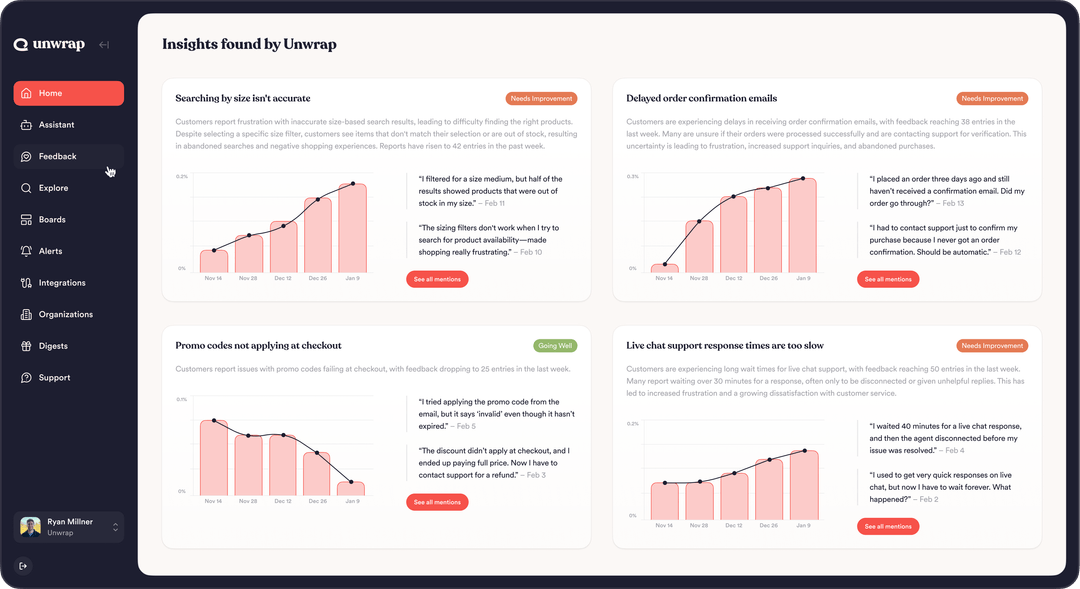
Strip away the category jargon - "customer intelligence," "voice of customer" - and Unwrap does one concrete thing. It pulls in every piece of feedback a company generates, no matter where it lives, and uses natural language processing to sort it into themes a human can act on. A single dashboard fed by app store reviews, Zendesk tickets, Gong-recorded sales calls, survey responses and social posts. Instead of a person reading 40,000 comments and giving up around comment 300, the model reads all of them and answers the only question that matters: what are people actually saying, and what changed since last week?
The founders' background matters here, and not in the LinkedIn-bio sense. The natural language technology at the heart of Unwrap is the same class of tooling that made Alexa understand messy human speech. Millner and Singhania first built it at Graphiq, a semantic knowledge-graph startup that Amazon bought in 2017 to power Alexa. They have been working together for more than a decade. When they say they know how to turn unstructured language into structured meaning, it is because they did it at consumer scale before ChatGPT made the idea fashionable.
02 / The DifferenceDashboards that come find you
Plenty of tools will chart your feedback. The category is crowded - Enterpret, Chattermill, SentiSum, Thematic and the old-guard survey giants all promise a version of the same thing. Unwrap's argument is about timing. A dashboard is passive; you have to remember to open it. Unwrap's Alerts are built to interrupt you the moment a theme starts moving - a 3X spike in a specific complaint about a volume setting, say, before it becomes a one-star review avalanche. The pitch is less "look at this chart" and more "drop what you're doing, this is starting to trend."
The other wedge is who gets to ask questions. Unwrap's Assistant lets anyone interrogate the full feedback set in plain English - "what are enterprise users saying about onboarding this month?" - without waiting on a data analyst to write a query. In practice that means a support lead, a designer and a VP can all pull the same truth from the same pile, which is a quietly political feature. It takes the loudest-voice-in-the-room dynamic out of roadmap meetings and replaces it with a number.
The problem underneath all of this is old and rarely admitted out loud: most companies do not actually read their customers. They sample them. A product manager skims the newest reviews, a support agent remembers the three angriest tickets from Tuesday, and a roadmap gets built on that thin slice plus intuition. The bigger the company, the wider the gap between the feedback it receives and the feedback anyone has time to absorb. Unwrap's whole reason to exist is that gap - and its pitch is that closing it is no longer a matter of hiring more analysts, but of pointing a model at the pile.
03 / The ToolkitMore than a tagger
What began as an auto-tagging engine has grown into a suite. There is SupportIQ, which measures how support is performing at scale and points to where it is quietly breaking. There is Surveys, for collecting cleaner structured feedback at the source rather than only mining what exists. There is Responder, which drafts faster replies using the context the platform already holds, and Dashboards anyone can build and share. The through-line is that Unwrap does not want to be the tab you check once a quarter. It wants to sit in the workflow - the thing that tells a product manager what to build next and a support manager what is about to blow up.
What used to take 15 to 20 hours a month now takes 1 to 2.Charles W., GitHub Copilot
04 / The BusinessWho pays, and why they stay
Unwrap sells the way most modern B2B software does: subscriptions to product, CX and support teams, priced against data volume, seats and the modules a company turns on. The target buyer is a "scaled" company - big enough that feedback has become a firehose no team can drink from, established enough to have a budget for the problem. That profile explains the logo wall. A startup with 200 users does not need a machine to read them. Microsoft, Lyft and Deckers - the parent of Hoka and UGG - do.
The customer roster spans further than software. Oura and WHOOP make wearables. JetBlue and Southwest fly planes. Rad Power Bikes sells e-bikes; Lululemon sells leggings; Sunrun sells solar. What they share is not an industry but a shape of problem - a large, vocal customer base leaving feedback faster than any team can triage it. That breadth is a hint about where the market is heading. Feedback analysis used to be a job title buried inside a research department. Unwrap is part of a wave arguing it should be infrastructure, a live feed every builder-facing team plugs into, the way they already plug into analytics or error monitoring.
Illustrative. A person reads a sliver of a month's feedback before fatigue sets in; the model reads the whole pile.
Investors have bought the thesis that listening is its own product category. In January 2025 Unwrap closed a $12 million Series A led by Scale Venture Partners, with Atlassian Ventures and returning backers Cercano, ScOp and AI2. The angel list reads like a reference check: David Singleton, the former CTO of Stripe; Johnny Ho, co-founder of Perplexity, who both invested and became a customer; and senior operators from HubSpot and Oura. Rory O'Driscoll, who has sat on the boards of Box, Bill.com and DocuSign, joined Unwrap's. Before the round, the company had raised north of $3 million in earlier funding, starting with roughly $4 million out of the AI2 Incubator.
05 / The CompanyFour people, Santa Barbara, a ribbon
Unwrap is not a Bay Area story, which is part of its texture. It runs out of Santa Barbara, and the website signs off with "Made with love in California." It started as a team of four and describes itself, without much polish, as a group that "moves fast, works hard, and actually enjoys the ride." Even the logo carries the idea - a ribbon-shaped mark that, look again, is also a speech bubble. Dialogue, wrapped up, waiting to be opened.
Where Unwrap fits in the market is at the seam between two teams that historically did not share a system: product, which decides what to build, and support, which absorbs the consequences when it is wrong. Unwrap's bet is that the same pile of feedback should serve both, and that whoever owns that pile owns a piece of every roadmap decision a company makes. It is an unglamorous position. It is also, if the founders are right, a durable one - because the flood of things customers are trying to tell you is not going to get smaller.