Unwrap Turns Customer Complaints Into a Product Roadmap
The Santa Barbara startup, built by two Amazon Alexa veterans, uses AI to read the reviews, tweets, and support tickets your product team never gets to - and tells them what to build next.
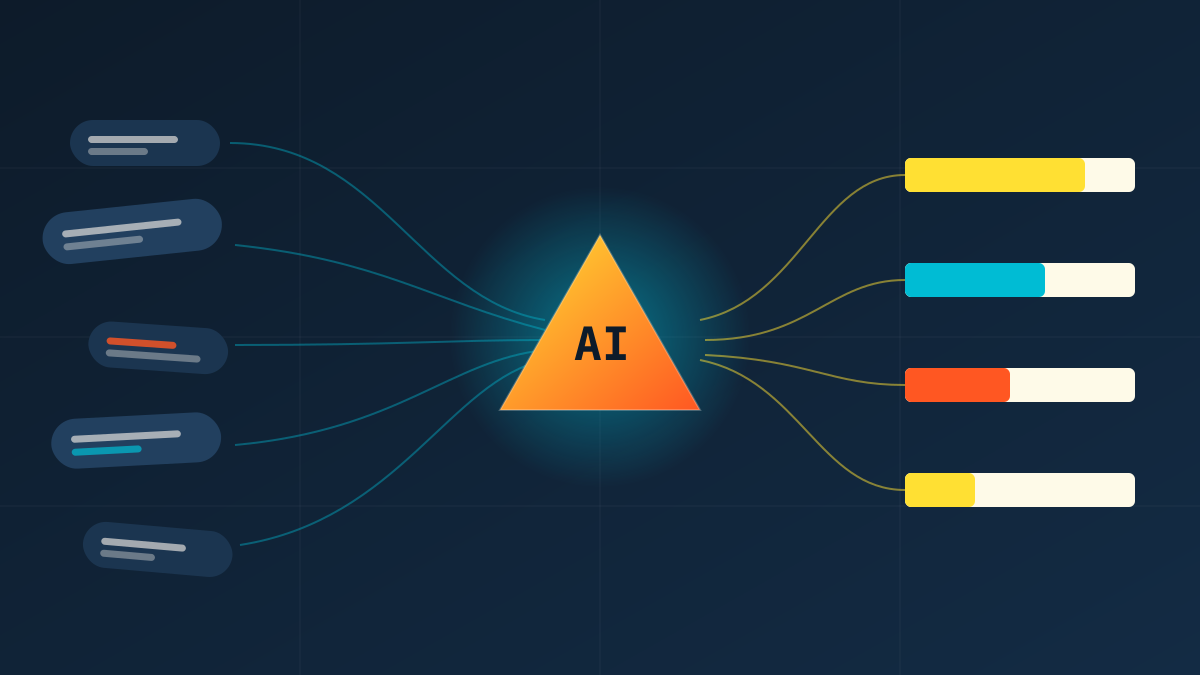
Somewhere right now, a customer is typing a one-star review, tagging a company in an angry post, and firing off a support ticket about the same broken feature. Three signals, three tools, and a decent chance that no one on the product team will ever connect them. That gap - between what customers say and what companies actually hear - is the entire business of Unwrap.
Unwrap is an AI customer intelligence platform. In plain terms: it plugs into the places where feedback piles up - app store reviews, Zendesk and Intercom tickets, survey responses, sales-call transcripts, Reddit, X, community forums - and reads all of it. Then it tags each piece, clusters the ones that are really saying the same thing, and ranks the themes by how often they come up and how much they seem to matter. A product manager opens a dashboard and sees, in order, the things customers keep asking for.
It is a boring-sounding job that almost no company does well, because doing it by hand is miserable. That misery is where the company started.
The Reddit problem that wouldn't go away
Co-founders Ryan Millner and Ashwin Singhania have been working together for about eleven years. They met at Graphiq, a semantic knowledge-graph startup that Amazon acquired in 2017 and folded into Alexa. There they led teams behind the system answering the majority of Alexa's question-and-answer queries - which meant they spent a lot of time trying to figure out what users actually wanted from a voice assistant.
Part of that job, it turned out, was reading. Every month, the two would sit down and pore over Reddit threads and review forums, hunting for the handful of comments that pointed to a real product problem. It worked, sort of. It also did not scale, and it was the kind of task that made two engineers stare at the ceiling and think there had to be a better way.
In 2022 they left Amazon to build the tool they'd wanted. Unwrap came out of AI2, the Seattle research institute founded by Microsoft co-founder Paul Allen, and raised roughly $3 million in seed funding to start. The bet was simple and, at the time, a little early: large language models had gotten good enough to read unstructured text at scale and pull out meaning. The most valuable data most companies own - the stuff their customers write in their own words - had always been too messy to use. That was about to change.
What the product actually does
The mechanics are the pitch. Feedback comes in from dozens of channels, in dozens of formats, all of it unstructured. Unwrap normalizes it, then applies what the company calls "zero-shot" tagging - the model surfaces themes without anyone first building a keyword list or a taxonomy. New issues get named as they emerge instead of being forced into last quarter's categories.
On top of the clustering sit the things that make it usable day to day: real-time alerts when a new issue starts trending, a feedback assistant you can ask questions in plain language, automated reports, and a live dashboard instead of a slide deck someone assembles once a quarter. The company likes to say the payoff is teams "saving 4+ hours per week" they used to spend tagging and summarizing by hand.
The channel mix is the quiet insight here. Surveys and NPS scores are still useful, but they only capture what you thought to ask. Most of what customers volunteer arrives everywhere else - and that "everywhere else" is exactly the pile that a human analyst can't keep up with.
Where customer feedback actually lives
Illustrative: the channels Unwrap ingests, ranked by how much unstructured feedback typically hides in each. Surveys are the smallest slice.
Why the incumbents don't quite cover it
Unwrap is walking into a crowded room. Pendo, Medallia, Sprig, Contentsquare, and research tools like Aurelius all touch some version of "listen to your users." The difference is where each one started, and starting points tend to stick.
| Player | Grew up as | Sweet spot |
|---|---|---|
| Sprig | In-product micro-surveys | Targeted questions at key moments |
| Pendo | Product analytics + guidance | All-in-one usage & in-app help |
| Contentsquare | Behavior analytics | What users did on the page |
| Medallia | Enterprise VoC | Omnichannel CX at scale |
| Unwrap | AI-native text analysis | Ranking the feedback you never asked for |
Most of these platforms bolted AI onto a survey or analytics engine they'd already built. Unwrap ran the order the other way: it started as an AI company that reads unstructured language, and treats the survey as one input among many. That framing is the whole argument. If you believe the richest feedback is the stuff customers write unprompted, you want a tool built to read it - not one built to send questionnaires that later learned to read.
The money, and who's behind it
In January 2025, Unwrap announced a $12 million Series A led by Scale Venture Partners, with Rory O'Driscoll joining the board. Atlassian Ventures, Cercano, ScOp, and AI2 joined, alongside a set of operator-angels who read like a reference list: David Singleton, the former Stripe CTO; Johnny Ho, a Perplexity co-founder; Karen Ng from HubSpot; and Tyler Schleich from Oura. That brings total funding to roughly $15 million.
The customer roster does more work than the cap table. Microsoft, Perplexity, Oura, Lyft, JetBlue, GitHub, DoorDash, and lululemon have all used Unwrap. It's a deliberately mixed bag - a hardware ring maker, an airline, an AI lab, a fitness brand - which is the point. The problem of "too much feedback, not enough reading" isn't specific to software. Any company with customers who type has it.
The bet underneath the pitch
Strip away the dashboards and Unwrap is making a wager about how product decisions get made. Today, a lot of them are guesses wearing the costume of data - a loud customer, a founder's hunch, the feature a competitor shipped. Unwrap's argument is that the honest version of that decision is a count: here is what customers said, here is how often, here is what it's worth to fix. Replace the guess with the count, and building the wrong thing starts to look expensive.
Millner puts the goal in softer language. "The vision is filling the world with products people love," he says, "and bringing these two groups of people closer together." The two groups being the people who build and the people who use. It's a nice line. The unglamorous machinery underneath it - deduping tickets, clustering complaints, ranking themes nobody had time to read - is what has to work for the line to mean anything.
Go deeper
unwrap.ai About Series A announcement Fortune coverage GeekWire (2022) LinkedIn CrunchbaseFAQ
What does Unwrap.ai do?
It's an AI customer intelligence platform that pulls unstructured feedback from support tickets, app reviews, surveys, social media, and sales calls, then automatically tags, groups, and prioritizes it so product teams can see what customers want and what to build next.
Who founded Unwrap and when?
Ryan Millner (CEO) and Ashwin Singhania (CTO) founded Unwrap in 2022. Both are former Amazon Alexa leaders who previously built Graphiq, which Amazon acquired in 2017.
How much has it raised?
About $15 million total - roughly $3 million in seed after the AI2 incubator, plus a $12 million Series A led by Scale Venture Partners announced in January 2025.
Who are its customers?
Publicly named customers include Microsoft, Perplexity, Oura, Lyft, JetBlue, GitHub, DoorDash, and lululemon.
How is it different from Pendo, Medallia, Sprig, or Contentsquare?
Those platforms grew up around surveys, in-app guidance, or behavioral analytics. Unwrap is AI-native and focused on unstructured text - the feedback customers volunteer across many channels rather than only what a survey asks - clustering and ranking it automatically.