accounting-software
(30)
SafeSend and the $600 million chase for a signature
The tax return was finished. The work wasn’t. SafeSend built a business around that awkward gap, then followed the paperwork all the way back to the beginning.
Gappify and the invoice that hasn’t arrived
The month ends. The bills do not. Gappify turns the awkward gap between work done and invoices received into an accounting workflow with a paper trail.
Progress ShareFile and the $875 Million Paper Chase
The file was never the whole problem. Progress ShareFile built a business around everything that happens before a document arrives, and after somebody clicks send.
EBizCharge and the work that starts after “paid”
A payment can arrive in seconds and still leave hours of accounting behind it. EBizCharge has built a business around closing that awkward little gap.

Trullion and the Number That Wouldn’t Explain Itself
A lease can hide the fact an accountant needs on page 73. Trullion’s bet is that software should find it, calculate the consequence, and keep the evidence close enough for an auditor to argue back.

Capsitech wants to put the back office on speaking terms
From accounting software to a technology institute in Jodhpur, Capsitech is building around one stubborn business problem: the work that falls between people, systems and skills.
Dayshape wants to put your staffing plan on the money
The Edinburgh software company connects who does the work with what the work earns. Its customers reveal why the hard part of AI scheduling is often getting people to change their habits.
Dext built a business on the receipts nobody wants to type
Receipt Bank grew by tackling the drudgery before the ledger. Now part of IRIS, Dext is expanding into data checks, AI assistance and payments - with a business case that still comes down to minutes saved.
AffiniPay Found a $20 Billion Business Hiding in the Lawyer's Trust Account
A lawyer's payment is not just a payment. AffiniPay turned that fussy distinction into LawPay, then bought its way from the checkout page into the daily machinery of 245,000 professional firms.
ProfitSolv Bought the Boring Software That Keeps Professional Firms Alive - Then Added Payments
The private-equity-backed company assembled a shelf of legal and accounting software, kept the specialist brands, and built payments into the daily work. Its bet: the least glamorous screen in a firm may be the most valuable one.

Enumerate Is Turning the HOA Back Office Into One Big, Boring Advantage
HOA work is a thicket of invoices, late dues, board questions and bounced emails. Enumerate's bet is that the winner will be the company boring enough to connect every last one of them.

Karbon’s $59-a-Month Bet: Turn Your Accounting Firm’s Inbox Into an Operating System
Accounting firms lose hours in the seams between inboxes, checklists and billing systems. Karbon’s answer is a shared operating layer - powerful when a firm standardizes its work, pricey when it does not.
SWK Technologies Wants to Make the Back Office Disappear
For growing companies stuck between QuickBooks and enterprise-scale complexity, SWK sells something more useful than another dashboard: a way to make finance, inventory, operations and IT behave like one system.
Mazeed Wants to Be the Finance Department in Every Small Business Owner's Pocket
The Dubai fintech is betting that Gulf businesses do not want another blank accounting dashboard. They want software that knows the rules - and a human expert when the rules get complicated.
Sage
Sage grew from a pub-side solution for one printer's paperwork into financial infrastructure for millions of businesses. Its next act is less about replacing the accountant than teaching software to chase invoices, explain anomalies and show its working.
AccountMate Software Corporation
AccountMate has spent four decades betting that the awkward parts of a business should shape its software - not be sanded away by it. In a cloud-first ERP market, that old-fashioned flexibility looks unexpectedly current.

Cone
Cone is a YC S22 B2B SaaS company building an AI-powered work operating system for accounting and professional service firms. It unifies proposals, engagement letters, billing, payments, project management and client engagement into one platform so firms can go from proposal to payment without stitching together separate tools.

Swipe
Swipe is a Hyderabad-based billing and accounting app that lets India's small and medium businesses create GST-compliant invoices in seconds, share them over WhatsApp with instant payment links, and manage inventory, purchases and tax filing from one place. Backed by Y Combinator (S21), it targets the roughly 75 million SMEs that still run on paper ledgers and spreadsheets.

Mekari
Mekari is Indonesia's leading business software company, offering a unified SaaS ecosystem that helps companies run HR, payroll, accounting, CRM, expenses, and digital signing on a single connected platform. Formed in 2019 from the merger of Sleekr, Talenta, Jurnal, and Klikpajak, Mekari now serves roughly 300,000 businesses and more than a million users across the country, positioning itself as the operating backbone for Indonesian SMBs and enterprises going digital.

Qoyod - قيود
Qoyod is a Riyadh-based cloud accounting and e-invoicing platform built for the Saudi market. Founded in 2016 by Abdullah AlDayel, it lets small and medium businesses issue invoices, track expenses, manage inventory and stay compliant with ZATCA (Fatoora) e-invoicing rules - without needing formal accounting expertise. It bundles accounting, point-of-sale and tax compliance into one Arabic-first, locally hosted system now used by tens of thousands of Saudi businesses.

Rewaa
Rewaa is a Riyadh-based retail technology company that builds a cloud-based operating platform for small and medium retailers, unifying point-of-sale, inventory management, accounting and ZATCA-compliant e-invoicing in a single dashboard. Founded in 2018, it synchronizes physical stores and online sales channels in real time and has grown to serve more than 23,000 active merchants across Saudi Arabia and the wider region. Rewaa raised the largest Series A for a SaaS company in MENA ($27M in 2023) and followed with a $45M Series B in late 2025 to expand its AI-driven automation tools.
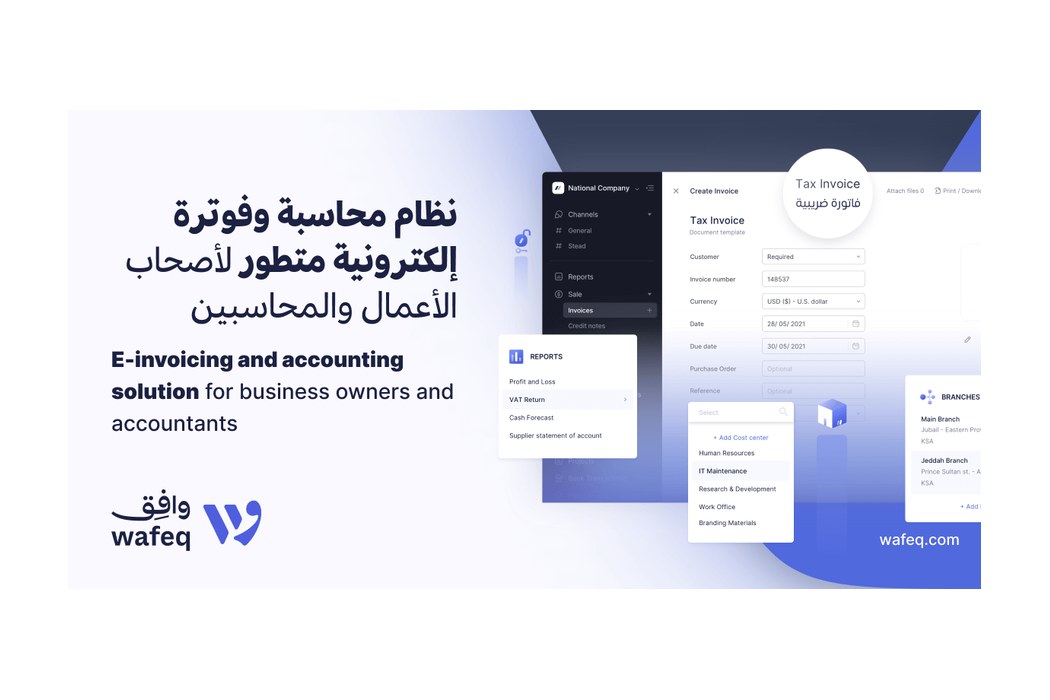
Wafeq وافِق
Wafeq is a cloud accounting and e-invoicing platform built for small and medium businesses across Saudi Arabia and the UAE. Founded in 2019 by Nadim Alameddine, it gives SMEs and accounting firms ZATCA- and FTA-compliant invoicing, VAT and corporate tax reporting, payroll, inventory, and 40+ financial reports in one Arabic-and-English interface. The platform processes roughly 2 million invoices worth about $400 million every month and serves more than 10,000 customers, with the vast majority of activity in Saudi Arabia.

Lili
Lili is a New York-based financial technology company that runs an all-in-one business banking platform for small businesses. It bundles a fee-free business checking account with built-in accounting, expense management, invoicing, automated tax savings and high-yield savings - collapsing tools that owners would otherwise stitch together. Founded in 2018 by Lilac Bar David and Liran Zelkha, Lili started serving freelancers and solopreneurs and has since repositioned toward growing, multi-employee small businesses. Banking services are provided through partner bank Sunrise Banks, N.A., Member FDIC.

Intuit
Intuit is a global financial technology company that builds software to help consumers and small businesses manage money, taxes and growth. Founded in 1983 around Quicken, it now runs four flagship platforms - TurboTax for tax filing, QuickBooks for small business accounting, Credit Karma for consumer credit and finance, and Mailchimp for marketing - reaching roughly 100 million customers worldwide. In 2026 the company is rebuilding its products around an AI-driven expert platform anchored by Intuit Assist, its generative-AI financial assistant.
Sage Group
Sage Group is a British multinational software company based in Newcastle upon Tyne that builds cloud-based accounting, payroll, HR and ERP tools for small and medium-sized businesses. Founded in 1981 and listed on the London Stock Exchange as a FTSE 100 constituent, Sage serves millions of customers across 23 countries with products spanning Sage Accounting, Sage 50, Sage Intacct and the AI assistant Sage Copilot.

Ignition
Ignition, founded in Sydney in 2013 as Practice Ignition, is a revenue and billing automation platform for accounting firms, bookkeepers, and professional-services businesses. It combines digital proposals, engagement letters, automated invoicing, and integrated payments into one system so firms can win clients, get paid on time, and reduce scope creep. More than 7,500 businesses use Ignition, and customers processed roughly $3.1 billion through the platform in 2025.

Numeric
Numeric is a San Francisco-based, AI-native accounting platform that automates the month-end close for controllers, CFOs and senior accountants. Founded in 2020 by Parker Gilbert, Anthony Alvernaz and Andrew Bihl, it unifies close management, analytics and cash reconciliation into one system, using AI to draft flux (variance) explanations, reconcile accounts and flag anomalies in transaction data. Companies including Brex, Plaid, Wealthfront, OpenAI and Betterment use Numeric to close their books faster and with fewer manual steps. The company has raised roughly $89 million to date, capped by a $51 million Series B in November 2025.

Rillet
Rillet is an AI-native ERP built by accountants that automates the month-end close, recognizes revenue in real time, and surfaces SaaS metrics directly from the general ledger. Founded by former N26 US CEO Nicolas Kopp and CTO Stelios Modes, the San Francisco company positions itself as a modern replacement for legacy systems like NetSuite and QuickBooks, letting finance teams close their books in days instead of weeks. Backed by Sequoia, Andreessen Horowitz, and ICONIQ, Rillet has raised over $100M and serves 500+ scaling companies.

Studio Designer
Studio Designer is the interior design industry's leading business management platform, combining project management, product sourcing, branded proposals, payments, and designer-specific accounting in one system. Founded in 1985 and based in Los Angeles, it serves 20,000+ designers who run roughly $5 billion in annual orders through the software. Backed by Serent Capital since 2022, the company has expanded through the acquisitions of DesignDocs (2023) and Mydoma (2024) to support design firms at every stage of growth.

Xero
Xero is a cloud-based accounting software company founded in Wellington, New Zealand in 2006. It serves more than 4.4 million subscribers - mostly small businesses and the accountants and bookkeepers who advise them - across New Zealand, Australia, the UK, the US and beyond. Xero connects bank feeds, invoicing, payroll, expense tracking and a marketplace of thousands of third-party apps into a single real-time platform, and reported NZ$2.1 billion in revenue in FY25.