The modern accounting firm has a peculiar problem: the numbers may be reconciled while the work around them is not. A client’s promise sits in one partner’s inbox. A deadline lives on a spreadsheet. A reviewer is waiting for a document nobody realized had arrived. Then, weeks after the work is finished, someone remembers to send the invoice. Karbon built a company around this unglamorous space between message and money.
Founded in 2014 by John Freeman, Stuart McLeod and Ian Vacin, Karbon makes cloud practice-management software for accountants, bookkeepers and tax professionals. The product gathers shared email, contacts, recurring work, tasks, client requests, documents, time, budgets, invoices, payments and reporting into one workspace. In March 2026, it added broadly available AI summaries that can draw on the same operational context.
That distinction matters. QuickBooks and Xero record financial reality. Karbon tries to record the human choreography required to produce it. The company says more than 30,000 accounting professionals use the platform. Its public pricing begins at $59 per user each month when paid annually. The proposition is not cheap task management. It is fewer dropped handoffs, faster billing and a firm whose memory does not disappear when Karen takes Friday off.
01 / The wedgeThe inbox was the first broken machine
Generic project software can tell an accountant that a tax return is “in progress.” It usually cannot explain that the return is waiting because a client replied to a private email with the missing file, or that another teammate already promised a Tuesday delivery. Karbon’s Triage feature makes email a team object: colleagues can assign, comment on and connect messages to clients and work.
This was the early failure Karbon saw, and its customer stories repeat it with comic consistency. CENTaccounting lacked visibility across a distributed team. Sadler Accounting was trying to manage work through Outlook, paper and private client conversations. Information did not vanish spectacularly; it hid politely. The first thing to fail was shared context.
The platform’s practical trick is to keep the chain visible. A recurring workflow creates work from a template. Tasks receive owners and due dates. Automatic reminders chase clients. Files and notes stay attached to the client timeline. Time can feed budgets and invoices. Managers view work in dashboards instead of conducting a small oral history every morning.
“Karbon is the glue that holds everything together. It’s the central piece and everything stems from it.”Steph Hinds, Growthwise - Karbon’s first paying customer
02 / The originThey sold the promise before the pixels
Karbon’s founders began in a San Francisco cafe with no product, logo or even a name. They did have a specific belief: accountants deserved software designed around how firms actually coordinate. Growthwise founder Steph Hinds became the first paying customer while the product was still largely a promise. A decade later, she was still describing it as the firm’s central piece.
What changed the founders’ minds was not a failed horizontal app or a theatrical pivot. It was proximity to a profession that had been asked to improvise with email and general-purpose tools. Karbon’s roadmap followed the job outward. Workflow led to client collaboration and document requests; work data led to time, capacity and reporting; completed work led to billing and payments. The expansion is a classic vertical SaaS move: start with one daily pain, then follow the customer’s process until more of the business runs through you.

03 / The billWhat it costs - before implementation eats Tuesday
Karbon’s Team plan lists at $59 per user per month on an annual commitment, or $79 paid monthly. Business, its most popular tier, is $89 annually or $99 monthly. Enterprise pricing is negotiated. A 10-person firm therefore spends $7,080 a year for Team or $10,680 for Business before paid implementation, add-ons, e-signature credits and transaction fees. Card and ACH processing carry separate charges.
The real cost includes decisions. Someone must map work, clean contact data, choose statuses, build templates, define who owns what and teach people to stop keeping the “real” process in their heads. Karbon provides group onboarding and paid guided implementation, which is an implicit admission of a healthy truth: a practice-management system is partly an organizational redesign wearing a login screen.
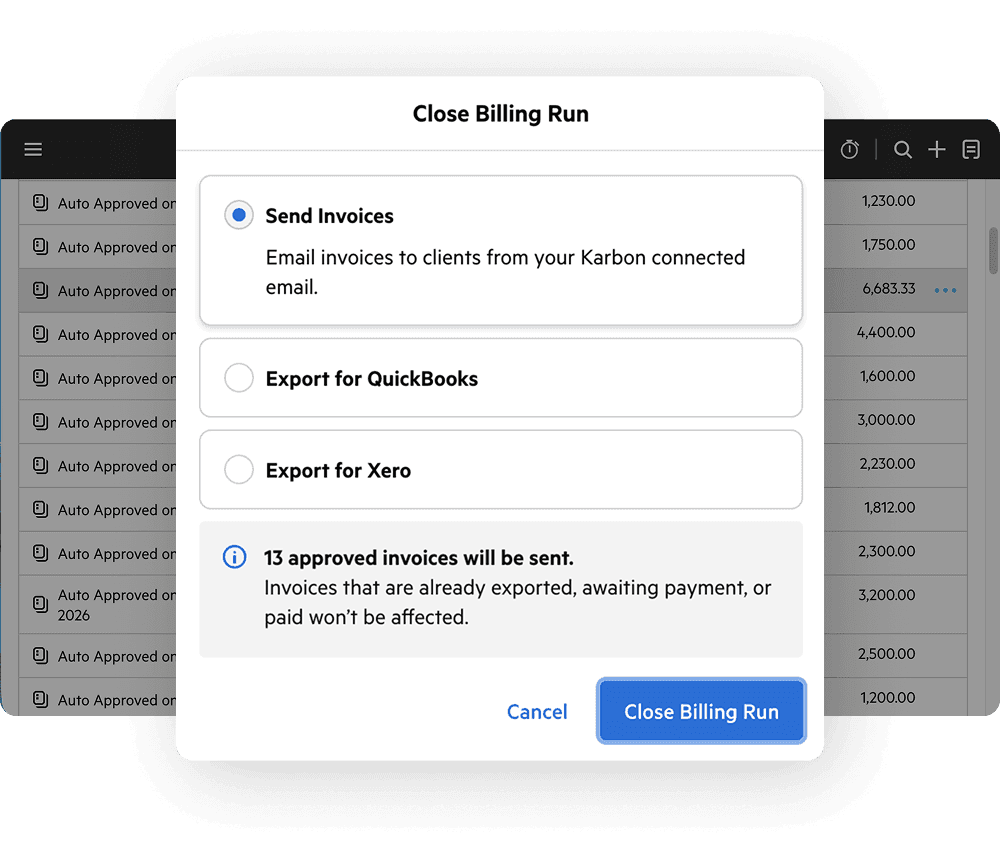
Karbon says its 2024 customer research found an average saving of 18.5 hours per employee each week, based on responses representing 15 percent of its customer base. That is a company-produced result, so buyers should treat it as a testable hypothesis, not a universal law. Individual case studies are more concrete but equally specific: CENTaccounting reports saving five and a half hours a day across the firm; Sadler Accounting says it saves two hours and fifteen minutes a day; DigitPro reports eight hours a week firm-wide.
04 / The differenceAn operating layer, not an everything app
Karbon competes with Canopy, TaxDome, Financial Cents, Jetpack Workflow, FYI and a long tail of accounting-specific tools. It also competes with the home-built stack: Outlook plus Excel plus Asana plus the partner who remembers everything. Karbon is typically strongest when email and team collaboration sit at the center of the bottleneck. Tax-first suites may go deeper on organizers, IRS transcripts or document-heavy delivery. Lightweight workflow products can be easier on a tiny firm’s budget.
Its most interesting strategic choice is restraint. Karbon says the average accounting firm uses 14 pieces of technology, and it does not pretend to replace all of them. Instead, the platform offers more than 80 integrations. Xero connects financial and invoicing data. Gusto can create recurring payroll work and synchronize due dates. Float handles capacity planning. Cognito Forms feeds onboarding. Dext, Jump, FinOptimal, FuseSign, Filed and other partners move specialist work into the shared timeline.
This ecosystem turns fragmentation from an enemy into a reason to buy the coordination layer. It also creates risk. An integration can be shallower than a buyer expects, and a firm can still end up tab-hopping. The right demo question is not “Do you integrate with X?” It is “Show me exactly which object moves, in which direction, and what my employee still has to copy.”
05 / The AI chapterContext first, model second
Karbon AI became available to all customers in March 2026. It summarizes a client across emails, notes, work items and billing data; condenses work conversations; and distills email threads. Karbon says general-availability processing stays in the region where customer data is stored. For firms handling sensitive financial information, that data-residency detail is more consequential than a shimmering “summarize” button.
The AI strategy is credible because the platform already owns context. A generic assistant can summarize a message. Karbon can, in principle, summarize the message beside the job, client, deadline and money attached to it. The useful output is not prettier prose. It is a faster answer to “What is blocked, who promised what, and what should happen next?” The limitation is equally plain: if the firm’s data is incomplete or employees continue working off-platform, the summary becomes a confident tour of half the room.
Software can expose a workflow. It cannot make a team agree on one.The implementation rule buyers should print above the coffee machine
06 / The stealWhat another operator can copy
First, look for coordination debt, not merely an old database. The best wedge may be the handoff people repeat all day: forwarding, checking, asking, reminding. Second, attach communication to the object of work. A message is far more valuable when it travels with the client, task and deadline. Third, package expertise. Karbon’s hundreds of workflow templates reduce the terror of a blank workspace and turn industry knowledge into product.
Fourth, expand along the customer’s cash cycle. Once Karbon knew work status and time, billing was adjacent rather than random. Fifth, build an ecosystem where specialists already exist. The platform can become more central without rebuilding payroll, ledgers, resource planning and every tax utility. Finally, make customer results legible. The firm that saved five hours a day tells a better story than a grid with 147 green checkmarks.
A buyer can borrow a smaller version of the same playbook. Pick one recurring engagement - monthly close, payroll or a tax return. Map every input, owner, exception, client request and approval. Run it with real clients during the trial. Measure time spent chasing, rework, days to delivery and days from completion to invoice. Only then migrate the next service. A workflow suite should earn the right to become the operating system.
It works when
- Several people touch each client
- Services repeat often enough to template
- Email visibility is a genuine bottleneck
- One owner has authority to redesign the process
It breaks when
- A solo firm only needs a checklist
- Every job is treated as a special snowflake
- The team keeps truth in private tools
- Specialized tax or document depth matters more than collaboration
07 / The marketThe middle layer becomes the valuable layer
Karbon sits in a useful market position. It is more specific than Asana or ClickUp, more collaborative than many legacy practice tools, and broad enough to touch revenue without becoming the general ledger. Its 2022 Series B of up to $66 million, led by Tidemark with participation from Five Elms, funded expansion across product, customer success and international markets. Mary Delaney now leads the company as CEO, while Freeman and Vacin remain on its published leadership team.
The company’s bet is that accounting’s labor shortage makes coordination software more valuable. If fewer professionals must serve more clients, the invisible minutes matter: searching for a reply, recreating context, chasing a signature, discovering unbilled work. Karbon does not eliminate those tasks by decree. It gives a disciplined firm one place to see and automate them.
That last condition is the whole story. Karbon can turn the inbox into an operating system, but only if the firm is willing to operate from it. For the right team, $59 a seat is a lever. For the wrong one, it is a handsome new address for the same old mess.