At Brex, the vendor list grew until an ordinary accounting habit became an unreasonable one. People were sending confirmation emails, gathering replies and consolidating them in Excel. Each additional vendor meant another small chase. Kevin Moore, the controller quoted in Gappify’s published case study, described the verdict plainly: the process was no longer scalable. The trouble arrived before the journal entry.
- The job: account for expenses whose invoices have not yet arrived.
- The method: gather confirmations, compare evidence, review estimates, post supported entries.
- The stakes: Brex reported a three-day shorter SG&A close; GoodRx reported six days off its close, with accrual automation a critical factor.
Gappify is built around that chase. Its cloud software serves corporate accounting teams caught between two clocks: the date a business incurs an expense and the date a supplier sends the bill. Those clocks seldom display the same time. Month-end, with its splendid indifference to everyone’s inbox, arrives anyway.
The bill is late. The expense is punctual.
Consider a simple illustration. A supplier finishes work in September and invoices in October. September’s accounting still needs to reflect the work. An accrual records the expense and associated liability before the invoice is processed. Someone must establish what happened, estimate the amount and preserve enough support for a reviewer to understand the decision.
That sounds like arithmetic. Much of it is correspondence. The supplier knows one part of the story; the purchase-order owner knows another; the finance system contains a third. A capable accountant can assemble them. Repeat the exercise across a long vendor list, however, and professional judgment becomes entangled with reminders, downloads and copy-and-paste.
Gappify’s Accrual Cloud makes those handoffs repeatable. It schedules requests to vendors and internal owners, sends reminders, captures replies and brings estimates into a shared review process. It also supports straight-line, historical-average and percentage-of-completion calculations using data from existing systems. Reviewers can compare proposed amounts with current activity, prior periods and budgets before journal entries reach the ERP.
- 01GatherPOs, actuals and confirmations
- 02TestCalculate and compare estimates
- 03ReviewResolve exceptions and approve
- 04PostJournal entry plus supporting history
The software after the software
Founder Jotham Ty knew the peculiar disappointment of a modernized finance department that still had old chores. In a 2022 interview published by investor Rally Ventures, he described leaving KPMG in 2004 and starting a practice focused on Sarbanes-Oxley compliance. The practice later helped multinational companies improve their technology stacks. Yet clients continued asking for help with low-value accounting tasks after adopting cloud software.
The automation gaps prompted him to start Gappify, founded in 2016. Its original approach followed the actions accountants already performed. In 2017, the company introduced Alan, a bot intended to handle mechanical tasks across accounting functions. The name had the reassuring ordinariness of a colleague who might remember to chase a missing reference.
Today the commercial pitch centers on accruals. The distinction matters: Gappify occupies a specific stretch of the close, connecting evidence collection to review and posting. Its expertise comes from treating the accountant’s actual sequence of work as a product problem. Installing a ledger leaves plenty of room for that kind of specialist.
“sending confirmation emails manually and consolidating responses in excel workbooks was no longer a scalable solution.”
Kevin Moore, Controller, Brex
Company-published customer case study
What changed at Brex and GoodRx
Brex used Gappify for internal purchase-order accruals, vendor confirmations and posting accrual journal entries into NetSuite. Its case study lists NetSuite and Coupa among its systems. Moore highlighted the ability to preview the financial impact before posting, reducing questions and rework. The reported result was a three-day reduction in the monthly selling, general and administrative expense close.
GoodRx described a different pressure. Revenue and vendor volume were doubling each year, according to its customer account, and IPO preparation exposed the limits of manual processes. Its close took 15 days. Accounting had to get faster and more accurate while keeping controls intact. Accruals emerged as a major roadblock.
GoodRx’s published account attributes a six-day close reduction to a broader improvement in which automated accruals were essential. It also reports doubling the accruals captured each month without additional effort. The lesson is about coverage as much as speed. A quicker process that gathers too little evidence would merely deliver an incomplete answer sooner.
An estimate needs a memory
Accounting software has to remember how a number came into existence. Gappify’s control features capture confirmation responses, timestamps, edit history and reviewer comments. Access roles distinguish preparers from reviewers and restrict available actions. The company describes its service as SOC 1 and SOC 2 certified. These features support a controlled process; accounting teams still decide how to use it.
That makes the audit trail a working part of the product. When someone asks why an expense appeared in a particular period, the supporting history needs to survive the person who booked it being on vacation. A well-kept record is a kindness to one’s future colleagues, who otherwise inherit an amount and a mystery.
AI, with the working attached
Gappify now markets AI Accruals, which draws together signals such as unapproved invoices, calculations and historical patterns to propose estimates. It presents confidence scores and supporting rationale so teams can prioritize review. The useful question is whether a reviewer can follow the recommendation back to its evidence.

AI Vendor Anomaly Detection tackles another chore: investigating unusual activity. It compares the current period with historical patterns and purchase-order information, then uses invoice patterns and service dates to help explain variances. Insights adds visibility into spending trends, confirmation response rates and purchase-order compliance, including invoices without POs or linked to POs retroactively.
The current leadership page lists Rahul Somani as interim CEO. Previously Gappify’s EVP of Product and Engineering, he helped build its vendor accrual technology and brings experience from Google and Responsys. The emphasis on AI accompanies an existing accounting workflow, with evidence and review still at its center.
A specialist has to connect
Gappify’s customers are mid-market and enterprise accounting teams; published material also includes Puma Biotechnology, Contentful, Planful and Khoros. Its route to those teams combines software with partners. CFGI’s August 2023 agreement pairs Accrual Cloud with accounting advisory expertise, highlighting life sciences and pre-IPO controls. Zanovoy supports implementations. An October 2025 Alluvia partnership expands the routes into accounting and source systems.
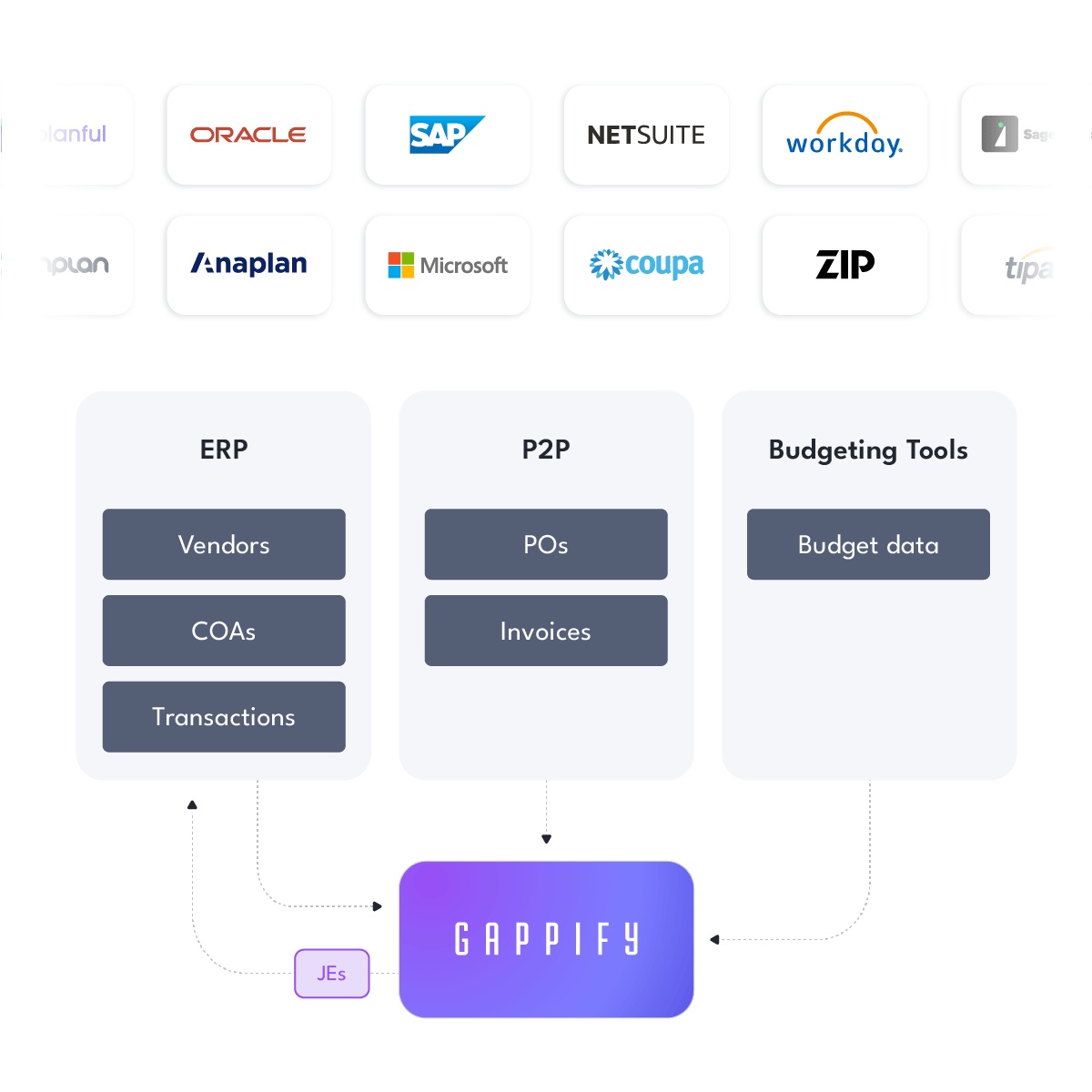
Investors supplied capital for the effort: a $6 million Series A led by Rally Ventures in December 2021, followed by a $10 million Series B led by FINTOP Capital in May 2023. The latter announcement put total funding above $22 million. This is a demo-led enterprise software business; buyers discuss pricing and implementation with the sales team.
Its alternatives include the incumbent email-and-spreadsheet process, custom ERP workflows and broader accounting platforms. BlackLine’s Verity Accruals, for example, also markets third-party confirmations, calculations and draft journal entries. Gappify’s case rests on its focused accrual workflow and customer evidence. A buyer should compare the actual handoffs, controls and system connections each option supports.
Copy the sequence before buying the speed
My practical reading of these customer stories is to map the chase first. Identify the expense population, decide whose confirmation counts, define the estimation method, assign the reviewer and keep the support beside the posting decision. Then measure response coverage, adjustments and time spent. Those habits are available to a team with a spreadsheet as well as one buying software.
The same reasoning sets limits. Automation needs usable inputs and people who can resolve business questions. A sparse vendor population may offer fewer repetitive tasks to remove. An inaccessible source system or an ambiguous approval rule requires work before a faster workflow helps. These are implementation judgments, rather than claims about a particular customer’s outcome.
Gappify’s appeal is easiest to see in the space between two documents: the evidence that work happened and the invoice that eventually confirms the bill. Organizing that space gives accountants something better to do with month-end than keep asking the same question.
Follow the work
Explore the company, its customer accounts and conversations about accounting automation.