The first person who needs Puzzle is not an accountant. It is the founder who has three bank accounts, two cards, Stripe, payroll, and a recurring suspicion that the burn number in last month’s spreadsheet belongs to a different company. Puzzle pulls those feeds into a live general ledger, keeps cash and accrual books, and makes financial statements behave more like a dashboard than a postcard from the past.
The second person who needs it is the accountant serving that founder. Puzzle’s current pitch is less about replacing professional judgment than packaging the repetitive work around it. Transactions are drafted into categories, accounts are reconciled, exceptions are surfaced, and journal entries are prepared. A human reviews the evidence and approves the result. That approval button is the most important feature in the product.
Puzzle now calls this combination AI-powered, human-led accounting. The wording has earned its keep. In a field where one confident error can leak into a balance sheet, a tax return, and a fundraising conversation, automation without a named reviewer is merely a faster way to become unpopular.
Who should put their books in this box?
Puzzle is most persuasive for a US startup or small business already living in the modern finance stack. Stripe billing, Brex or Ramp cards, Mercury banking, Gusto or Rippling payroll, Deel contractors, and bank feeds through Plaid are its native habitat. Connect the accounts and the ledger begins receiving the context that old-fashioned CSV imports flatten out: vendor detail, receipts, payroll lines, invoice metadata, and the relationships between transfers.
That makes it useful for a first-time founder who wants runway and burn in plain sight, a finance lead who needs accrual schedules without maintaining another spreadsheet, and a bookkeeping firm that wants one review queue across many clients. Puzzle says it can support businesses through roughly $35 million in annual revenue. The practical ceiling will depend less on revenue than on complexity. A $2 million software company with Stripe can be an easier book than a $700,000 retailer with inventory, sales-tax obligations, and several entities.
Do the boring trial first. Import a closed month. Reconcile every bank and card balance. Rebuild one prepaid, one fixed asset, one payroll run, and one awkward revenue contract. Then hand the reports to the person who files your return. A glossy burn chart cannot compensate for a missing workflow.
The trick is that the ledger stays awake
Traditional small-business accounting often runs in batches. Data piles up, a bookkeeper cleans it, and management sees the answer days or weeks later. Puzzle was designed as a streaming financial-data platform attached to its own general ledger. The distinction sounds architectural; its everyday effect is emotional. The number on the screen is intended to be usable now.
From that foundation, Puzzle calculates cash, burn, runway, margins, ARR and MRR, churn, spend, and revenue schedules. It can maintain deferred and accrued revenue from Stripe subscriptions, track prepaids, manage fixed-asset depreciation, and draft financial statements. The same underlying transactions can be drilled into from a high-level chart rather than exported into a spreadsheet for detective work.
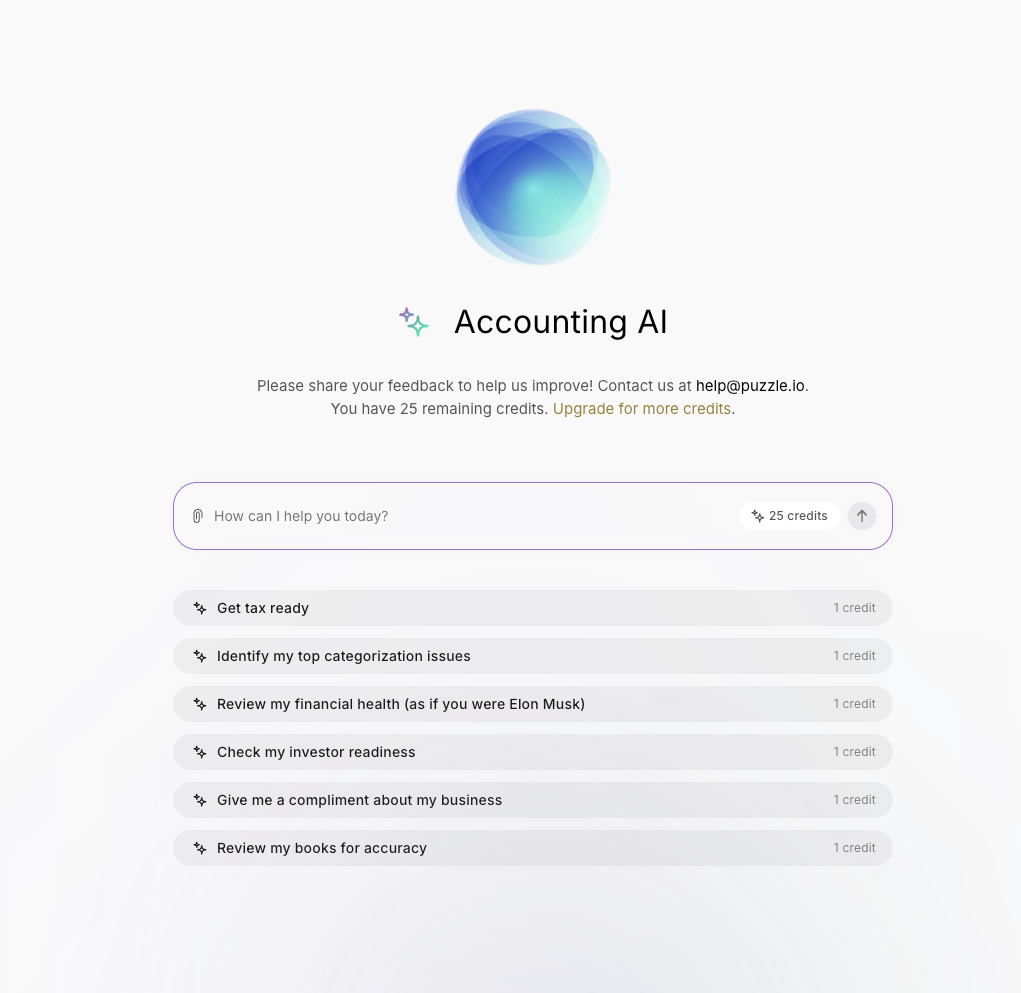
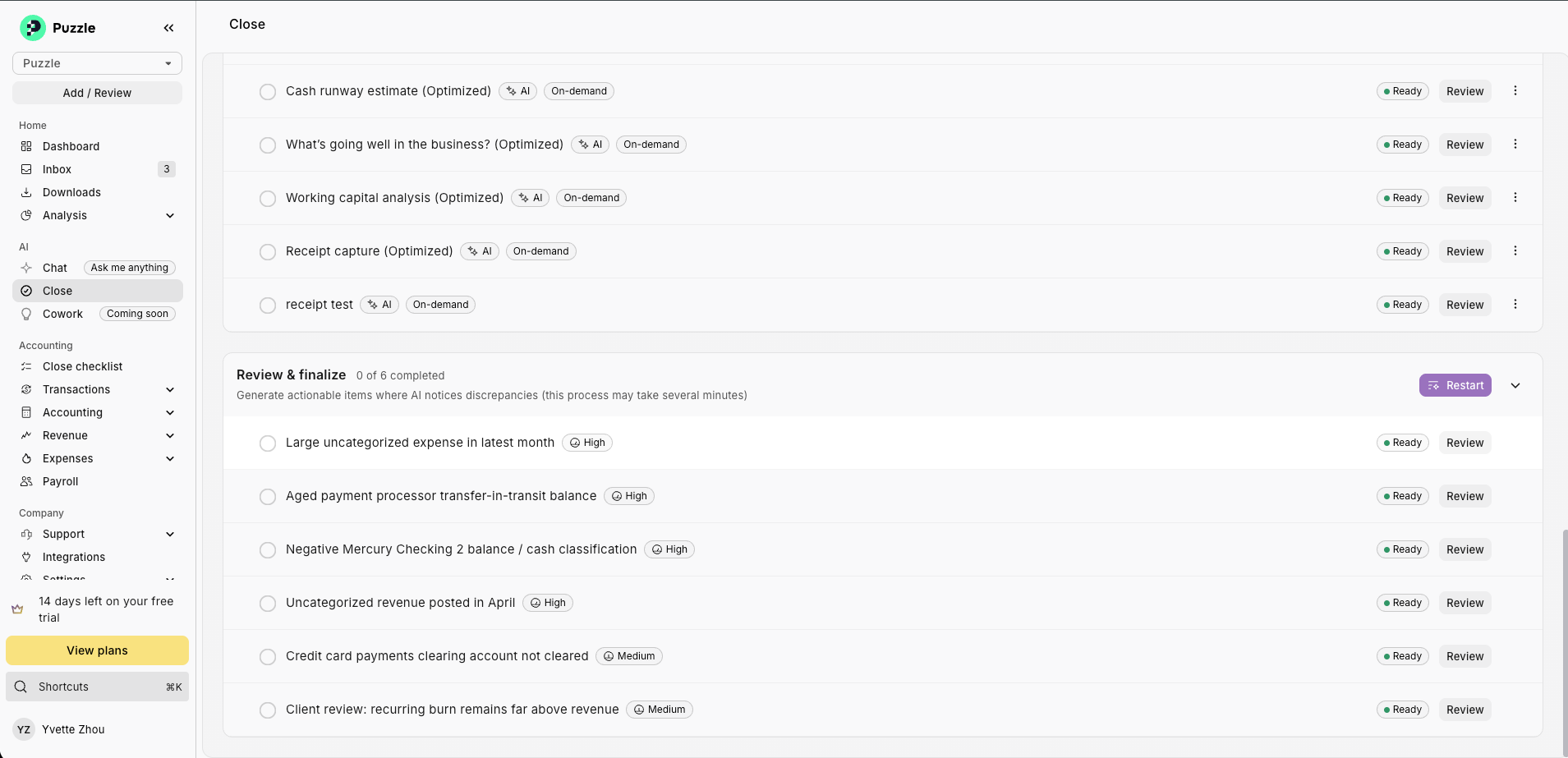
AI Close extends that logic across month-end. An accounting firm describes its workflow in ordinary language. Puzzle turns the steps into tasks for categorization, reconciliation, accruals, anomaly checks, and variance explanations. The agent runs the work, stops at review points, and records what it did. Puzzle’s Accuracy Reviews scan the ledger and point back to affected accounts and source transactions. Nothing posts through this workflow without sign-off.
“I could use Puzzle to change a category in a transaction without watching a single video.”Dr. Lindsay Padilla, Hello Audio, in a Puzzle customer testimonial
A clean interface meets messy reality
Customers repeatedly praise the interface. One bookkeeper on Reddit called Puzzle “a rare gem in a sea of bad software.” Another user singled out the smooth Stripe connection. Puzzle’s own testimonials focus on founders finding reports, changing categories, and seeing burn without learning the dialect of QuickBooks first. This is not trivial. Accounting software is often designed as if discomfort proves seriousness.
The criticism is equally useful. A small-business user reported gaps around specialist depreciation schedules and difficulty deleting a journal entry, along with slow support on that case. A bookkeeping discussion warned against trusting any AI categorizer without review. These comments are anecdotal, but they point to the correct buying question: does Puzzle handle your ugly transaction, correction, and compliance edge case?
Where Puzzle fits
- US startups on Stripe and modern fintech
- Founders who need daily cash and runway
- Firms managing many startup clients
- Books with recurring accrual workflows
- Teams willing to review AI drafts
Test before moving
- Inventory-heavy or highly bespoke books
- International statutory accounting
- Complex consolidations and ERP controls
- Unusual tax depreciation requirements
- Workflows dependent on niche integrations
Puzzle is SOC 2 compliant, according to the company, and says data is encrypted in transit and at rest with role-based access and audit trails. It also says it does not sell user data and allows exports or deletion. Those are table stakes for financial records, not decorations. Buyers should still request the current security packet, confirm retention rules, and map which outside service partners can see the books.
The price card has a plot twist
Puzzle advertises a 14-day trial and annual plans with introductory discounts. Starter lists at $25 a month after two free months. Core is $60, Complete is $100, and Scale is $300, all when billed annually. The page currently displays discounted first-three-month equivalents of $30, $50, and $150 for the latter plans. Monthly billing is higher. Accounting-firm pricing is custom.
| Plan | Annual list price | Best read on the buyer | AI allowance |
|---|---|---|---|
| Starter | $25/mo after 2 free months | One user, first set of books | 25 lifetime credits |
| Core | $60/mo | Five-user QuickBooks alternative | 25 lifetime credits |
| Complete | $100/mo | Accruals, reviews, unlimited users | 100/month |
| Scale | $300/mo | High-volume books and API access | 300/month |
The credit system deserves a calculator. AI Chat, Cowork, and Close actions consume credits, and AI Close is listed as an add-on. Extra credits cost $25 for 40, $50 for 100, or $100 for 250; purchased credits do not expire. Add the cost of an outside accountant, tax work, and any implementation help. Puzzle itself does not provide those professional services. It matches customers with vetted partners who do.
Puzzle 2.0 changes the company, not your login
Puzzle was founded in 2019 by Sasha Orloff and John Cwikla, then launched publicly in February 2023 with a $15 million Series A led by General Catalyst. Nine months later it announced another $30 million led by S32 and XYZ Capital. The early product was unapologetically for venture-backed startups. Partnerships with Decimal, Brex, Deel, and accounting firms gradually widened the aperture.

On September 2, 2026, the company announced Puzzle 2.0. Ozgur Uzuner became CEO and Jason Mitchell became CTO. Orloff moved to Accrual full time while remaining on Puzzle’s board; Cwikla moved into an advisory role. The new thesis joins software with a more structured network of accounting firms, clearer service packages, and customer matching. Existing accounts, pricing, data, and support contacts were said to remain unchanged.
This is a reasonable correction to a software-only fantasy. Businesses rarely want categorized transactions for their own sake. They want someone credible to explain cash flow, sign off on the close, prepare the return, and answer when a number looks strange. The risk is coordination: software experience and service quality now have to feel like one product even when separate companies deliver them.
The verdict: buy the workflow, not the acronym
Puzzle is a thoughtful alternative to QuickBooks for a particular kind of company: digitally native, US-centered, integration-friendly, and impatient with month-old information. Its ledger, operational metrics, accrual schedules, and close tools live together. The interface asks founders to understand the business, not become amateur accountants. For firms, the value is capacity: less data entry and a clearer path from preparation to review.
Do not buy it because “AI-native” sounds inevitable. Buy it if the connected data is better, the close is measurably shorter, your accountant can trace every proposed entry, and your difficult month reconciles cleanly. Keep an eye on credits, service fees, specialist requirements, and correction workflows. Puzzle’s best idea is also the standard it should be held to: software can do the legwork, but somebody competent must own the answer.