- Quanta is both the accounting system and the team running it for growing software companies.
- Its own ledger keeps reconciliations, policies, source data, and human decisions attached to each number.
- Prism lets finance teams question that reconciled record in plain language and trace the answer back.
- Public pricing starts at $250 a month for pre-revenue companies and $500 for the Early Stage plan.
There is a peculiar ritual at the end of every month. A company that ships code every hour, watches customers by the minute, and measures servers by the second decides that its financial life must move at the speed of a manila folder. Transactions are exported. Spreadsheets breed. Someone asks why cloud spend jumped, and the answer is hidden in a contract amendment, a Slack thread, or the memory of the one person who built the model.
Quanta was built around a small but consequential objection to this ritual: the accounting system should remember the work that produced the number. Founded in San Francisco in 2023 by Helen Hastings, the company combines three things that are usually sold separately - an accounting firm, a general ledger, and reporting software. Its in-house accountants manage bookkeeping, reconciliations, accruals, revenue recognition, financial statements, and the close. Its software connects the operational systems around them. Its reporting product, Prism, answers questions using the same reconciled record.
This is the key distinction. Plenty of finance products promise a smart window onto the books. Quanta wants to own the basement, the plumbing, and the window. It does not simply place a conversational interface over QuickBooks or NetSuite. It is the ledger.
Five hundred years of useful amnesia
Hastings came to accounting sideways. She studied computer science at Stanford, then spent more than five years at Affirm, where she built financial systems of record, including an internal accounting system that tracked billions of dollars moving each day. In those systems, a number was not merely a number. It had provenance, rules, and a trail.
Traditional general ledgers surprised her. They were good at storing the final entry and surprisingly indifferent to the calculations, exceptions, and negotiations that created it. Hastings likens the process to doing math on a whiteboard, erasing the working, and submitting only the answer. When finance later asks why margin changed, a person must reconstruct the working from source systems and scratch files. Quanta calls this lost context the old ledger’s bug.
There was no cinematic shower thought. Hastings began full-time user research in 2022 and has described the company as the result of steady immersion. The first thing to fail was obvious in customer interviews: outsourced accounting arrived too late to run the business. Before Quanta, its early users received draft books, on average, more than three weeks after month-end. January activity might not become dependable until the end of February.
“The system that creates the numbers becomes the system that explains them.”Quanta’s design principle
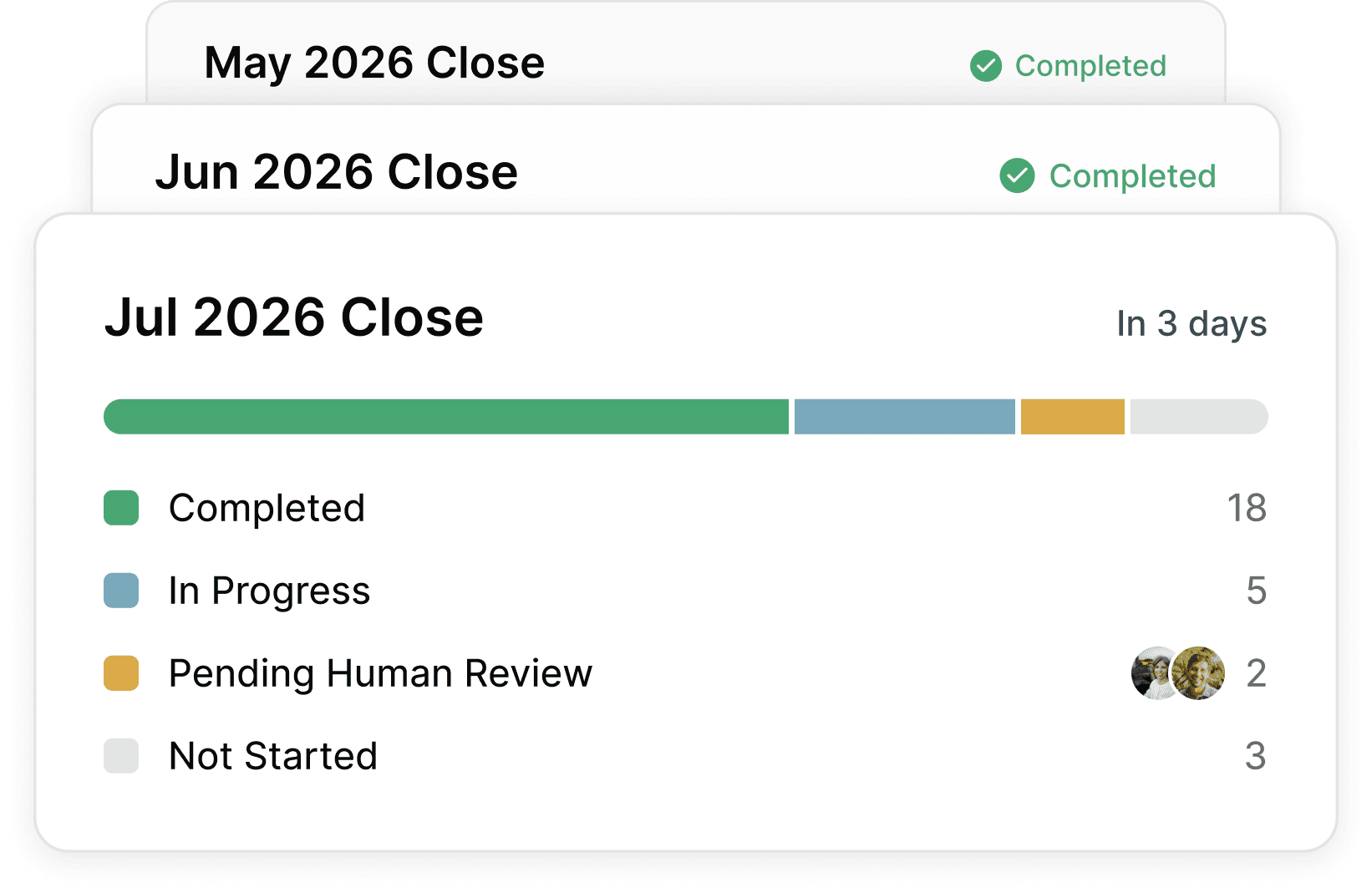
The company’s response was not to make the old monthly handoff prettier. It changed the unit of work. Reconciliations happen throughout the month. Policies can be applied programmatically. Exceptions are surfaced for an accountant. Changes are event-sourced, so history is preserved instead of overwritten. Then Prism can answer questions such as “What changed in burn?” or “Which product has the strongest margin?” and link the answer to reconciled entries.
Automation with an exception queue
Quanta’s automation is deliberately bounded. Routine entries, validation, schedules, and reconciliations belong to software. Ambiguous revenue treatment, material estimates, policy choices, and one-off contracts belong to accountants who know the business. Customers work with named, San Francisco-based accounting staff, including through Slack, rather than filing tickets into an anonymous queue.
The clearest example comes from Lightning AI. When finance director Vasanth Thiruvadi arrived, the company’s outsourced close took 20 to 30 days. The accounting was sound, but it was historical. Lightning also used a particular mix of Ramp, American Express, and internal billing systems. Quanta connected that setup, maintained categorizations and allocations as activity happened, and reduced month-end input to a short note about unusual events. Thiruvadi’s formulation is refreshingly practical: hire a senior accountant, or pair Quanta with a strong operations team. For Lightning, the second arrangement was more flexible.
Elsewhere, a Quanta customer reports an 85 percent reduction in closing time. Mintlify says Quanta helped restructure its profit-and-loss view when usage-based revenue complicated blended gross margin. Decagon uses Departments, Quanta’s team-level spend product, to map payroll, expenses, and vendors into more useful cost views. The product is tuned to software companies because their mess has a recognizable shape: contract amendments, usage pricing, cloud costs, prepaid credits, and revenue recognition that generic defaults tend to exile into spreadsheets.

A firm, a platform, and one bill
Quanta sells recurring plans based on stage and complexity. Its public trial page lists pre-revenue companies from $250 a month and an Early Stage plan from $500, with monthly or annual billing and no long-term commitment. Larger businesses get a rate after Quanta reviews their setup. The company raised a $4.7 million seed round led by Accel in February 2025, then another $15 million Series A led by Accel that December. Total disclosed funding is $19.7 million.
The money is meant to expand both halves of the operation. That is the opportunity and the tension. A pure software company can add customers cheaply. An accounting service must preserve quality as the client list and the catalog of edge cases grow. Quanta’s answer is to make every client engagement improve the system: accountants encounter the exceptions; engineers turn repeatable cases into infrastructure; accountants move upward into review and judgment. If that loop works, service knowledge becomes product. If it does not, the company is simply running an accounting firm with an expensive software team.
Where the model earns its keep
- A software company has several operational systems and SaaS-specific revenue edge cases.
- The finance team is lean and needs usable numbers during the month.
- Leaders care about tracing a metric back to transactions and accounting decisions.
- There is enough recurring structure for automation, plus a manageable queue of exceptions.
Where the fit narrows
- A company wants stand-alone software but not a managed accounting relationship.
- The business sits far outside Quanta’s software-company specialization.
- It needs audit, review, or other work requiring a licensed public accounting firm.
- Its source systems and internal processes cannot be connected or made consistent.
Steal the operating idea, even if you keep your ledger
The transferable lesson is not “buy AI.” It is procedural. Reconcile throughout the month instead of staging a rescue at its end. Keep the source, the policy, and the explanation attached to the resulting number. Turn strange transactions into a short exception document. Automate decisions only after the rule is stable. Make one person accountable for the integrity of the record, even when five systems feed it.
This is what changed Hastings’ mind about where to start. The enticing product was an answer machine for finance. The prerequisite was the unglamorous machinery that makes the answer defensible. Quanta spent its first years doing the books of real companies because the company could not learn the edge cases from a distance. Prism came later.
That order makes Quanta easy to underestimate. Its interface may be modern, and its language is full of AI, but the company’s sharpest observation is ancient: a result is only as trustworthy as the working behind it. The old ledger remembered the answer. Quanta is trying to remember why.