A city can have miles of fiber beneath its streets and still make a new office wait months for a working connection. That was the odd arithmetic Joseph Fasone encountered before founding Pilot Fiber. He had spent four years directing information technology at WeWork, where a network problem could quickly become everybody's problem. In 2014 he started Pilot in New York with a less glamorous idea than inventing a new internet: find the strands already in the ground, learn where they lead and make the last stretch into an office less of an ordeal.
The short version
- Pilot sells business internet and private network links over a fiber footprint it owns and operates in the New York metro area.
- Its in-house crews and already connected buildings make a claimed 5-15 day installation possible for on-net customers.
- The August 2026 Extenet acquisition added New Jersey routes, more than 20 data centers and roughly 200 customers.
- The buyer's real question is physical: does the right route already reach the building?
Foundry Group, which joined a $17 million financing in 2017, described Pilot's early work as a geospatial inventory of underused and sometimes poorly documented fiber. It is a revealing origin story. A strand can exist a few yards from a tenant and still be commercially useless if nobody knows its route, can secure access to it, or can arrange the crew that completes the circuit. Fasone was selling certainty in a market that often offered a calendar invitation to discuss uncertainty.
The clock starts before the customer calls
Pilot's current pitch rests on ownership. The company says it built more than 300 route miles of fiber, connected more than 1,000 buildings and serves at least 3,700 businesses, according to its August 2026 announcement. Its network page lists 47 connected data centers. These are company-reported figures, but the logic behind them is easy to understand: every building already connected makes the next installation easier to quote and faster to deliver.
For an office in one of those buildings, Pilot advertises a typical 5-15 day installation; its acquisition announcement compares that with a 30-90 day industry norm. A quote for a building outside the network is a different proposition. Someone has to survey the property, obtain access, plan the path and do the physical work. Pilot's distinctive answer is to employ its own construction and splicing teams. The advantage is less mysterious than the word fiber makes it sound: fewer handoffs between the salesperson, the landlord, the contractor and the network operator.
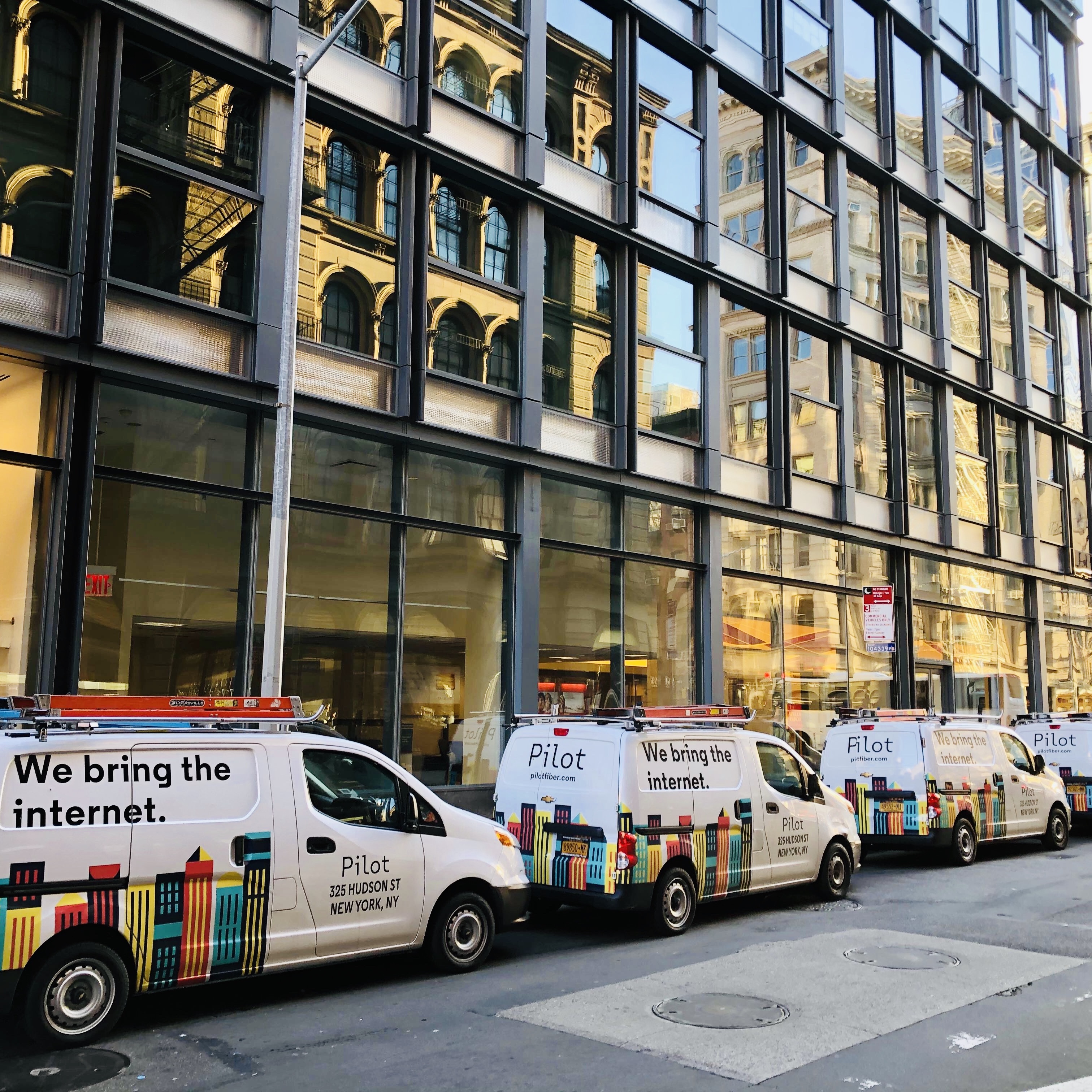
Property owners are part of the equation, not merely gatekeepers. Pilot offers to install and maintain building fiber at no capital cost to a participating owner. Tenants then buy the service they need; qualifying buildings can receive circuits for common areas, and Pilot offers tenant referrals. It is a two-sided arrangement with unusually tangible benefits: the landlord gets a better equipped building, while Pilot gains an address from which it can serve several customers. The company also pays continuing commissions to telecom channel partners who bring it business.
One route, six kinds of customer
A small firm may meet Pilot as a dedicated internet provider. Its current service page advertises symmetrical tiers from 100 Mbps to 100 Gbps, direct peering and support for customer IP routing. A company with offices on both sides of town may instead buy Ethernet transport, a private connection between locations. CloudConnect carries traffic privately toward AWS, Azure, Google Cloud or Oracle Cloud. Data centers and network operators can buy IP transit. Carriers can lease dark fiber, installing their own equipment to light the strands. The highest-capacity buyers can buy a dedicated optical wavelength.
Follow the traffic
That range explains why Pilot names trading floors alongside studios, retail stores and professional offices. The trading desk may care about a fixed path and predictable latency. A post-production studio may care about moving large files without turning uploads into an overnight ritual. A law firm may simply need its video calls and cloud applications to work all afternoon. These are different problems, but they share the inconvenient fact that a circuit is ultimately a physical path, with physical points of failure.
The Hudson changes the map
In August 2026, Pilot completed its purchase of Extenet Systems' enterprise fiber business. The assets included former Hudson Fiber Network and Axiom Fiber Network routes, extending Pilot's owned footprint from Manhattan into New Jersey. Pilot said the deal added more than 20 data centers and approximately 200 enterprise, carrier and institutional customers. It also opened direct access to facilities used by Nasdaq and the New York Stock Exchange. The purchase price was not disclosed.
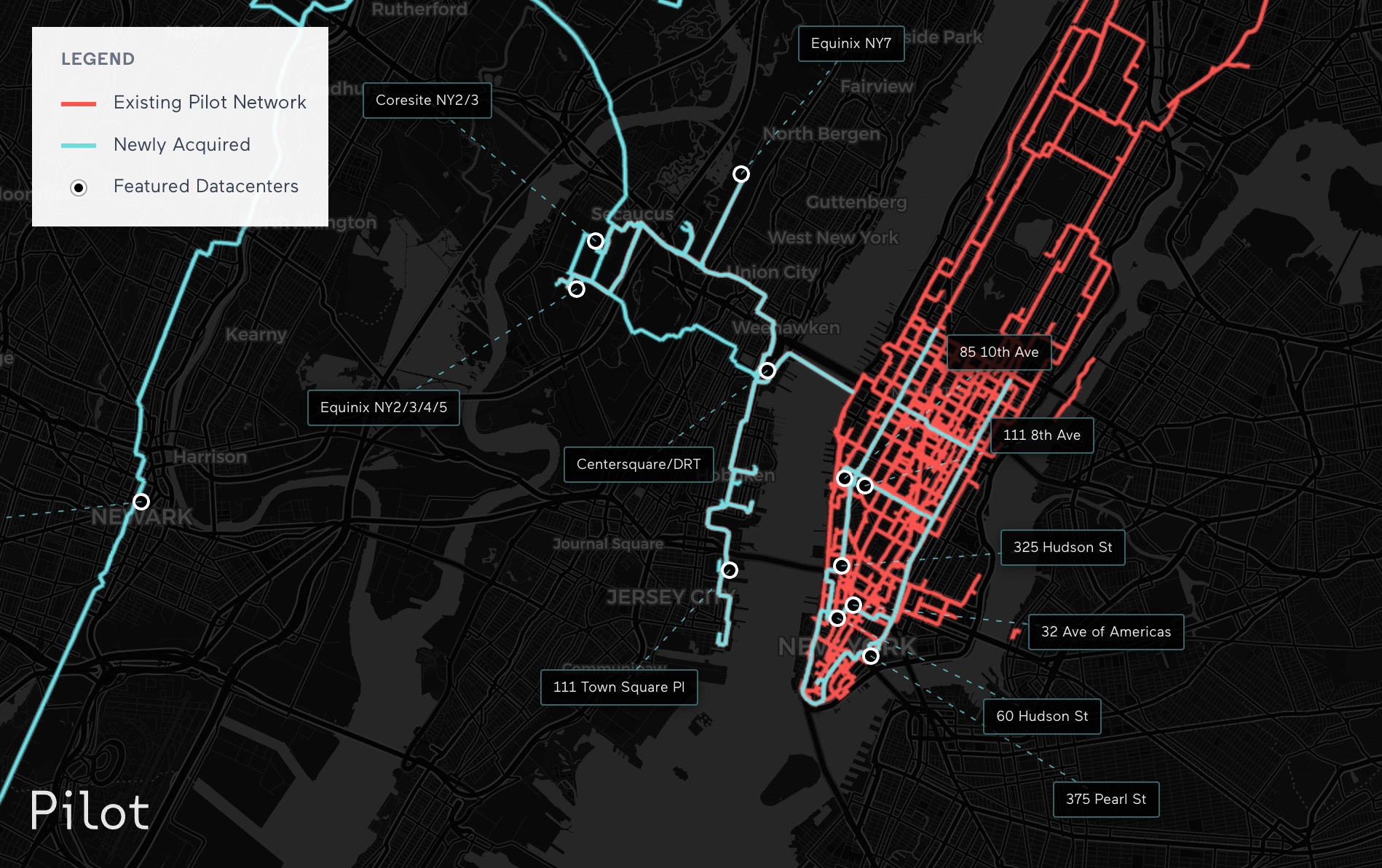
Look at the map and the strategy becomes less abstract. Manhattan has a dense mesh of office and carrier locations; across the river sit clusters of facilities in Secaucus, Jersey City and Newark. A company that can control the path between them can sell something more valuable than a bigger speed number: route choice. That matters to an institution backing up systems, a carrier looking for diversity, or a financial firm measuring latency by fractions of a second. It also puts Pilot in closer contest with national carriers and other metro fiber operators, where geographic coverage and route diversity are as important as price.
Pilot had already been preparing for those higher-capacity jobs. In March 2026, optical equipment maker Smartoptics announced Pilot wavelength services up to 400G and a backbone upgrade with a path toward 800G. Fasone said the equipment was installed, tested and brought online in about two weeks. The compact gear could fit a customer circuit in two rack units, a prosaic detail with real value in crowded New York network rooms. The old mapping problem had grown into an engineering problem: how to move more data through finite space along routes customers can trust.
What the bill buys
Pilot built its reputation partly on clear prices and flexible terms. An older company landing page still lists dedicated internet at $500 a month for 100 Mbps, $1,000 for 1 Gbps and $2,500 for 10 Gbps. Those figures illustrate its historical pitch; a present-day circuit needs a location-specific quote. Current pages also advertise month-to-month options, though custom dark-fiber routes have terms that depend on the service. An on-net office, a new construction project and a protected route to a data center are hardly the same purchase.
There is a useful lesson here for any company that sells infrastructure. Pilot began by treating a vague complaint - business internet is slow to arrive and painful to manage - as a chain of concrete delays. Map the available asset. Secure the building. Keep the crew close. Give the customer a clear route and a human being who can explain it. The model depends on density: buildings near an owned network make quick installations and recurring revenue much easier to sustain. Far from that footprint, construction economics change, and so does the promise.
Pilot's history is thus a story about proximity. In 2014, it meant discovering that a useful strand might be hiding beneath a familiar street. In 2026, it meant owning a route to the data center on the other side of the Hudson. For the person in the meeting room waiting for the network to work, both developments lead to the same welcome outcome: the map has already been drawn.