Mesh Wants to Give Finance Teams Back the Last Four Days of Every Month
The San Francisco startup builds AI agents that reconcile the books, draft the accruals, and answer questions in plain English. Two ex-Carta operators are betting the least glamorous job in accounting is the one most worth automating.
Every finance team keeps a quiet secret. For most of the month the books are calm, and then the last week arrives and the office lights stay on. Invoices get chased across email threads. Someone rebuilds an accrual spreadsheet from memory. A junior accountant reconciles bank lines at an hour when the rest of the company is asleep. This is month-end, and it repeats forever. Mesh, a San Francisco company in Y Combinator's Winter 2025 batch, is trying to make it stop.
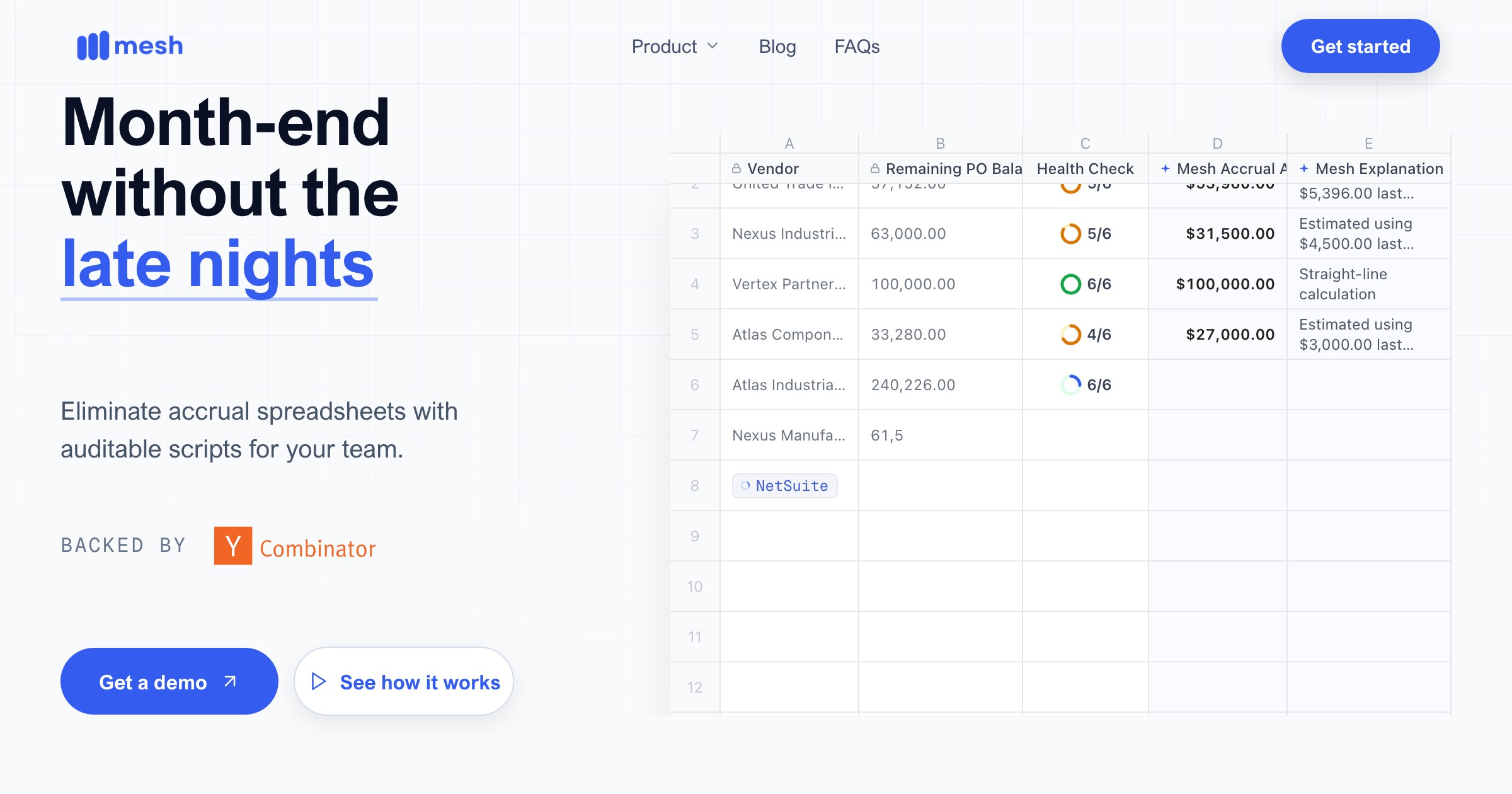
Mesh builds AI agents for accounting teams. The pitch fits on a bumper sticker the founders actually use - month-end without the late nights - but the work underneath it is specific. The software autonomously reconciles bank transactions, drafts accruals, and posts journal entries, then lets a founder or controller ask questions about the numbers in plain language and get an answer back. Think less "another dashboard" and more "a co-worker who does the parts nobody wants to do."
01The problem, in hours
The number that keeps coming up is thirty. According to Mesh, startups waste more than thirty hours a month reconciling scattered financial data - stitching together bank feeds, payroll, expense tools, and a general ledger that never quite agrees with itself. The usual fixes are either a piece of software that automates the easy 60% and leaves the judgment calls, or an outsourced bookkeeper who is affordable precisely because they don't know your business well enough to catch what's wrong.
Mesh's answer is to go after the hard part on purpose. Instead of month-end reconciliation as a single dreaded event, it runs reconciliation continuously - daily, in the background - the way an engineering team runs tests instead of checking everything by hand the night before a release.
02How it actually works
The interesting engineering isn't the chat box. It's the plumbing. Mesh captures real-time signals from the places where financial reality actually lives before it reaches the ledger - the accounts-payable inbox, Slack, Microsoft Teams, and a company's own historical journals. That context is what lets it estimate an accrual the way a seasoned accountant would, rather than guessing from a single number.
AP inbox · Slack · Teams
Chart of Accounts
+ auditable script
NetSuite & more
Two design choices stand out. First, the outputs are meant to be auditable - Mesh generates scripts and explanations you can trace, not just an answer you have to trust. Second, it's plug-and-play with the rest of the finance stack: a Chart of Accounts maps against bank transactions, and integrations pull from payroll (Rippling, Gusto), expense management (Ramp, Expensify), and document storage (Box), with NetSuite on the far end as a general-ledger destination.
Beyond the automation, Mesh runs an AI-native chat interface. A founder can ask "what did we spend on infrastructure last quarter?" or "how's cash flow trending?" and get an immediate, plain-language answer - the always-available version of a CFO you'd otherwise have to schedule time with.
03Why these two founders
Mesh is run by Erin Kim (CEO & CFO) and Nandini Ramakrishnan (CTO). The credential that matters here is shared: the two worked together for more than five years at Carta, where they grew the fund accounting business from $20 million to $100 million in annual recurring revenue. Kim ran the go-to-market and finance side; Ramakrishnan, a Carnegie Mellon electrical and computer engineer, built the general-ledger and accounting-automation systems.
That history is the reason the product is aimed where it is. People who have spent years inside fund accounting don't romanticize it. They know exactly which four days of the month hurt, and which manual steps produce the errors. Starting a company on accruals and reconciliation is not the kind of idea you pick because it demos well. It's the kind you pick because you've felt the pain and can't unsee it.
- Founded2025, San Francisco
- BatchY Combinator, Winter 2025 (W25)
- FoundersErin Kim (CEO/CFO), Nandini Ramakrishnan (CTO)
- CategoryAI · Fintech · FinOps · B2B SaaS
- WedgeReconciliation, accruals, journal entries
04Where it sits in the market
The obvious comparison is QuickBooks, and Mesh doesn't try to be it. QuickBooks handles the basic automation most small businesses need. Mesh is going after the layer above - multiway reconciliation, context-heavy accruals, and continuous rather than monthly reconciliation - and it's aiming first at high-volume businesses like marketplaces and e-commerce platforms, where the transaction count makes manual work genuinely painful.
It sits in a crowded and fast-moving neighborhood of AI accounting startups. The competitive question for all of them is the same: can an AI agent do work that has to be right, and be trusted enough that a controller signs off on it? Mesh's bet is that the answer comes from context and auditability, not from a bigger model - which is why so much of the product is about reading the messy inputs a chatbot never sees.
05The business, and the boring bet
Mesh is early. It's a small, technical team in San Francisco, backed by Y Combinator's W25 batch, hiring its first engineers and go-to-market lead. The model is B2B SaaS: sell AI accounting automation to finance teams and replace the hours currently going to manual reconciliation and outsourced bookkeeping.
The strategic read is that Mesh picked a deliberately unglamorous problem. Nobody grows up dreaming about accruals. But recurring, expensive, universally-hated work is exactly where durable software gets built - and naming the pain instead of the technology ("month-end without the late nights," not "AI for finance") is the kind of positioning that makes a controller lean in. If Mesh is right, the win isn't a flashier close. It's a quieter one.