The modern wedding can turn otherwise capable adults into frantic switchboard operators. Someone needs the hotel address. Someone else has lost the rehearsal-dinner time. An aunt replies to an email from three weeks ago. A cousin posts the surprise on Facebook. Meanwhile, the couple are meant to look serene. Sharmeen Mitha-Sehgal saw this tangle before a wedding app felt inevitable. Her decisive observation was not that people needed more social media. It was that a private occasion needed its own room.
In 2012, she explained that wedding updates had begun to clog her Facebook stream. The details mattered intensely to a small set of people and hardly at all to everyone else. “I thought that those updates should be reserved for the people involved in that event,” she said. The sentence contains Appy Couple's original brief: keep the celebration social, keep the audience intentional, and make the information useful.
This was not a founder arriving from the customary software route. Mitha-Sehgal had spent two decades in advertising. She began as an art director at Trikaya Grey in 1991, moved through SSC&B Lintas, Euro RSCG and Lowe Group's Enterprise Nexus, then took senior creative roles at Ambience D'Arcy and Quinn Fable Advertising. By the time she worked as a creative director and consultant at Ballpoint in 2011, she knew how to turn a jumble of messages into a deliberate experience. Software simply gave the experience buttons.
The feed was public. The problem was intimate.
A large family wedding in India supplied another part of the spark. Mitha-Sehgal returned from an event where considerable effort had gone into the celebration, yet guests still struggled to find the information they needed. Weddings are lavish in visible places and oddly makeshift behind the curtain. The flowers may have a production plan. The guest with a delayed flight has six message threads and a screenshot.
Appy Couple gathered those loose ends. A host could create a coordinated website and mobile app, add the couple's story, list the wedding party, publish maps and travel notes, collect RSVPs, and invite guests into a shared gallery. Multiple events could carry different guest lists, an important courtesy when the rehearsal dinner and ceremony do not have identical audiences. Privacy was not a preference buried in settings. It was architecture.
“I thought that those updates should be reserved for the people involved in that event.”Sharmeen Mitha-Sehgal, on separating wedding logistics from the social feed
The product also understood that a wedding is not merely a database with a cake. Guests were invited to leave messages, upload photographs and offer virtual toasts. Couples could stream those photos during the event. The administrative machinery sat beside small digital rituals. That combination is revealing: Mitha-Sehgal was not trying to make the occasion feel like enterprise software wearing a boutonniere.
An art director writes the product brief
For Mitha-Sehgal, polish was not the reward users received after enduring setup. It had to be present at the first click. The builder needed to work for people without technical skills, while its output had to satisfy couples who had already chosen paper, flowers, clothes and place settings with microscopic care. She described the standard plainly: a wedding website should feel “as elevated and luxurious and gorgeous” as a paper invitation.
That comparison is more instructive than it first appears. A paper invitation does several jobs without advertising the labor. It conveys facts, establishes tone, signals importance and gives the recipient a small object to hold. Translating it to a screen was not a matter of shrinking the card. The digital version had to acquire new responsibilities - live updates, selective visibility, directions, replies - without losing the sense that someone had considered how it all looked.
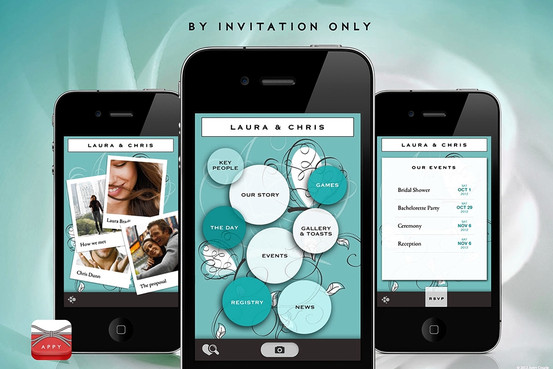
Appy Couple offered hundreds of themes, from restrained to elaborate. The visual choice carried across the website and app, so hosts entered information once and guests met the same identity on different screens. In a category famous for assembling tools from several vendors, continuity became a feature. The map did not look borrowed from one party while the RSVP belonged to another.
Seven thousand people raised their hands
The idea found its audience quickly. Appy Couple entered the winter 2012 cohort of Entrepreneurs Roundtable Accelerator in New York and graduated in April. While the service was still in beta, roughly 7,000 couples joined its waiting list. It was a tidy demonstration of demand: thousands of people were willing to wait for a tool meant to reduce waiting on everyone else.
In October 2012, the company raised a $1.2 million seed round led by ff Venture Capital. John Frankel joined the board. Mitha-Sehgal said the money would expand the product team on both the creative and development sides. The balance mattered. Appy Couple's advantage depended on engineering and taste developing at the same pace, a difficult duet when Android alone presented a thicket of screen sizes and resolutions.
Mitha-Sehgal begins her advertising career as an art director.
Creative consulting at Ballpoint leads into the formation of Appy Couple's company.
Appy Couple completes ERA, attracts a 7,000-couple beta waitlist and raises $1.2 million.
A Brides.com partnership arrives as the service reports more than 500,000 hosted guests.
By March 2013, Appy Couple said it had hosted more than 500,000 guests. A partnership with Brides.com added fashion-informed themes to a library already numbering in the hundreds. The company was becoming a meeting point for two industries that share a vocabulary but not always a temperament: software likes repeatable systems; weddings insist that this one is different.
Designing for the person who did not buy it
A curious thing about wedding software is that the customer and the crowd are different people. The couple chooses the platform, but scores or hundreds of guests must use it. Some will be enthusiastic. Some will arrive without remembering the code. Some will have an old phone. The product has to flatter the host's taste while respecting the guest's time.
Mitha-Sehgal's answer was to make the guest experience more than a noticeboard. People could contribute photographs, sign a digital guestbook, join a playlist and consult travel information. A guest who downloaded the app for directions might later add the picture nobody else caught. Utility invited participation. Participation created the keepsake. The same loop turned every celebration into a live demonstration for future couples in attendance, although the software never needed to announce that fact over the champagne.
There was also an ambition beyond weddings. Mitha-Sehgal said she wanted people to use their personalized apps after the day itself. She pointed toward Appy Life, an extension for births, birthdays, new homes and anniversaries. The underlying idea was broader than matrimony: life's private milestones need tools that gather people without throwing open the doors.
A campaign organizes attention. A product organizes behavior. Mitha-Sehgal carried the same eye for hierarchy from one craft into the other.
The useful lesson is in the seams
Appy Couple's enduring product lesson is not about weddings alone. People rarely experience a feature list. They experience transitions. The invitation becomes an RSVP. The RSVP becomes an itinerary. The itinerary becomes a route. The route ends at a room where photographs begin returning to the same place. Every handoff is a chance for confusion, and every smooth handoff feels like hospitality.
Mitha-Sehgal recognized those seams because her previous profession trained her to notice coherence. An art director decides what the eye meets first, what can wait, what should match and what deserves space. A founder has to make the same decisions with people, capital and code added to the canvas. Her career pivot looks less like a leap when viewed this way. The medium changed. The instinct did not.
There is another practical choice worth keeping. Appy Couple treated the host's information as content that could move across formats, rather than forcing the host to rebuild the celebration on every device. Enter the details, choose the design, and let the system carry both into the website and app. Today that sounds ordinary. In 2012, when responsive expectations were unsettled and Android fragmentation occupied the product team's attention, it was a serious promise. The reward was not novelty for its own sake. It was one less version of the truth for a couple to maintain while dozens of guests asked perfectly reasonable questions at perfectly unreasonable moments.
The software continues to be available on iOS and Android, with recent releases maintaining the product long after the early accelerator headlines. That longevity suits an idea built around continuity. The wedding industry will keep inventing new aesthetics and new anxieties. Guests will keep losing details. Couples will keep wanting the useful bits to feel less like administration. Somewhere between the paper invitation and the phone screen, Mitha-Sehgal found a durable place to work.