Peter Kuhar’s personal website has the confidence of a note taped above a workbench. His name appears first. Beneath it, a sentence of three ordinary words: “I make things.” Then come the things - mobile software, a physical app blocker, chargers for smart glasses, publications, patents. There is no ceremonial biography and no founder mythology. The page behaves like its owner’s projects: short, direct and ready to be used.
That small sentence is the cleanest way into a career spanning more than two decades. Kuhar has written software for handheld computers, worked on secure banking systems, built low-power wireless networks, co-founded Azumio and led product engineering for apps used around the world. The chronology matters. More revealing is the repetition. He notices a signal that is difficult to see, a process with one step too many, or an everyday object that almost works. Then he reaches for code, a soldering iron or a resin printer.
In Palo Alto, where founders are often encouraged to turn each experiment into an industry, Kuhar’s recent work has become pleasingly literal. A charger belongs on the nightstand, so he makes one that belongs there. A background computer job is invisible, so he puts lights in an unused port. A software limit is too easy to dismiss, so he builds a physical boundary. The grand strategy, if there is one, begins with a private annoyance.
“I make things.”Peter Kuhar’s entire personal-site manifesto
Before the workbench became a company
Kuhar studied telecommunications engineering at the University of Ljubljana from 2000 to 2005. His first professional work, at Erpo sistemi, involved software for handheld computers and wireless utility-meter reading. This was the early 2000s, when “mobile” still suggested a device with a stylus and a stubborn sync cable. The job trained the useful reflex of making software answer to physical machinery.
At Halcom, beginning in 2005, the machinery became financial infrastructure. He worked on a mobile-payment solution and electronic-banking transport security. Three years later he founded Modula, where the focus shifted again, to low-power wireless systems for home automation. A public project from that period, m-stack, implemented the 6LoWPAN standard for small connected devices. Long before every light bulb demanded a password, Kuhar was dealing with how constrained objects talk.
Handheld-computer software and wireless meter-reading systems at Erpo sistemi.
Mobile payments and banking-security engineering at Halcom.
Founder of Modula, building low-power wireless systems.
Co-founder and engineering leader at Azumio.
Physical products from DoomCatcher to SidePulse.
In 2011, an app Kuhar had built reached the top charts and became the catalyst for Azumio. With Bojan Bostjancic and Tom Xu, he co-founded the company and became its technical leader. A $2.5 million Series A from Accel, Felicis and Founders Fund followed that July. Azumio grew into a portfolio of mobile products, and Kuhar’s work stretched from code into research, product direction and the messy orchestration required to ship on new devices.
One glimpse of his operating style arrived with Apple’s M7 motion coprocessor in 2013. Azumio’s Argus supported the chip on the day the iPhone 5s launched. Kuhar explained that the team had prepared by separating its existing software into modular components, then connected the new hardware when Apple’s documentation became available. Speed was less a last-minute sprint than a consequence of earlier architectural taste.
The useful annoyance
The founder story might have ended there: early engineer finds product-market fit, raises capital, builds a company and graduates into meetings. Kuhar did not stop touching the objects. His public self-description on Medium added color to the official titles: “Coding, soldering, motorbiking, quazi designing entrepreneur.” The misspelling feels less like carelessness than an escape hatch from design solemnity.
In 2014, he wrote a short essay about watching software intrude on dinners and hikes. His conclusion was unusually skeptical for an app builder. The point of useful technology, he argued, should be to help people eventually live “unassisted” and “untethered.” The interface was scaffolding. A good outcome made the scaffolding less necessary.
Eleven years later, that idea returned as hardware. Kuhar found himself scrolling late at night, deleting distracting apps, reinstalling nothing but still repeating the habit. Built-in limits presented an “Ignore” button, which was exactly the wrong feature at the wrong hour. Other physical blockers required a deliberate tap. He wanted the boundary to happen on its own.
The first DoomCatcher prototype appeared in late October 2025, shortly after his birthday. The device created an automatic phone-free zone. Kuhar kept adding apps to its blocked list until, in his account, only books remained available. Months later it was still working. The path from confession to product was almost comically straight: I have a problem; the current control includes an easy escape; remove the escape.
The same pattern produced chargers for Ray-Ban Meta glasses. Kuhar frequently forgot to charge them overnight because the case was elsewhere and, as he put it, he was “too lazy to get up.” Midday battery trouble followed. He designed a clip, a stand and a miniature adapter, printed them in high-resolution resin and hand assembled them in Palo Alto. The origin story has no invented customer persona. The customer was tired and already in bed.
Eight lights, almost no ceremony
SidePulse, released in 2026, may be the most compact expression of Kuhar’s taste. Coding agents and long computer jobs continue while the owner is in another application, across the room or carrying a closed laptop. The work is happening, but its state has vanished. SidePulse Pro slips into a MacBook Pro’s SD slot and turns that hidden state into eight RGB lights. SidePulse Dot uses USB-C and two lights.
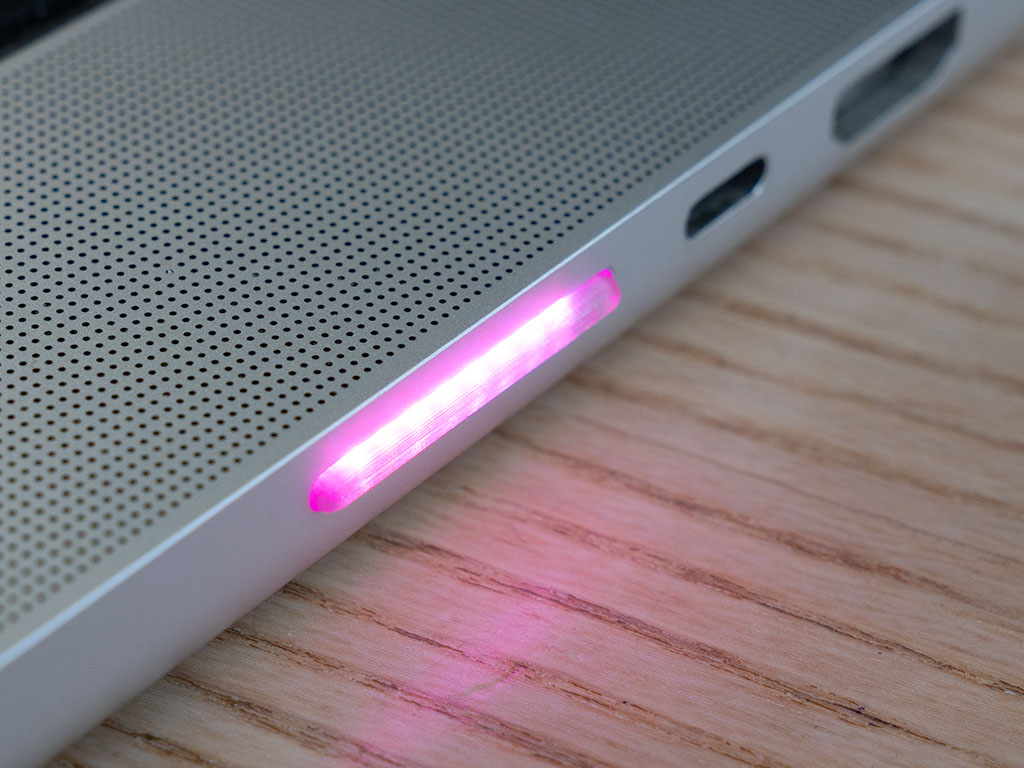
The charming decision is how little software sits between intention and glow. No proprietary driver is required. No companion app is required for the basic interaction. The device mounts as a tiny filesystem; write a color or animation command to one file and the LEDs respond. A shell script can do it. A build system can do it. An AI coding agent can do it. Kuhar reused the universal interface developers already possess: text.
Restraint creates the hackability. The language borrows familiar ideas from CSS, with hex colors, timing and easing. A job in progress can roll cyan; a failure can pulse amber; a finished task can settle on green. The object does not demand attention or try to become a dashboard. It offers a peripheral wink from the edge of the machine.
Then comes the less photogenic work. Kuhar’s 2026 posts document boards placed into fixtures, firmware flashed through pogo pins, cosmetic rejects, glue that wandered and boxes labeled by hand. He improved one flashing setup until it could handle 54 boards at once. He considered a sticker robot, then noted that automation would need enough volume to justify the time and could lock him into a form factor. This is product judgment measured in trays and adhesive.
“We’ll file this one under ‘Doing things that don’t scale.’”Peter Kuhar, while labeling SidePulse boxes by hand
The career beneath the titles
Kuhar’s résumé can be read as a series of widening responsibilities: engineer, founder, technical executive, researcher, inventor. His public work suggests another reading. He has spent a career turning hidden processes into visible behavior. Wireless devices communicate. Phone sensors become a legible interface. A background agent becomes a row of lights. A weak intention becomes a physical boundary. The material changes; the move remains recognizable.
There is a lesson here for founders tempted to define themselves by an industry. A durable creative identity may instead be a type of transformation you enjoy performing. Kuhar makes complicated systems feel tangible. Sometimes the result reaches millions of downloads. Sometimes it is a $19 adapter. Scale changes the logistics, but it does not have to change the maker’s eye.
His projects also expose a productive tension. The engineer wants elegance. The operator meets a bad batch. The founder imagines demand. The person at the packing table sees glue on the connector. Keeping those roles close together makes each one less delusional. The best abstraction is corrected by the stubborn fact of the object.
“I make things” therefore lands as more than a hobbyist’s motto. It is a refusal to let a title become too polished to be useful. At one end of Kuhar’s career sits a handheld computer. At the other, a tiny pink light. Between them are two decades of the same question: what would make this easier to understand and harder to ignore?