The difficult part of making a video is often the moment before you press record. You have a camera, a face and perhaps an audience. What you lack is something to say. Scorp’s original answer was wonderfully economical: supply the topic. Let people respond in fifteen seconds. Put their answers together. A blank screen became a conversation with somewhere to begin.
- Scorp began as a topic-based social video app developed by university students in Turkey.
- It sold advertisers participation in conversations, with distribution beyond its own app.
- The company dates its expansion into live streaming, video chat and communication to 2018.
- Its portfolio now includes a second-number app, a photo cleaner and an AI chatbot.
This is a useful company to examine because its first product does not explain its whole business. Look at the original app and you see a social network. Look at the present product selection and you see a mobile publisher willing to follow several kinds of demand. The distance between those descriptions is where the interesting decisions live.
Fifteen seconds, and a reason to use them
In April 2015, Turkish newspaper Dünya reported that Scorp had reached 60,000 users in its first month, with more than 200,000 videos uploaded. The app was then available only on iOS. Its makers were Koç University students İzzet Zakuto, Sercan Işık, Kaan Uğurlu and Övünç Dalkıran. They were working from the university’s incubation centre, with early support from angel investor Ömer Erkmen and the university.
The product resembled a video version of Turkey’s topic-based discussion sites. Users spoke under headings rather than having to invent a complete entertainment format. That distinction matters. A social product asks two separate questions: why would anyone watch, and why would anyone contribute? Scorp gave both groups the same organising device. The topic told a viewer what to expect and gave a contributor something to answer.
Consider the difference between “make an interesting video” and “tell us what you think about this.” The first asks for a performance. The second permits an opinion. Fifteen seconds keeps the invitation small. You could disagree, confess, joke or offer an observation without preparing a production. The resulting collection could be browsed for its subject as well as its personalities.
“We are a place for people with the same interest [to have] a conversation.”Sercan Işık, speaking in 2017
The appeal was social, but the mechanism was editorial: choose a heading and gather voices beneath it. That gives Scorp a more precise origin than the loose description “short-video app.” The question was part of the product.
The cake budget
In a 2017 interview, Zakuto and Işık described developers staying in a house without a door and living on packaged cake during an early cash shortage. Their response was to promote the app while it was still being designed. They also described university word of mouth as an early distribution method.
There is something bracing about this account. The immediate constraint was money, and the team’s response was to bring promotion forward. A founder reading it can borrow the sequence: define the invitation, show it to a reachable audience, and learn whether people want to participate. A campus gives such an experiment a useful boundary. People can explain the idea to one another in person.
Later, users asked for in-app messaging. The founders said they added it in response. That is a concrete instance of the audience changing the product. Public video responses may introduce people; private messages let a relationship continue. The request revealed a need that the original recording format alone did not satisfy.
When a brand buys a question
Scorp’s early commercial opportunity followed from its format. If a topic could gather opinions, an advertiser could commission a topic and invite replies. The company’s 2018 advertising presentation claimed more than 200 campaigns and showed a Türk Telekom / Selfy challenge among its examples.
The presentation packaged the work quite specifically. Its Native Large offer listed a minimum of 75 incoming videos and 400,000 views across channels, along with briefed videos, topic placement and social distribution. The larger package listed 150 videos and one million views. These were sales promises in historical marketing material, rather than a measurement of present performance.
The business insight is easy to copy in principle: build the advertisement around an action people already understand. Its usefulness depends on the audience wanting to perform that action. An awkward brand prompt remains awkward, however many placements accompany it. Participation needs a reason beyond the advertiser’s desire for attention.
The company gets larger than the icon
Scorp’s own timeline places its move into live streaming, video chat and communication applications in 2018. That establishes a change in scope. It does not, by itself, establish that the original app failed. The interesting commercial choice is the broader range of things the company became willing to build.
Recorded responses, live broadcasts and direct video interaction require different experiences. One lets a person prepare a contribution. Another makes timing part of the attraction. A communication tool must make contact practical. My reading of the portfolio is that Scorp increasingly organised itself around mobile behaviour, with several products serving different occasions.
The company’s website reports more than 250 million registered users, over 100 countries and more than 25 languages. Registrations describe accumulated reach; they do not tell us how many people return each month or pay. Still, the geographic and language claims make the intended market clear: consumer software distributed internationally.
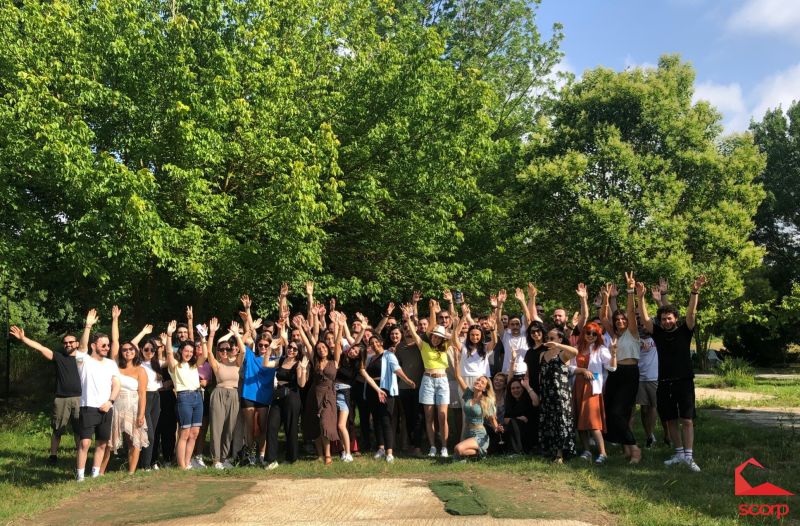
Its workplace profile adds a human detail to that expansion. Great Place To Work Turkey publishes a 70% overall positive workplace response and a 92% positive response about welcoming new colleagues. The company describes a culture of hard work and continued learning. Treat the survey as a snapshot of employee experience, rather than a permanent certificate of happiness. Software portfolios need people who can keep learning; the workplace must make room for them.
A second number, a tidier gallery, an answer
Nextline makes the wider business tangible. Its App Store description offers additional phone numbers and travel eSIM services. Someone separating work calls from personal life has a different reason to install an app from someone seeking entertainment. The US listing includes a $9.99 monthly subscription and a $59.99 annual subscription, among other options. Prices and offers can vary. It also states that emergency services are unsupported.
Cleaner Pro addresses a quieter irritation: a photo library that has become a cupboard nobody wants to open. Its listing describes a like/dislike interface, duplicate cleanup and sorting videos by size. It says processing works locally without an internet connection and deletion requires permission. Paid access follows a trial. The practical appeal is reducing the work of deciding what to keep.
Robo AI offers writing and question answering, marketed as using ChatGPT and GPT-4. Its listing records a May 2023 update for fixes and performance improvements. Here Scorp competes for the convenience of a mobile interface in a crowded assistant market. The value has to appear in the user’s experience of asking and receiving, where a model’s name alone cannot distinguish an app.
These products expose several competitive markets. TikTok and Instagram are alternatives for short-video attention; live social apps compete for interaction; second-number services compete for communication budgets. Photo tools and assistants face their own alternatives. Scorp’s distinction is the breadth of its mobile publishing activity. Each product still has to earn its place on a phone.
The invitation survives
The original Scorp lowered the effort of joining a discussion. Its newer utilities try to lower the effort of managing calls, photographs or a question. That continuity is an interpretation of the products, rather than a claim that they all share one technical system.
A small team can copy the habit of beginning with a specific, recognisable inconvenience. Copying the whole portfolio is a larger undertaking: more products mean more support, more updates and more promises to honour. Expansion makes sense when the team can maintain what it ships. Otherwise, a collection of icons becomes a collection of unfinished obligations.
Scorp’s first invitation was short enough to fit inside fifteen seconds. Its later choices suggest a company willing to let that invitation evolve. The useful question for another founder is whether the next product serves a need the team understands well enough to keep serving. A first idea can open the door. It need not furnish every room.
Follow the conversation
Explore Scorp’s website, LinkedIn, X, Instagram and Facebook. Watch the Scorp YouTube channel, or read the 2017 founder interview (in Turkish).
See the product listings for Nextline, Cleaner Pro and Robo AI.