At seventeen, Andrew Frame woke in Las Vegas to armed federal agents pulling him out of bed. The surprise was not that his roommates might have found trouble. The surprise was that the trouble belonged to him. Two years earlier, while other teenagers were working out what to do with dial-up internet, Frame had found his way into systems at NASA's Jet Propulsion Laboratory. The case ended without prison. He received probation and community service, and helped demonstrate the weaknesses he had found. It also supplied an unusually severe lesson in what happens when technical ability gets ahead of judgment.
That lesson shadows the company he runs today. Citizen moves urgent public information through a network at phone speed. It translates radio traffic, public records, user video and location into alerts about what is happening nearby. The attraction is easy to understand: a city is full of signals, and most residents hear none of them. The danger is equally plain: when the subject is danger itself, a fast mistake can travel farther than a careful correction.
The boy inside the network
Frame was born in Las Vegas and took to networks early. At fifteen he co-founded an internet service provider. At seventeen he used false identification to land a support job at Cisco, an act of youthful nerve that would look absurd if the technical result were not so concrete. In his first year he earned two CCIE certifications, Cisco's demanding expert credential. A Stanford profile later noted that only eight people then held that combination. Before he was old enough to order a drink, he was helping solve routing problems for major service providers.
At nineteen, Cisco moved him into its Global Center of Expertise. The work took him into networks across the Pacific Rim and Latin America. He later joined Procket Networks, a startup building core routers. This was his real education: no campus, no degree listed on his public biography, just packets, outages, exact causes and systems that announced failure without caring for anyone's feelings.
“We all have supercomputers in our pockets, with geolocation technology and the ability to broadcast live video. There must be something more we can do.”Andrew Frame, on the idea behind Citizen
First, make the machinery disappear
In 2004, at twenty-four, Frame founded Ooma. The premise was a useful bit of magic: package internet telephony into a consumer device and make home calls feel free. Ooma forced the network engineer to become a salesman, recruiter, product chief and keeper of a company story. He built the early team and channels, then stepped aside as chief executive in 2009. The company later listed on the New York Stock Exchange.
Around the same period, friendships with Sean Fanning and Sean Parker brought him into the orbit of early Facebook. Frame briefly advised the young company and received shares. It was another education in networks, this time in the human variety. A router moves information because the protocol tells it to. A social product needs people to choose movement, repetition and return.
A founder walks into a screenwriting class
After leaving Ooma, Frame did something that sounds like a detour only until Citizen appears. He attended a Los Angeles screenwriting intensive led by producer Joan Scheckel. He did not intend to make films. He saw an analogy between filmmaking and consumer technology, then concentrated on story structure.
The connection is shrewder than the usual founder's trip to Hollywood. Consumer software is choreography. It reveals information in sequence, gives a person a role and tells them what action belongs next. Frame later said he preferred poetry and philosophy to business books. One can see why. A business manual tells you how a company should work. A story tells you why a person should care.
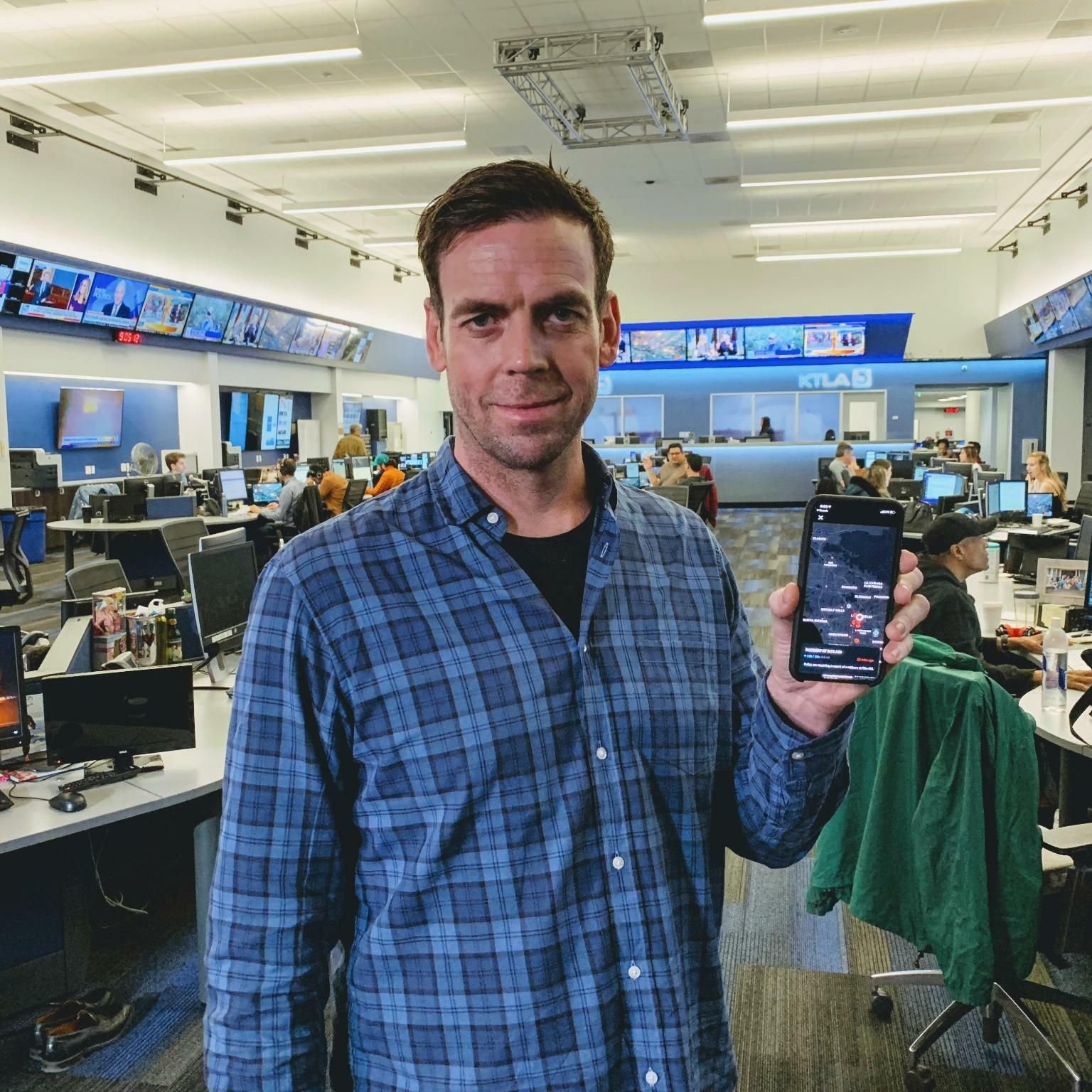
The name that arrived shouting
By 2016, Frame had drawn up five conditions for his next company. It had to be mission-oriented, consumer-based, mobile, propelled by a network and genuinely different. Then he remembered the police scanners he had seen at Radio Shack as a teenager. Emergency radio was open, but functionally hidden. Smartphones could turn that ambient stream into location-aware information.
The prototype took weeks. The first name, Vigilante, arrived with its elbows out. Its promotional film showed nearby civilians converging to help a woman under threat. Attention followed, then alarm. The New York Police Department warned that crimes in progress belonged to police, not people carrying phones. Apple removed the app over concerns that it could expose users to physical harm.
Frame and his team returned in 2017 with a calmer noun: Citizen. The rules explicitly told users not to interfere with first responders or put themselves in danger. The rebrand was more than cosmetic. “Vigilante” casts the user as an actor. “Citizen” gives the user membership and, with it, responsibility. The app kept the same dramatic engine, but rewrote the part.
How a city signal reaches a pocket
Safety and news share a fence
Citizen grew because it answered a question local news often could not answer quickly: what is happening on this block, now? Yet Frame resists calling the company a news service. His sharpest formulation concerns a missing child: the event is news to everyone except the family; for them, it is safety.
There are examples that support his distinction. Citizen alerts have mobilized large searches for missing people. A San Francisco fire official told a reporter that video on the app revealed a person hanging from a window, changing the rescue response. Research described in 2022 found that hospital patients flagged through Citizen alerts arrived, on average, 12.9 minutes before those announced over standard emergency radio. A notification can be gossip, spectacle or a life-saving head start. The software cannot know which meaning it will acquire in every hand.
“A missing child is news to everyone except the missing child's family. For them, it's safety.”Andrew Frame
Critics have argued that a constant feed of nearby disorder can distort a person's sense of risk and encourage suspicion. Frame's reply is that uncertainty also creates fear, and that accurate knowledge permits a better choice. The word doing the hardest work there is accurate.
Two clocks, one alert
In 2021, Citizen offered a reward for information about a man it wrongly associated with a Los Angeles wildfire. Police had questioned and released him; he was not responsible. The company withdrew the notice. Frame later said speed had been optimized over accuracy and that Citizen changed its policies.
The episode exposed the central operational tension in unusually stark form. A safety network is valuable because it beats the evening bulletin. A safety network is trustworthy only when it refuses a thrilling claim that has not earned publication. Frame's early life contains a neat, perhaps too neat, echo: technical access is not the same as permission, and capability is not judgment. The adult company must relearn that distinction every day, under pressure and in public.
When the product enters City Hall
By 2023, Frame was no longer only arguing about how Citizen should handle public information. He was arguing that the information should remain public at all. As the NYPD moved to encrypt radio transmissions, he testified before New York City Council committees alongside members of the press. In March 2024, he submitted written testimony opposing the change. He said 38 percent of people in New York had downloaded Citizen and warned that encryption would remove a source used for timely alerts.
The debate turned a consumer app into a participant in civic infrastructure. Police cited operational concerns. Journalists, volunteer first responders, council members and Frame pressed for transparency and continued access. Citizen's interests were plainly commercial as well as civic, but commerce does not make the public question vanish. Who gets to hear the city in real time? Who decides which listeners count?
The seconds before the headline
Frame remains most legible as a network engineer, even when he talks like a philosopher or stages a launch like a filmmaker. Ooma translated internet plumbing into a household object. Citizen translates emergency systems into a pocket signal. Both businesses begin by exposing useful capacity that already exists, then hiding the machinery required to make it ordinary.
He has described Citizen as a mission rather than a product, with the compact aspiration to “protect the world.” Grand phrases are cheap; systems make them expensive. Every expansion, subscription and alert creates another obligation to be useful without being theatrical, fast without becoming reckless, intimate without becoming invasive.
Frame once told a Stanford audience that vision is rarely made by one person. It should combine leadership input, then break into objectives a company can actually execute. Citizen has turned that management lesson into a public experiment. Its mission may fit on a coffee mug. Its consequences arrive one block and one phone at a time.
The boy who entered networks before he understood their boundaries now runs a network defined by boundaries: between knowing and fearing, watching and intervening, speed and truth, public signal and private company. Citizen's familiar ping occupies barely a second. Andrew Frame has built much of his life around what that second permits, and what it demands.
Follow the signal