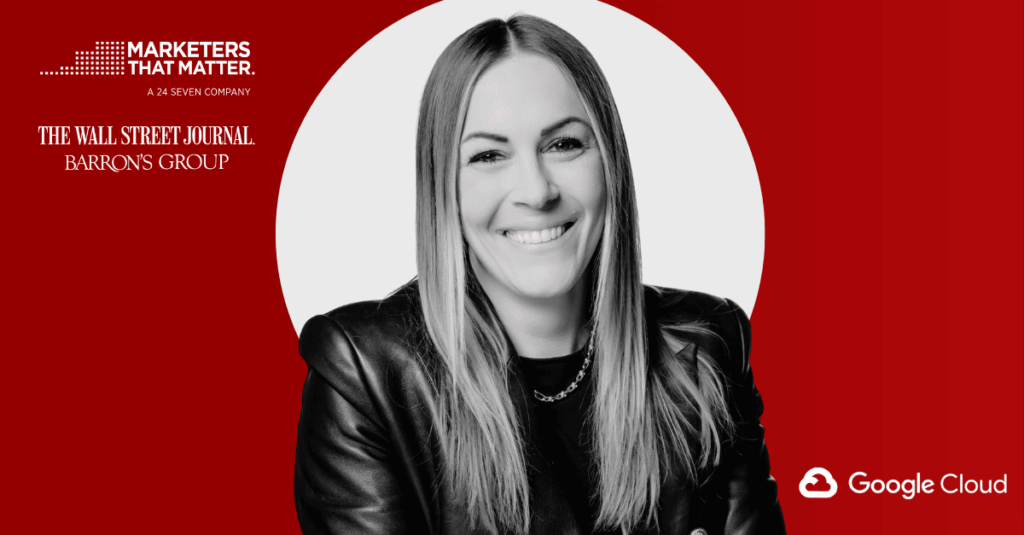
Profile
The deal-maker, the cloud whisperer, the VP who turned AI positioning into a growth engine
Her Twitter handle is @saykay - a phonetic spelling of her initials, S.K. It's a small detail, but it tells you something. Sarah Kennedy Ellis has been building her own shorthand, her own signal, since before most enterprise CMOs understood what Twitter was for. She joined the platform in September 2008. Sabre Corporation, where she spent her first decade, was still trying to figure out whether social media belonged in enterprise travel tech at all. She wasn't waiting for permission.
Today she runs global marketing for two of the most consequential products in enterprise technology - Google Cloud and Google Workspace - at a moment when the entire cloud industry is reorganizing around artificial intelligence. The run rate for Google Cloud has grown from roughly $12 billion when she arrived in 2020 to more than $39 billion. The positioning she helped engineer - "the first choice in AI" - is not an accident of timing. It's a deliberate, developer-first thesis that required someone who understood both the old playbook and the new one.
"The customer is always the answer."
- Sarah Kennedy Ellis
Before Google, she was CMO at Marketo, the marketing automation company that became synonymous with demand generation. She joined in October 2017 and spent the next year turning a company into an acquisition target. The deal closed in late 2018: Adobe paid $4.75 billion for Marketo, one of the largest acquisitions in Adobe's history. Ellis didn't just survive the acquisition - she became CMO of Adobe Experience Cloud and inherited a 400-person global marketing organization that spanned demand generation, digital, social, PR, product marketing, and sales enablement.
Three companies in three years. Each one larger, more complex, and more consequential than the last. The pattern suggests someone who gravitates toward moments of transformation - not because chaos is comfortable, but because she's learned to move faster than the uncertainty around her.
Career Track
Sabre
VP Marketing / Labs Director
2007 - 2017
Marketo
Chief Marketing Officer
2017 - 2018
Adobe
CMO, Experience Cloud
2018 - 2020
Google
VP Global Marketing
2020 - Present
A Decade at Sabre: Learning to See Around Corners
Most people don't realize she spent her first decade in enterprise travel technology. Sabre Corporation - the global distribution system that underpins much of the travel industry's booking infrastructure - is not the kind of company that produces flashy marketing careers. It's the kind of company that teaches you rigor, systems thinking, and patience. Ellis arrived in 2007, fresh from her MBA at the University of Texas at Dallas, having already completed a dual undergraduate degree in Business Management and Business Journalism at Baylor University in 2004.
At Baylor, she attempted to walk on to the women's basketball team. The coach at the time was Kim Mulkey - the same Kim Mulkey who would go on to become one of the most decorated coaches in women's college basketball history. The tryout didn't go Ellis's way, but the instinct behind it - the willingness to show up unrequested and compete - surfaced repeatedly throughout her career.
Inside Sabre, she ran social solutions product marketing from 2010, championing enterprise social media at a time when most B2B companies treated it as a communications experiment rather than a business function. She created the Young Professionals Council, the kind of community-building initiative that reveals a leader who thinks about institutional infrastructure. Then she became Director of Sabre Labs - the company's innovation and R&D arm - and spent two years pointing the organization toward what came next.
"There's no perfect substitute for a whiteboard in a room and being face-to-face over late night pizza to solve problems."
- Sarah Kennedy Ellis, VP Global Marketing, Google Cloud
The Marketo Moment
When she joined Marketo as CMO in October 2017, the company was already a recognized name in marketing automation. But the category was crowding, and the pressure to grow - and to eventually provide a liquidity event for investors - was real. Ellis came in with a track record in B2B demand generation and a philosophy she'd been refining across a decade: that community, not broadcast, was the engine of durable enterprise growth.
She used community to grow Marketo's market presence in ways that traditional demand gen couldn't replicate. The approach gave the brand a gravitational pull - customers who felt ownership over the ecosystem became the most effective sales force the company had. Less than a year after she joined, Adobe announced the acquisition at $4.75 billion. The deal valued Marketo at a premium that reflected not just the technology, but the community and market position around it.
Named one of 21 Best CMOs to Follow on LinkedIn by Drift.com, before LinkedIn influencer culture became a contact sport.
The Adobe chapter that followed was a masterclass in integration marketing. Taking a 400-person organization built around a newly acquired product and aligning it with Adobe's existing Experience Cloud narrative required someone who understood both the acquired company's identity and the acquirer's strategic goals. She did both, simultaneously, while managing the demands of a Fortune 500 marketing organization at scale.
Google Cloud: Building the AI Chapter
She joined Google in July 2020, stepping into a cloud business that was growing fast but still defining its identity against two better-established competitors. AWS had the market share. Microsoft Azure had the enterprise relationships. Google Cloud had something different: the research pedigree of Google DeepMind, the developer trust of a company that had built the internet's infrastructure, and a set of AI capabilities that were, arguably, the most sophisticated in the industry.
The marketing challenge was translation. Ellis's thesis - built on her experience at Marketo and Adobe - was that enterprise cloud adoption follows a developer-first path. Bottom-up, not top-down. Engineers choose the tools; procurement follows. The AI positioning she helped develop wasn't aimed at CIOs making annual budget decisions. It targeted the developers building products on Google Cloud's AI infrastructure, betting that grassroots technical adoption would create the enterprise pipeline that traditional field sales couldn't generate alone.
"The future doesn't belong to the ones who know the most - but to those who learn the fastest."
- Sarah Kennedy Ellis
The Wall Street Journal named her a 2024 Marketer to Watch for this work. The citation pointed to her role in "spearheading global customer acquisition and shaping Google's AI go-to-market strategy" - language that understates the difficulty. Cloud AI marketing in 2023-2024 required navigating an environment where every competitor was making identical claims about superior AI capabilities, while customer skepticism about AI ROI was hardening into real resistance. Standing out required specificity, proof, and a willingness to position through demonstration rather than declaration.
Her answer was to make Google Cloud's own teams "Customer Zero" - using Google's AI products to run Google's own marketing operations, creating authentic stories of enterprise transformation that prospects could evaluate directly. The approach compressed the sales cycle and gave the marketing organization something rare: firsthand evidence of what they were selling.
A Philosophy Built From Scar Tissue
The ideas Ellis brings to marketing aren't abstract. They come from three company transitions in three years, from a decade navigating a conservative enterprise industry before that, and from a consistent pattern of arriving into situations where the playbook needed to be written, not followed.
She recommends Adam Grant's Think Again not as a management cliche but as a survival manual for a period when the tools available to a marketer change faster than the strategies built around them. Her concept of "intellectual flexibility" - the willingness to let go of approaches that worked recently in favor of what works now - is less a philosophy and more a competitive advantage she's watched people lose when they stopped practicing it.
"What was old is new again - traditional methods evolved with emerging tech."
- Sarah Kennedy Ellis
She's specific about where AI fits in the marketer's toolkit. AI agents handling copywriting, campaign reporting, and project management aren't threats to marketing careers - they're the tools that free marketers to focus on judgment, strategy, and the parts of the work that require human context. The physical events she still champions - enhanced now with livestreaming, AI translation, and automated agendas - are a case study in what happens when a fundamentally human activity gets infrastructure around it rather than being replaced by it.
She splits her time between Denver, San Francisco, and Breckenridge. She describes herself as a trap music aficionado. She has 9,663 Twitter followers who followed @saykay before it was obvious that following a B2B marketing VP on social media was something worth doing. These details don't need connecting - they sketch someone who holds multiple identities comfortably, who built her professional presence the same way she built her companies: by showing up before the crowd arrived.