A corporate gift has two lives. In the first, somebody opens a box and finds something pleasant. In the second, somebody else wonders who approved it, where it went, what it cost, and whether the sales representative remembered to follow up. Postal by Sendoso has built a business around that second life. The first gets the photograph. The second gets the software budget.
- Postal connects gifts and direct mail to the tools business teams already use.
- Its remit runs from prospect outreach to employee kits and branded company stores.
- Customer results are useful case studies; they are not promises of a universal return.
- Sendoso acquired Postal in May 2025, keeping it as a standalone platform.
The box has a back office
Think about the small indignities of sending merchandise at work. A spreadsheet lists names. A cupboard holds shirts in the wrong sizes. An address belongs to an office the recipient rarely visits. Marketing knows a package was ordered; sales knows a meeting happened. Neither has a tidy explanation of how the two events connect.
Postal sells a way to coordinate those handoffs. Its marketplace supplies gifts; its warehousing and fulfillment services handle physical inventory; its software records activity and connects it to business systems. The company occupies the meeting point of marketing technology, merchandise commerce, and logistics. A conventional online shop can sell you a present. Postal’s proposition is to make sending presents an organized company activity.
The buyers are marketing, sales, customer success, and people operations teams. They might be trying to restart a stalled account, thank a customer, equip a new employee, or distribute event merchandise. Postal’s customer hub says it serves more than 600 global organizations. The range matters: a salesperson’s invitation and an employee’s welcome kit require similar delivery machinery, even when their purposes differ.
A catalogue with a memory
Postal Engage is the principal sending workspace. Users can browse gifts, arrange direct mail, source branded merchandise, control budgets, and inspect campaign performance. Postal Brand adds company storefronts, including inventory management and checkout. Postal ABM organizes gifting around selected accounts, with Salesforce-connected triggers and visibility into engagement and spend.
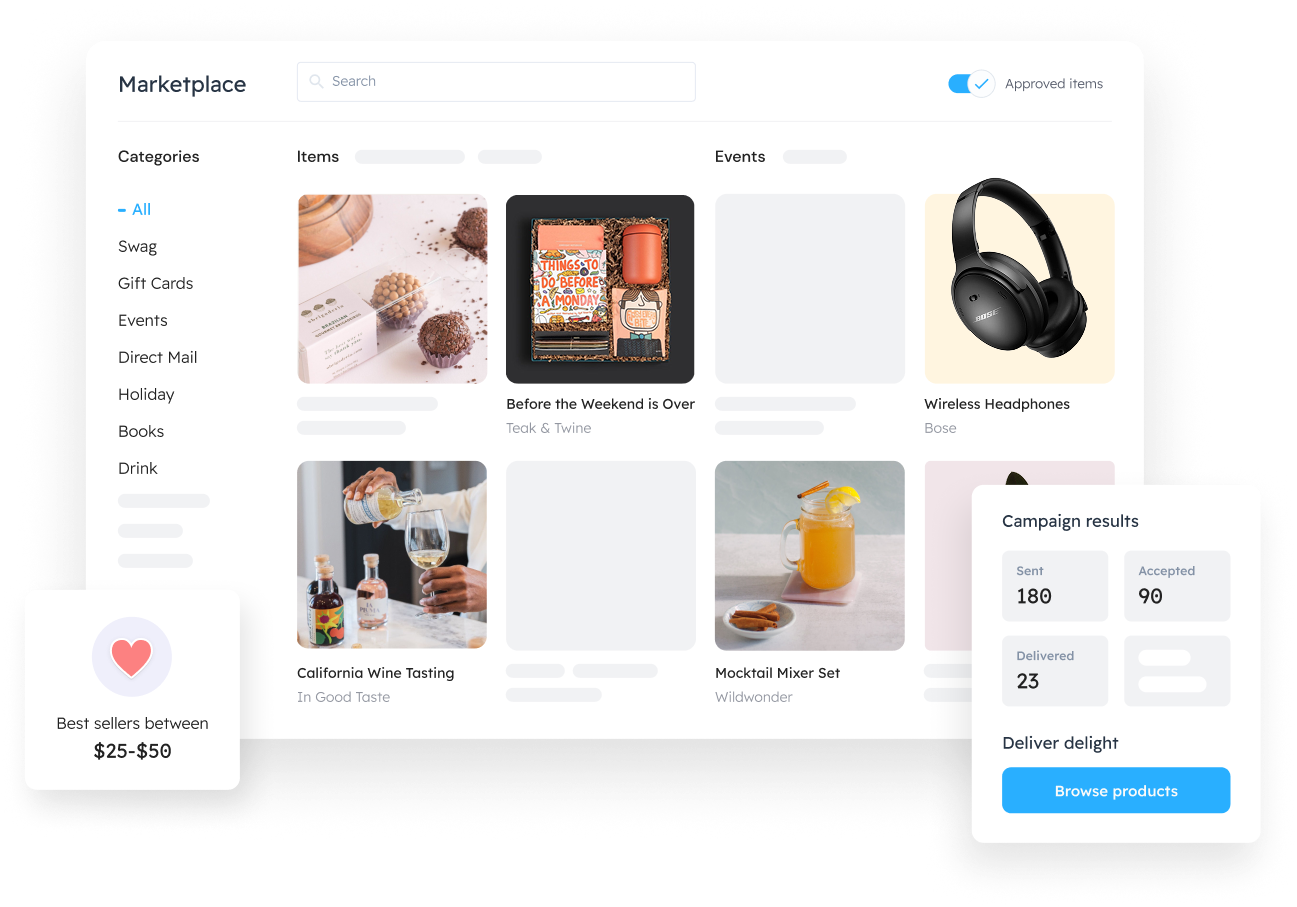
There is also Paper Plane, the creative agency offering. It helps with campaign ideas, custom merchandise, packaging, and kits. That is a consequential addition. A software catalogue cannot decide why your particular customer should care about your particular box. Sometimes the missing ingredient is an idea; sometimes it is a person who can source the right object and make the packaging behave.
The sending mechanics are practical. A personalized email or MagicLink can invite recipients to accept a gift and supply a preferred address. The sender need not begin with a reliable street address. The recipient gets a say in where the item arrives. An office directory becomes less of an obstacle when the person can choose the doorstep.
- 01Choose the moment
- 02Offer the gift
- 03Recipient accepts
- 04Fulfill & track
- 05Follow up in CRM
Postal’s January 2024 AI Smart Collections announcement addressed another bottleneck: choosing. The company said users could spend so long deciding what to send that they abandoned gifting. Its collections use engagement data to group suggested gifts around interests and occasions. The launch’s prospecting assortment included items priced at $30 or less. AI here has a decidedly domestic assignment: shorten the shopping trip.
Three thousand dollars, seventy meetings
Supermetrics offers a useful test of the proposition. Its earlier email campaign to connect self-serve customers with account managers booked 12 meetings, at roughly 1.3% conversion. The revised campaign combined appreciation, a choice of gifts, and an offer of a 30-minute account review. HubSpot emails carried Postal MagicLinks.
Postal’s case study reports 70 meetings from 3,309 contacts, $140,000 in pipeline, and $27,000 in revenue, against $3,000 spent on gifts. It calls that 9x ROI. The arithmetic is revenue divided by gift spend. It does not establish profit after software, staff, delivery, and other costs. Nor are the two campaigns presented as a controlled experiment.
$27,000 ÷ $3,000 = 9× revenue / gift spend
Pipeline is separate. This ratio excludes other campaign costs.
The offer had substance beyond the gift: useful advice from an account manager. That is the copyable lesson. Recipient choice lowered the guesswork; the review gave the conversation a purpose. A company can borrow that design without assuming it will inherit the same numbers.
Coffee, with an account score on the side
Fivetran’s campaign began with something it already possessed: a Forbes feature. Postal’s Paper Plane team helped package the magazine with coffee from a local, BIPOC-owned Oakland shop. A branded clip held the magazine open to the relevant page. A QR code led to a landing page with a CEO message and customer video. Even publicity, apparently, benefits from a bookmark.
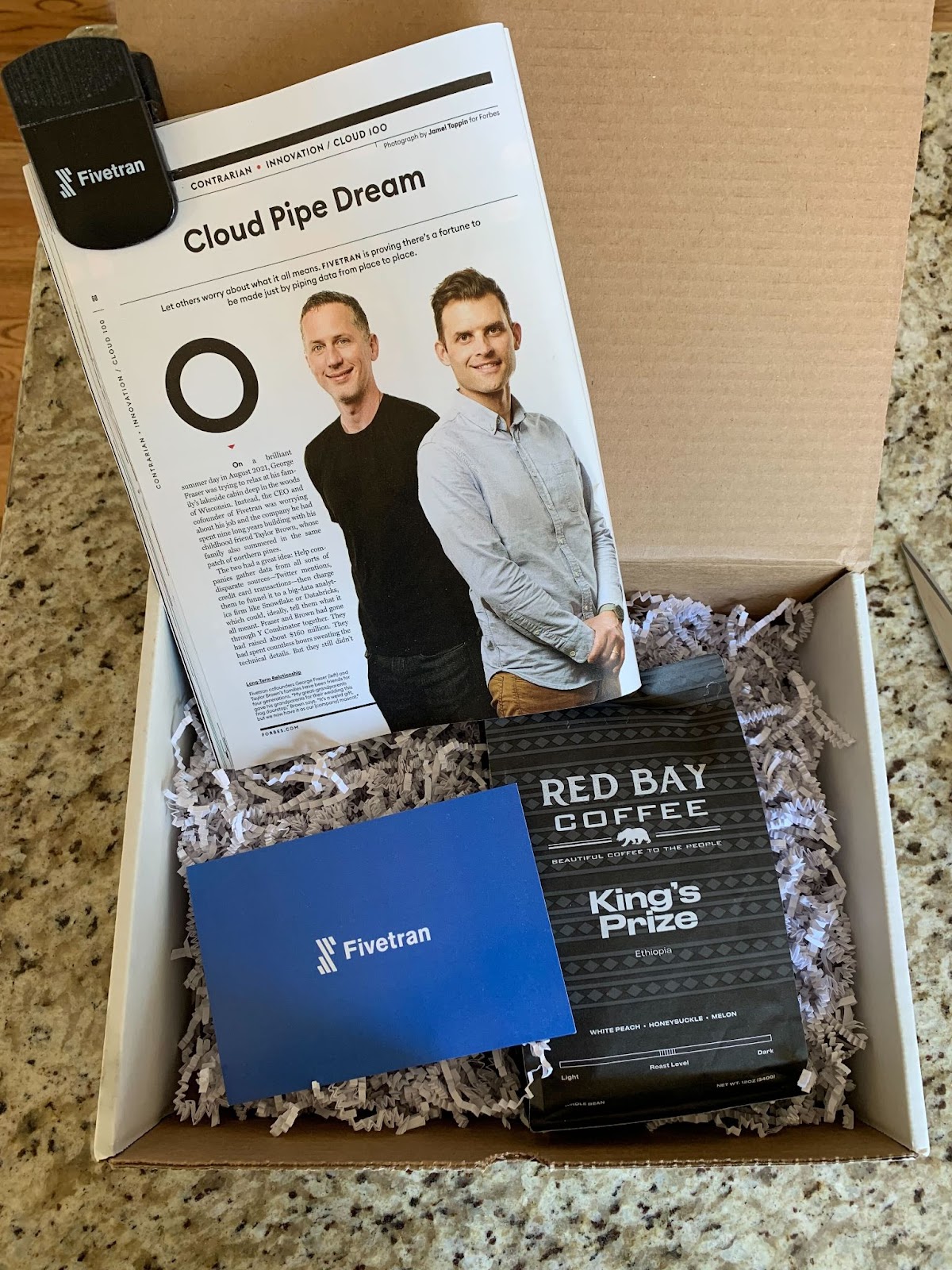
Sales managers allocated boxes; representatives could track acceptance; Salesforce, Marketo, and Demandbase connected the activity to account engagement. Postal’s published account reports $660,000 in influenced pipeline. “Influenced” deserves its full syllables: it does not mean a box single-handedly created that revenue. The operational insight is that the physical gesture returned a usable signal to the people responsible for the next conversation.
RollWorks supplies a different lesson: timing. Its published campaign waited 90 days after an opportunity was marked closed-lost, then paired a product-update webinar with a cocktail-kit offer. The reported conversion from accepted item to opportunity was 20%. Another sequence offered coffee at the proposal stage; contacts who redeemed it had a reported sales cycle 30 days shorter. Those selected groups may already have been more engaged. The results suggest a testable approach, rather than a causal verdict.
“It is saving me time”
Angela Laginess, Seismic, on Postal’s account-based gifting workflow
The rival becomes the parent
Postal was founded in 2019 by Erik Kostelnik and Jed Danner. The founders had previously worked together at TextRecruit, which was acquired by iCIMS. Their new company applied software discipline to another business activity full of manual work.
A $22 million Series B in September 2021, led by OMERS Ventures with Mayfield participating, brought announced equity funding to $31 million. Postal said the money would support hiring, its product roadmap, and international expansion. In November 2024, it announced a No. 34 position on Deloitte’s Technology Fast 500. The progression is a useful backdrop to the next development: a former competitor becoming the owner.
Sendoso announced the acquisition on May 1, 2025. Its explanation highlighted Postal’s interface, people operations capabilities, branded swag, and company stores as complements to Sendoso’s gifting business. Postal would continue as a standalone platform. That continuity matters to buyers assessing an existing workflow: the deal is a change in ownership, not evidence that every customer moved immediately into one application.
It also sharpens Postal’s market position. Its attraction is the combination of campaign software, curated purchasing, physical fulfillment, and creative help. Alternatives include other gifting platforms, merchandise suppliers, agencies, or employees managing the whole operation themselves. The relevant comparison is the work each option takes off the buyer’s desk.
Make the next conversation worth having
Postal’s current pricing page offers a sales conversation rather than a public dollar tariff. Its commercial offering combines platform access with gifts and services. A sensible budget must therefore account for the deployment, items, fulfillment, and staff time. Cheap merchandise can become expensive when it produces no useful next step.
Start with a specific audience and a moment that warrants attention. Offer something appropriate, make acceptance easy, name the person responsible for follow-up, and decide beforehand what success means. A reply, a meeting, an opportunity, and a renewal are different outcomes. Keep their numbers separate. If possible, compare a similar group receiving the same outreach without a gift.
The approach is less suitable when recipients cannot accept gifts, the economics of the account cannot cover the campaign, or nobody has capacity to act on the response. Acceptance is also an imperfect proxy for buying intent. Someone may like coffee considerably more than they like your proposal.
Postal can organize the gesture and preserve its trail. The useful discipline for its customer is to make the conversation that follows worth having. Otherwise, all that lovely automation has merely arranged for a mug to arrive on time.
Visit Postal · Product overview · Company blog · Acquisition announcement