The first thing to admire about a beautifully designed mailer is its confidence. It has been printed, packed and posted on the assumption that somebody, somewhere, will open it. The postal system is rather less sentimental. A wrong address sends the whole performance back to the sender.
Paycor learned this in bulk. In a customer story published by PFL, the payroll and HR software company describes a 50,000-piece mailing in which more than half the pieces came back because of bad data. Temporary staff were brought in to sort the returns. Imagine planning a campaign to start conversations and ending up with a sorting project.
- PFL connects physical mail to customer data and marketing workflows.
- It combines software with its own printing, storage and fulfillment.
- Its customer examples make the case for better operations before bigger sends.
- Vomela acquired the company in July 2025.
The address gets the last word
There is a tempting diagnosis for a failed campaign: the creative was dull, the offer was weak, the audience was indifferent. Paycor’s experience points to a humbler possibility. Some of the intended audience never received anything to be indifferent about. A marketing problem had become a location problem.
That distinction is a useful way into PFL.com. The company sells direct mail automation, alongside print and fulfillment. Its pitch is that a physical send can become a managed step in a customer relationship, connected to the systems marketers already use. The address is one of several details that must survive the journey.
The evidence becomes more concrete in another Paycor case study. Before a planned send to 15,000 prospects, PFL’s validation work updated more than 55,000 data points. The published account reports delivery of 95 percent of packages, compared with a historical level around 75 percent. These are figures from PFL’s customer account, rather than an independent experiment.
Different campaign conditions may apply. This comparison illustrates the published customer account, not a controlled test.
A printer walks into a software stack
PFL started in 1996 as a local printer in Livingston, Montana. Founder Andrew Field and his team launched PrintingForLess.com in 1999. That sequence matters. The business had to understand the stubborn physical properties of printing before it could turn a print order into a software action.
A digital marketer can change a subject line in seconds. A printed piece involves materials, production and transit. Somewhere between the campaign idea and the recipient’s desk are people who must make the thing, store its components, assemble it and dispatch it. PFL’s evolution connects that work to the digital decision about who should receive it.
Its current offering ranges from postcards and letters to catalogs, custom packaging and dimensional kits. Traditional direct mail handles batch campaigns without requiring an automated journey. The automated product connects mail to customer relationship management and marketing automation systems. A sales team, meanwhile, can use personalized, marketing-approved pieces to support outreach.
Customers include organizations selling software, enrolling health-plan members and serving bank customers. Those are different audiences with a common practical need: get a specific message to a specific person, with enough context to make a response plausible. A renewal reminder and a prospecting gift need very different manners.

PFL’s stated working culture has a similarly practical streak. Its careers page emphasizes people, relationships, progress and results, including simplifying processes and learning from failures. These are the company’s own commitments. For a business spanning software and production, the promise is relevant: a campaign depends on both the person configuring the workflow and the person making the package.
What happens between the click and the doorstep
PFL lists integrations with Salesforce, Adobe Marketo Engage, Iterable and Oracle Eloqua. The point of these connections is timing. Customer data can determine the recipient, personalize the piece and trigger a send. Delivery information can then support the next action in the same marketing or sales system.
- 01Choose the audience
Data + a reason to send - 02Make the mail
Personalize, print, assemble - 03Deliver + follow up
Track, respond, measure
Consider a prospect who has shown interest in a product. A team can make a mail step part of the existing nurture sequence, rather than export a list and invent a separate campaign. Once a tracked package arrives, a delivery notification can prompt sales outreach. There is a practical difference between calling with relevant context and asking whether a parcel might have appeared.
PFL’s distinguishing emphasis is the combination of software with in-house printing, storage and fulfillment. This makes it attractive to a team weary of coordinating several suppliers. It sits between commercial printing and enterprise marketing software, with human campaign support alongside both. A customer is buying execution as well as access to a tool.
That market has alternatives. Sendoso offers automated gifting and direct mail, with its own fulfillment and integrations. A team can also hire a printer, arrange fulfillment separately and manage the coordination itself. The useful comparison is which arrangement fits the formats, workflows and service requirements of the campaign. Owning more of the process is a purchasing consideration, not proof that every result will improve.
The arithmetic before the applause
The old Paycor address-validation case estimates that undeliverable packages could have incurred $161,000 in return-shipping and restocking fees. Treat that as a modeled exposure in a customer story, not a receipt for savings. Still, it directs attention to a cost often absent from the cheerful mock-up: what happens when the package fails to arrive.
PFL’s commercial offering combines software and physical services. A useful budget needs to account for platform access where applicable, setup and creative, printing or merchandise, assembly, storage and postage or shipping. Format and destination change the economics. So do rejected deliveries. A proposal should make those assumptions legible before anyone orders an impressive box.
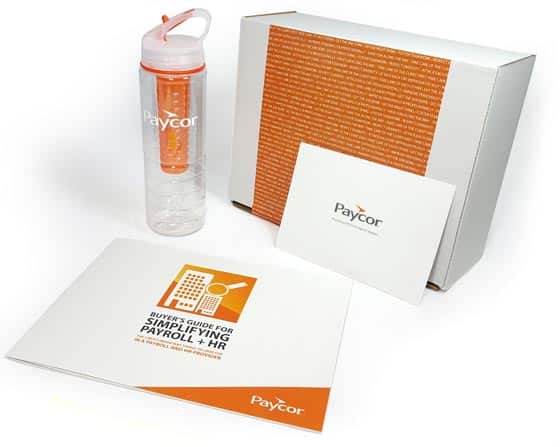
A separate Paycor story reports 15.6 times return on investment and a 13.7 percent conversion rate to sales meetings. Those are customer-specific reported outcomes, not a rate card for future success. Its more portable idea is the inclusion of useful buying content alongside the gift: give the recipient something that helps a decision, and give the salesperson something useful to discuss.
Hinge Health buys back its time
Hinge Health’s problem was less theatrical. Its direct mail campaigns encouraged eligible people to enroll in its services, but the steps were manual and costs were difficult to predict. The team wanted to scale, and it had selected Iterable as its marketing automation platform. Iterable’s recommendation brought it to PFL.
According to PFL’s account, existing templates were coded and built in roughly a couple of months. The team subsequently experimented with nine new mail formats. Growth marketing manager Gia Harris reported a lower average cost per piece and greater predictability, without publishing a campaign budget or a numerical reduction.
“We immediately had complete control of our costs.”Gia Harris / Hinge Health, in PFL’s customer story
The appealing part of this example is the change in what the team could spend its time thinking about. Less manual coordination leaves room to test messages and formats. Automation earns its keep when the team can make better decisions, rather than merely send more of the same thing.

A larger home for a physical channel
In April 2018, Goldman Sachs Growth Equity invested $25 million in PFL. The announcement earmarked the investment for research and development, product development and sales growth. It was a bet on the connection between marketing software and tangible delivery.
In July 2025, The Vomela Companies acquired PFL. Vomela’s announcement said PFL would remain in its Livingston facility and operate as a division, maintaining staff. Riverside had invested in Vomela earlier that year. The deal gives PFL a place within a broader visual communications business, rather than leaving automated mail as an isolated specialty.
Vomela’s April 2026 website announcement confirmed that PFL would retain its own online presence. The practical question for customers is how that larger organization improves execution. The acquisition announcement describes broader creative and operational resources; any benefit to an individual campaign still has to show up in its delivery, service and economics.
Copy the sequence before the spectacle
The sensible lesson is to start with a well-defined audience and a reason to contact it. Validate the recipient information. Choose a format that suits the message and budget. Connect the physical step to the existing journey, and decide what happens after delivery. PFL’s own guidance suggests testing modest formats before expanding into more elaborate kits.
Then measure the action you wanted, not just the parcel you shipped. Delivery establishes that the piece reached a destination. It does not, by itself, establish that the mailing created revenue. A comparison group, where practical, can help a team judge whether the added physical touch justified its full cost.
There are obvious limits to copy along with the method. A campaign that needs an immediate response must allow for production and transit. An inaccurate list can waste even a modest budget. Useful content still needs a willing reader. And a beautifully packed gift must suit the recipient’s circumstances. The mailbox is a channel with physical constraints, not a shortcut around judgment.
PFL’s story is interesting because the grand ambition depends on ordinary competence. The right person, the right address, a relevant piece and a follow-up that arrives while it still makes sense. A box can be charming. A process that gets it to the person it was meant for is rather more useful.