The whole thing, before your next email
- Opensense centrally controls signatures, disclaimers, campaign banners, digital cards, and engagement data.
- Its useful trick is organizational: IT governs the plumbing while marketing programs the message.
- Published signature plans cost $1-$5 per user monthly, but the platform carries a $500 monthly minimum.
- The model works best when many employees email valuable audiences and manual inconsistency is expensive.
The modern office has spent decades improving the email and almost no time thinking about the bit beneath it. Subject lines are tested. Body copy is polished. Attachments are tracked. Then, at the bottom, comes the corporate sediment: a name, a title from two promotions ago, a stretched logo, perhaps a quote attributed to Maya Angelou that Maya Angelou never said.
In 2013, Opensense co-founder Amit Gupta received a message from a friend at Microsoft. The email was ordinary except for one extra line in the signature promoting a job opening. It was a small observation with an entrepreneur's favorite shape: if this, then what else? Gupta and co-founder Bobby Narang began experimenting with links, trackers, document viewers, designed signatures, and account-specific banners. The email signature stopped looking like stationery. It looked like distribution.


A billboard disguised as office furniture
What Opensense does is simple to describe and awkward to execute. It gives one administrator control over the signatures that appear across an organization - in Microsoft 365, Google Workspace, Exchange, desktop clients, browsers, and phones. Employee details can sync from a directory. Marketing can rotate a banner by region, department, recipient, account, or stage in the funnel. Legal can attach the right disclaimer. Sales can see engagement signals. The recipient still sees a signature.
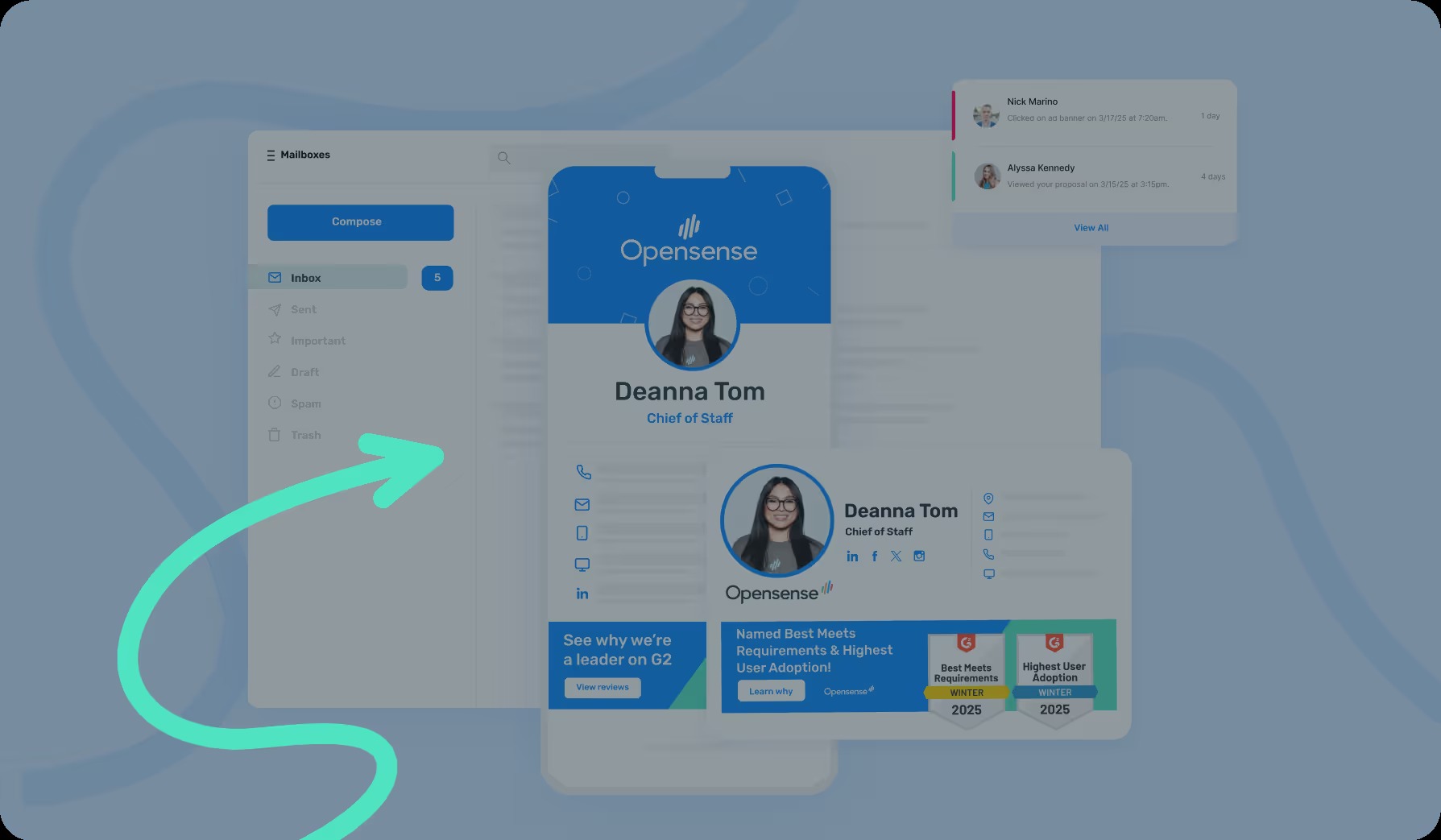
This matters because a company email is a peculiar media channel. It costs nothing extra to distribute, arrives inside an existing conversation, and is sent by a person the recipient can name. Opensense says campaign banners commonly see click-through rates of 4% to 7%. Treat that as a vendor benchmark, not a promise. The more persuasive evidence comes from named customers and the odd specificity of their results.
Outreach tested signature banners around Dreamforce, then used them to promote its own Unleash event. The company reported a 10% increase in ticket sales; those tickets cost more than $1,000. EDF Renewables, meanwhile, had started with a less glamorous emergency. More than 1,000 employees were improvising. There were bad mobile layouts, blurry images, even purple type on colored backgrounds. Within a day of deployment, the brand problem was under control. Then the banners lifted webinar registrations by 20%, and EDF stopped buying some outside advertising.
“We knew everyone was spending a lot of time sending emails, and that the potential customers getting the emails were perfectly targeted.”Christine Karlovic, EDF Renewables
The first thing to fail is usually the human workaround
The category exists because distributing a design file is not the same as governing a system. People copy old blocks. Phones render them differently. A new title stays trapped in the directory. Plug-ins need updates. Cvent described double banners and technical workarounds with a previous plug-in. American Cancer Society needed to move more than 3,000 signatures across three corporate entities. Montgomery County needed one rule system across 20 departments.
Opensense's distinction is less a single feature than the number of departments it asks to meet in the same tiny rectangle. Traditional signature tools may center IT. Marketing tools center campaigns. Sales tools center tracking. Opensense packages all three, then adds compliance and digital business cards. Its integrations include Salesforce, HubSpot, Marketo, Microsoft Dynamics, Outreach, Salesloft, Zendesk, NetSuite, and directories such as Entra ID and Google Directory. For government contractors, it also markets a deployment inside Microsoft 365 GCC High.
There is a revealing technical compromise. Server-side stamping applies the signature after a user presses send. That gives administrators firm control, but the sender may not see the finished signature while composing. A client-side add-in provides the preview and a friendlier experience, at the cost of some central enforcement. Opensense supports both. The boring detail is the point: enterprise software wins by respecting the inconvenient edge cases.
Customers asked for more than neatness
By 2025, the original promise - consistent signatures - was no longer enough. Opensense says customers wanted an interface that was easier to use, worked cleanly on mobile, and exposed more analytics and automation. The company rebuilt the platform around those requests, adding a redesigned campaign dashboard, upgraded engagement insights, and digital business cards. It was a shift from “keep this tidy” to “make this touchpoint perform.”
Its business model makes the target customer plain. Signature plans are publicly listed at $1, $3, and $5 per user per month. Tracking plans run from $20 to $65. But every plan begins with a $500 monthly minimum, plus applicable service costs. Opensense's own pricing copy says a ten-person company needing five signatures should use a free generator. That candor is also segmentation. The product earns its keep when scale, compliance, campaign volume, or support needs turn a cosmetic nuisance into operational work.
The playbook is hiding in the footer
There is something other companies can copy without buying Opensense: audit the surfaces you already own. Look for communication that is frequent, trusted, and boring enough to be ignored. Count its distribution. Ask which department currently controls it, which departments benefit, and what breaks when employees improvise. Then test one useful message against one clear outcome. EDF used webinars. Outreach used event tickets. Baker Hill used awards, recruiting, events, and video.
This is not automatic alchemy. A five-person studio will struggle to justify the minimum. A company whose employees rarely email customers has little inventory. Image blocking, security filters, weak creative, and an irrelevant offer can erase the marketing upside. Tracking introduces privacy and governance questions. And central control can become central clutter if every message is forced to carry this quarter's loudest promotion.
The good version is quieter. The banner fits the conversation. The directory data is correct. The disclaimer appears where required. The employee does not become unpaid tech support. Opensense's neatest achievement is not persuading companies to care about signatures. It is persuading IT, marketing, sales, and legal that they have been looking at the same object all along.