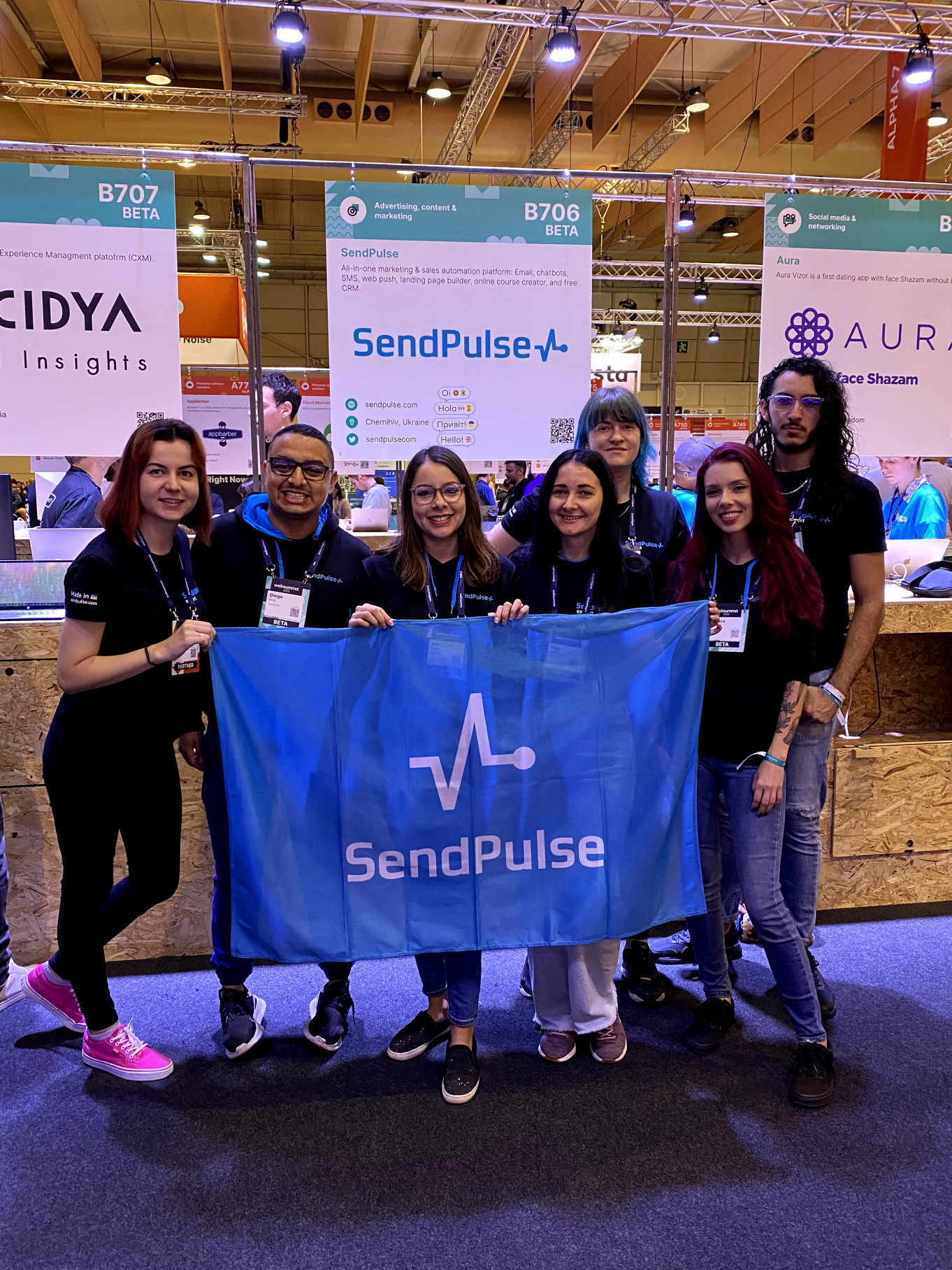
On the train from Lisbon to Kyiv, Alina Dykuha had a charged device, a head full of conference noise, and enough distance from Web Summit to see its machinery. The event had offered more than 70,000 people, 160 countries, 2,296 startups, and almost every imaginable way to become distracted. Dykuha responded by writing a field guide.
Her advice was gloriously concrete. Arrive with a goal. Give each teammate a basic KPI. Learn where the LinkedIn QR code lives before the crowd swallows your attention. Photograph the people you meet. Put context in the follow-up. Keep paper business cards because convention-center Wi-Fi is a creature of appetite and mood. Extract contacts before the event app becomes yesterday's furniture.
There was also the useful business of being findable. A colleague had blue hair; Dykuha had pink. When someone asked where they were, the answer was practically a coordinate system. Next time, she joked, they would add bright hoodies. Positioning theory has produced many thick books. Few improve upon two people with unmistakable hair in a hall the size of a small republic.
“Preparation is everything.”Alina Dykuha, writing after Web Summit 2022
The useful thing beneath the shiny thing
That dispatch reveals the habit beneath Dykuha's career. She likes the bright end of marketing: a stage, a launch, a piece of merchandise that people actually keep. But she keeps returning to the plumbing. What triggers the message? Who owns the lead? What will a reader understand? What must happen tomorrow morning, after the applause and the lanyards?
At SendPulse, where she became Head of Digital Marketing, the plumbing was literal software: email, SMS, chatbots, landing pages, course tools, and the connective tissue of automation. Her public teaching covered both B2B and B2C email strategy, messenger marketing, analytics, and the difference between a legitimate campaign and spam. A lecturer profile credits her with more than 50 launched projects. SendPulse's 2024 conference biography put her at more than ten years in digital marketing.
Teaching became another test of whether a system could survive contact with a person. For Diia.Education, the Ukrainian national learning platform, Dykuha served as the expert for a video course on email marketing. The syllabus begins with the profession itself, then moves through strategy, collection, segmentation, personalization, analytics, and the anatomy of a message that earns its place in an inbox. It was made with support from Google.org, the East Europe Foundation, and SendPulse. The sequence is telling: tools arrive after purpose.
Her other classrooms have ranged from SendPulse Academy and WebPromoExperts to conference stages including iForum, Nooma Marketing, and Marketing Point. The scale could be intimate or enormous. Over one five-year stretch, her SendPulse biography says, she trained more than 500 executives and business owners while webinars and online conferences drew more than 100,000 attendees. These are different teaching problems. An executive wants the decision hidden inside the method. A beginner needs the method opened carefully, without being made to feel late to the party.
Dykuha's course material tends to meet both needs by naming the next action. A subscriber list must be collected, then segmented. A campaign must be measured, then adjusted. A conference contact needs a note, then a follow-up. The pattern is modest enough to overlook, which may explain why so much marketing overlooks it. Momentum rarely comes from one enormous revelation. More often, somebody has removed the ambiguity from the next ten minutes.
A recurring operating loop
Dykuha describes herself as a messenger-marketing believer, a no-code lover, and an AI enthusiast. The labels might sound tool-first until one reaches her position on automation. In a 2025 panel, she and fellow fractional CMO Olivia Milton argued that automation should amplify a genuine brand voice rather than replace it. The machine can send the note. It cannot decide whether the note deserves to interrupt someone.
When the product is an industry
Her next major chapter expanded the unit of work. At Lviv IT Cluster, a business association of hundreds of technology companies, Dykuha led marketing and PR and held the same responsibility for IT Arena. A SaaS platform has features and users. An industry association has companies, workers, public institutions, partners, and an international reputation. The marketer is no longer explaining one product. She is helping many groups recognize themselves in one account.
IT Research Ukraine 2023 made that problem visible in rows and columns. More than 400 tech companies and over 7,000 respondents contributed to the study. Dykuha recalled opening the tables and spending a long time with their precision. Her team's challenge was editorial: how could complex descriptions become intuitive to someone who was not an analyst? They worked through the report's language and presentation so that the data could travel into business decisions.
The anecdote is a small rebuke to the notion that communication begins when research ends. Presentation was part of the research's usefulness. Accuracy tells the truth; legibility lets the truth leave the room.
The same bridge between national story and practical marketplace appeared in CodeUA. The Ministry of Digital Transformation and Lviv IT Cluster created the platform to connect global clients with vetted Ukrainian technology companies. Dykuha and her team prepared its release on Web Summit's main stage in November 2024. She reported that more than 100,000 people saw it in a day. The metric mattered because the platform's job was visibility with a destination attached.
IT Arena 2024 brought a different sort of operational theater. Dykuha wrote afterward about brainstorming sessions, abandoned drafts, filming, transfers, real-time social coverage, and even defending against DDoS attacks. The public saw an edition called New Dawn. Her team saw the weeks required to make three days look coherent. Her account placed the credit with them: “My dream team, you already know everything, but I will remind you that none of this would have happened without you.”
A deliberate change of distance
At the end of that chapter, Dykuha stepped down from the director roles at Lviv IT Cluster and IT Arena. She had been considering part-time work and described the choice as difficult but considered. “Sometimes, to move forward, you need to let go,” she wrote. A sabbatical was somewhere in the imagined next scene.
It did not survive first contact with demand. Projects that matched her philosophy arrived quickly. Dykuha moved into fractional CMO work in B2B SaaS, explaining the attraction with unusual precision: enter deeply enough to act as an in-house team member, but retain enough distance to see the whole system. Focus effort. Choose the work. Balance the terms of life and labor. She closed the announcement with three brisk verbs: “Moving forward, experimenting, living.”
The portfolio has since acquired names. Current public listings identify Dykuha as Advisory Board Chief Marketing Officer at KeyCRM and VECTOR. At VECTOR, a Ukrainian creative-tech media company, she said her team's remit includes video production, events, social media, and promotion for both internal and client projects. Ringostat's digital-agency jury also describes her as an entrepreneur who helps Ukrainian and global companies grow through marketing and automation, and lists her teaching work with Google Ukraine, Diia.Business, Diia.Education, and Udemy.
It is tempting to read the move from operator to advisor as a retreat from detail. Dykuha's record suggests the opposite. Advice is only valuable when it respects the texture of execution: the table that frightens a non-analyst, the lead without a note, the follow-up sent too late, the clever bot with nothing human to say. Distance helps only if one remembers what the machinery feels like from inside.
The person inside the process
Outside the process charts, Dykuha plays guitar, takes photographs, and likes discovering new countries. Travel shows up in her professional writing less as escape than observation. After Web Summit, she moved through Nazaré, Porto, and Valencia, finding Ukrainian groups and extending conversations beyond Lisbon. Even leisure came with a community layer, though fortunately not every guitar needs a conversion funnel.
Her public voice is candid about effort. Teams sleep little. Drafts fail. Numbers shock before they clarify. A grand event contains transfers, screenshots, messages, and someone remembering the paper cards. This refusal to airbrush the operating work gives her optimism some weight. Experimentation is not a mood board. It is what remains after a failed draft has been useful.
“Moving forward, experimenting, living.”Dykuha on beginning her fractional CMO chapter
Across SendPulse, Lviv IT Cluster, IT Arena, KeyCRM, and VECTOR, the visible outputs differ: a chatbot, a national study, a conference, a marketplace, a media project. The recurring craft is translation. Set the outcome before choosing the channel. Turn complexity into a sequence. Give the audience a next move. Preserve enough personality that a person knows another person is present.
The pink hair eventually changed. The habit of being findable did not.