Kostyantyn Rozenshtraus-Makarov began his working life with an unusual salary negotiation. A programmer’s job advertised on a forum offered $10 an hour. Still a student, he volunteered to do it for $5. He got the job. Before the international offices, the chatbots and the arguments about artificial intelligence, there was a young programmer making himself a half-price proposition.
He had once considered becoming a lawyer because the money looked attractive. Mathematics came more easily, however, and programming offered the agreeable prospect of spending the day at a computer at home. His account of choosing a profession is refreshingly practical. Destiny seems to have received less consideration than the working conditions.
The job was at ePochta, which made software for email and SMS marketing. He eventually became its chief executive and a co-owner. Then customers began wanting something the business did not provide: a service they could use in a browser. His next chapter would require leaving a position he had spent years earning.
The browser changes the bargain
His early career took shape in Chernihiv, in northern Ukraine. After inviting his boss, Yevgen Medvednikov, to visit, he proposed opening an office there over the course of dinner and a walk. The office opened in 2006. The accommodation was less polished than the ambition: rooms in an old state enterprise, followed by moves between apartments.
By 2015, the two partners were building SendPulse. For someone who had advanced by making installed software, the browser posed an awkward question. How much of that accumulated expertise would still matter when the customer no longer wanted to install anything?
The answer was to carry the knowledge of marketing into a different product. SendPulse’s own chronology dates its launch and first customer to February 2015. Browser push notifications followed that December, Viber campaigns in July 2017 and Automation 360 in November 2017. Each addition widened the range of conversations a customer could manage.
There is a practical thread running through those releases. An email campaign, a browser notification and a triggered follow-up happen in different places, but a small business may need the same person to arrange all three. Bringing the tools together could spare that person another integration, another supplier and another explanation of what they were trying to sell.
- 2015SendPulse launches
Email meets the browser - 2017Automation 360
Follow-ups become flows - 2019Facebook chatbots
Conversations join the mix - 2022Course builder
Teaching enters the platform
New York sends back an answer
In August 2016, the Starta accelerator brought SendPulse to New York. Makarov wanted to understand the American market. The attraction was easy to see: a large pool of businesses already spending money on marketing software.
That existing spending also made the opportunity difficult. Those companies already had tools, habits and integrations. A sales pitch had to overcome the cost of abandoning them. A slightly better price could disappear inside the bill for moving.
SendPulse tried a US sales operation anyway. Makarov later put the six-month experiment’s cost at $100,000 and described it as unsuccessful. An expensive disappointment can become an expensive ornament in a founder’s biography. His account is more useful because it identifies the mechanism: customers had reasons to stay where they were.
He later described hiring two American sales managers and pursuing cold leads. The product’s advantages did not sufficiently compensate for switching costs. It is a sober detail in a business often discussed through launches and growth rates. A customer can agree that a product is good and still have no sensible reason to buy it.
For Makarov, international expansion would involve finding places where the proposition fitted better. Brazil and Mexico became important parts of the business. Getting there involved local managers, local payments and attention to how people actually communicated. A translated interface was only the beginning of the work.
$100,000spent, Makarov recalled
6 monthsto test the approach
Brazil asks different questions
The Latin American experience gave him a more specific vocabulary for expansion. By July 2025, he was explaining the need to integrate local payment systems and adapt sales funnels. In Brazil, he pointed out, much of the conversation happens through WhatsApp. Software has to accommodate the habits of the people paying for it.
Earlier experiments had been uneven. A Brazilian management change improved results; Chile proved difficult; Mexico developed into a base serving Latin America. His description of those experiences gives local leadership a central role. The country on the expansion slide matters, but so does the person answering the customer’s questions on Monday morning.
In January 2026, looking back on 2025, Makarov identified Brazil, Mexico and Colombia as areas of focus. Brazil, he said, had become second by new-user numbers. The geography that once followed an unsuccessful American experiment had become part of his explanation for the company’s continuing growth.
The US remained among SendPulse’s principal markets in its 2025 company account. That makes the early setback more interesting. A failed sales approach at one moment need not settle a country’s place in a business forever. It can tell a founder which route is proving too costly, while leaving other routes open.
A chief executive within talking distance
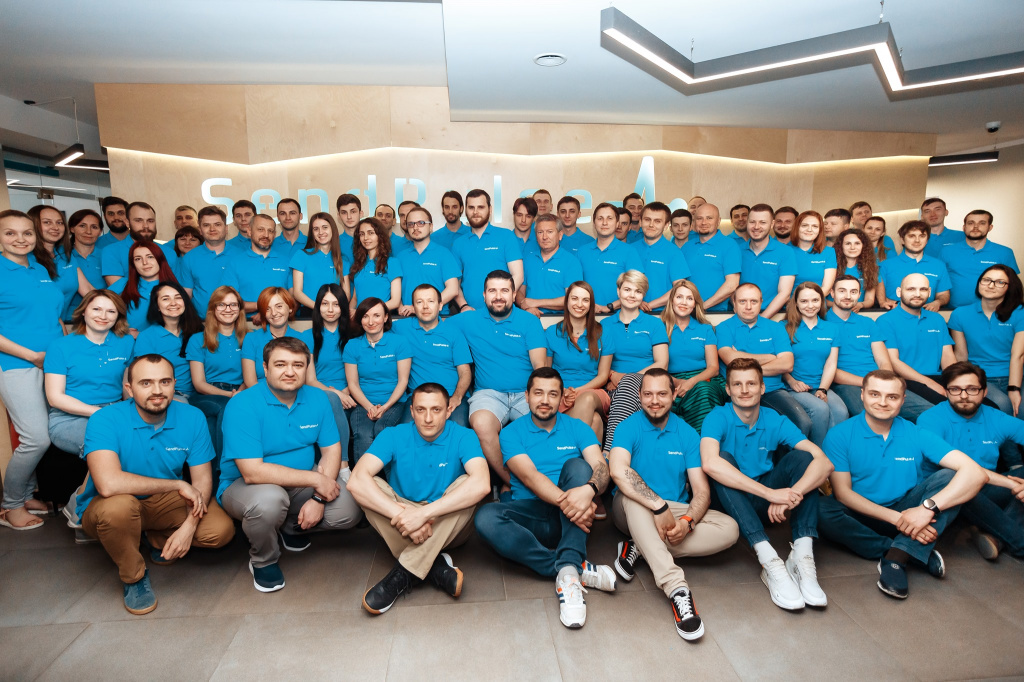
Makarov has described himself as calm and democratic, preferring to share an office with colleagues. The preference gives a physical form to his account of management. A person with a question should be able to ask it. The chief executive need not become an appointment with a door attached.
His description of product development is more structured than that informal proximity might suggest. In a 2023 post, he outlined six development teams, each responsible for one or more services. Product managers set priorities for their areas; the teams synchronized around broader goals. The development group then numbered 75.
He also described strategy meetings with senior management every six months. That rhythm allows a useful distinction between direction and detail. A platform can retain a coherent purpose while teams change what they are building next. Particularly when the platform contains several products, somebody has to reconcile the promises.
His partnership with Medvednikov remains part of that process. In a 2020 interview, Makarov said he wanted to remain involved in operations because he still had a vision for the company’s transformation. He discussed bringing Brazilian colleagues into strategy sessions, too. Distance was a management problem to address, rather than a reason to leave an office out of the conversation.
“I also listen to the opinion of the team.”
Kostyantyn Makarov, in a 2021 interview
His public writing extends to small details of usability. A 2017 article under his name advised email designers to use a single column on mobile and make buttons at least 44 by 44 pixels. The subject is less glamorous than an international launch. It also concerns the exact moment when a customer tries to do something and either succeeds or gives up.
Keeping people and work moving
In late January 2022, Makarov gathered employees to explain a contingency plan for a possible invasion. It included relocation within Ukraine or abroad, with travel costs covered and part of the rent supported for several months. The planning preceded Russia’s full-scale invasion on February 24.
The company’s later account describes colleagues exchanging practical information about roads, petrol stations and cash machines. The immediate demands were concrete. A relocation policy had to become transport, accommodation and a way for people to keep in contact.
In spring 2022, Makarov also wrote publicly about the commercial damage. Ukrainian sales in March had fallen to 44% of their prewar level; April reached 66% of projected sales. He announced three months of service credit for new Ukrainian customers. The offer connected the company’s own need to keep operating with its customers’ need to keep selling.
In 2025, he announced a technology partnership with Diia.Business’s Vidvazhna accelerator for women entrepreneurs. Participants would receive access to SendPulse tools, and the overall winner would receive 200,000 hryvnias in service credit for a year. The distinction matters: it was support through the company’s software, with a specified use and duration.
The programmer makes room for the teacher
One product choice widened his brief beyond marketing messages. Before the 2022 launch of SendPulse’s course platform, Makarov described a service for teaching customers, selling expertise and organizing staff training. His examples included structuring lessons, testing knowledge and giving moderators a way to supervise progress.
For a course creator, those tasks sit beside familiar business problems: attracting an audience, tracking a prospective student and accepting payment. A course builder inside a marketing platform follows the customer across more of that work. The product boundary moves because the customer’s working day does.
In November 2023, SendPulse also announced the integration of 13Chats, a service developed within its group since 2020. Pop-up forms and live chat fitted the same expanding picture: a website visitor could become a conversation, then a contact, then somebody a business could serve again.

The next change arrives through search
By September 2025, Makarov was discussing a fresh disruption: AI answers and changes to Google search were reducing traffic and leads. Referrals from ChatGPT, Perplexity and Gemini were growing, he said, but had not made up the loss. His response included diversifying acquisition and improving onboarding and retention.
It is a familiar predicament in a new setting. The programmer who watched customers move from installed software into a browser now has to consider what happens when prospective customers find answers without visiting a website. The point of contact keeps moving.
SendPulse’s March 2026 review of the previous year reported 350,000 additional users and 228 staff. Its stated plans for 2026 emphasized performance, analytics, integrations and AI. These are company figures and intentions, rather than a score for one person. They describe the scale of the operation he is helping to steer.
Looking back on 2025, Makarov said AI had helped him make decisions faster and improve his own effectiveness. His career offers a reason to pay attention to that claim without treating it as a forecast. He has already had to reconsider the product, the market and the work of running the business. The next decision will still need somebody to make it.