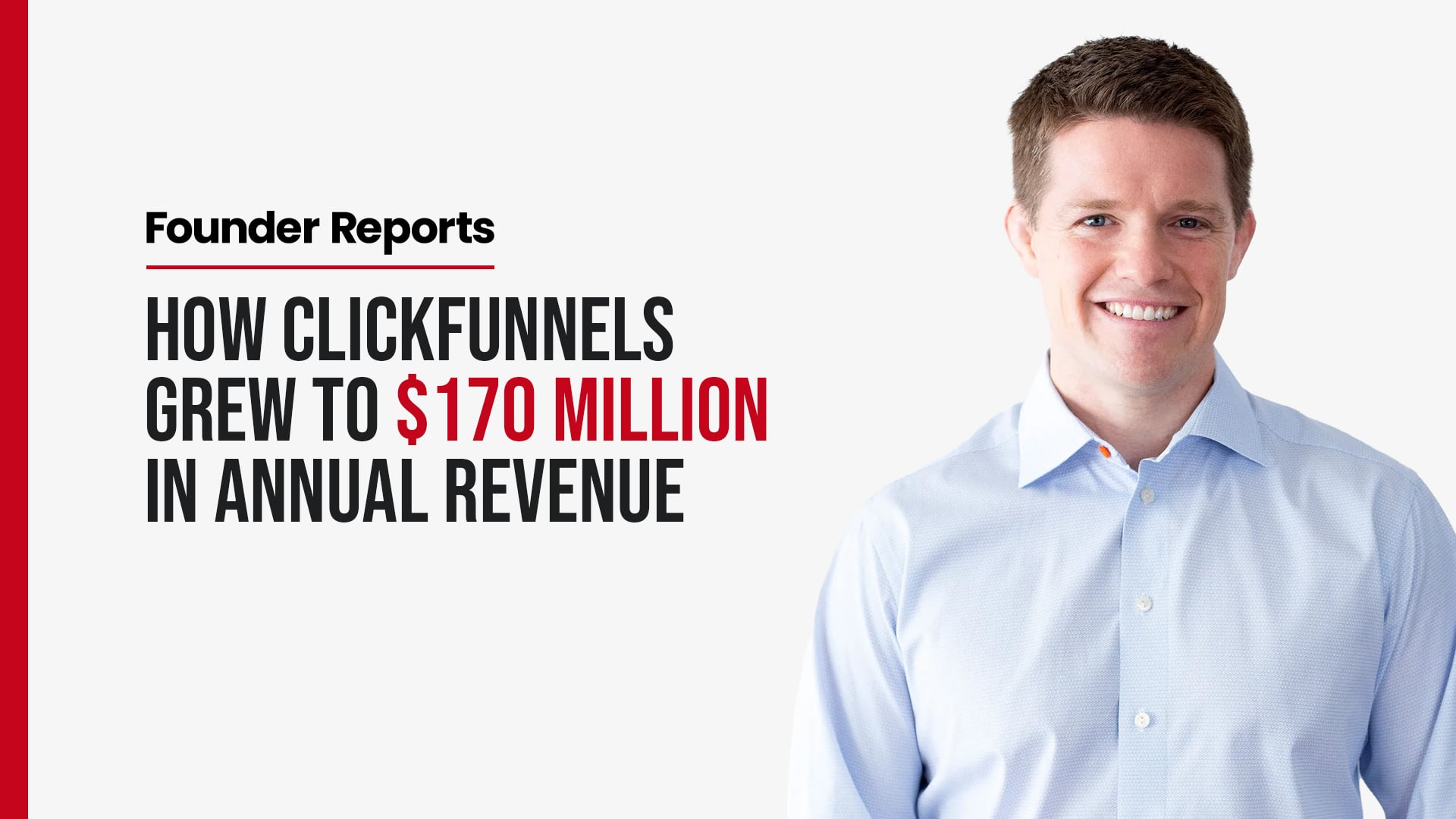
The awkward customer for a company selling sales funnels is the person who will not enter one. At ClickFunnels’ launch, Russell Brunson expected thousands of sign-ups. In his later telling, the ads struggled and the conversion rates disappointed. Then he gave a presentation in San Diego. He says 30% of the audience bought. The tool had found a teacher.
- The job: connect an offer, a checkout and the follow-up.
- The audience: entrepreneurs, coaches, creators and online sellers.
- The distinction: software sold alongside a method for using it.
- The price of admission: monthly plans start at $97; customers still supply the offer and the traffic.
A lesson before a login
Brunson and software builder Todd Dickerson launched ClickFunnels in October 2014. Their problem was familiar to anyone who had tried to sell online: pages, payments and marketing tools had to be persuaded to cooperate. Brunson handled the selling; Dickerson built the software. In the founder’s account, the successful presentation became an on-demand webinar. He reports growing from 100 beta testers to more than 10,000 paying customers during the first year.
Consider the change in the proposition. A stranger asked to subscribe must first decide whether the tool is useful. A stranger shown how to solve a sales problem has already begun that decision. The webinar gave the software a job. This is the useful inference from the launch story, rather than a conversion rate any other founder can expect to inherit.
The choreography of a sale
A conventional website lets visitors wander. A funnel arranges a sequence: an invitation, an explanation, a purchase, perhaps a second offer. ClickFunnels’ visual builder lets a business assemble those connected pages without commissioning each one from a developer. Templates supply a starting shape; the owner supplies the argument. A funnel is a proposed route, and the visitor remains free to leave.
Imagine a photography teacher offering a free guide, then a paid workshop. The first page collects an email address. The next explains the workshop. The checkout takes payment. An email sequence can follow up with someone who expressed interest. This is an illustrative use case, not a customer result. It shows why a solo operator might prefer one connected system to a collection of separately configured tools.
- 01InviteA useful free guide
- 02ExplainA workshop offer
- 03SellA clear checkout
- 04Follow upEmail and delivery
The checkout tools add two particularly revealing devices. An order bump offers an extra item at checkout. A one-click upsell offers an additional purchase after the first. For our imaginary teacher, that might be a workbook or a coaching session. Those offers can increase what a buyer spends. They also demand restraint: a checkout crowded with surprises is a poor introduction to a long relationship.
The product now extends well past the pay button. Courses provide a place to deliver instruction. CRM tools organize contacts and sales opportunities. Email and workflows handle broadcasts and triggered follow-up. These are separate business chores gathered around the same customer journey. Availability and allowances still depend on the subscription.
The monthly bill has company
The September 2026 price sheet lists Launch at $97 a month, Scale at $197 and Optimize at $297. Annual commitments cost $970, $1,970 and $2,970 respectively. Dominate is annual-only at $5,997. Launch includes one workspace, two team members, 10,000 contacts and 50,000 emails per month. Scale raises the contact allowance to 75,000 and adds full API and webhook access. The advertised unlimited-funnel offer is marked as limited time.
Software subscription only. Annual-only Dominate: $5,997/year.
That makes the question less romantic than “Can I build a funnel?” How many contacts will it hold? How often will I email them? Do I need several business workspaces? Advertising, payment processing, product costs and returns belong in the same calculation. A subscription is one line on the bill; it is rarely the whole bill.
There are overlapping alternatives. Shopify centers its proposition on commerce; Kajabi on knowledge businesses; Unbounce on landing pages and conversion work. My reading of ClickFunnels’ position is that it appeals most directly to an owner who thinks in offers and sequences. Choosing well begins with the work your business actually needs done.
A million dollars, with two commas
ClickFunnels sells an identity along with its software. Customers are “Funnel Hackers.” The Two Comma Club recognizes a million dollars in funnel revenue. The name is pleasingly literal: count the punctuation in 1,000,000. But revenue does not establish profit. The plaque cannot tell you what the advertising cost.
The company’s growth account describes free-book funnels with shipping charges and additional offers, plus challenges that teach funnel building. Historically, it says the One Funnel Away Challenge charged $100, helping cover acquisition costs and affiliate payments. Teaching became something people could buy on the way to buying the software. This is acquisition with homework.
“We bootstrapped ClickFunnels from day one.”
Russell Brunson · Founder Reports
The affiliate program advertises 30% recurring commissions on qualifying active accounts. That helps explain the abundance of enthusiastic recommendations around the product. It also makes the relationship worth knowing when assessing a review. A useful demonstration and a financial incentive can occupy the same browser tab.
The rebuild behind the promise
A March 2026 company account acknowledges a less tidy episode: ClickFunnels 2.0 was announced before it was ready. Its eventual reception included frustration with bugs and missing features. The same account says the company dropped the “2.0” branding by mid-2024. The ambition was to handle more of the business after the first funnel worked. Expansion made the promise larger, and delivery harder.
It also describes a remote workplace, where Ashley Dickerson took on culture and employee experience and introduced biweekly virtual fireside chats. There is a practical symmetry here: customers need to understand how the pieces connect, and employees spread across time zones need that understanding too.
The expansion continues. A July 2024 Zendrop partnership added a physical-product supply and fulfillment connection. The integration imports products and synchronizes orders and tracking. It reduces manual handoffs; the merchant must still evaluate the product, delivery experience and margin.
On September 18, 2026, Build with AI and the MCP server left beta. The former generates funnel steps, page designs and copy; the latter lets authorized AI clients work with selected business resources. The same day’s SDK and custom HTML release added routes for pages built outside the visual editor. More ways to make a page still leave the owner responsible for what it says.
Copy the experiment, then count the money
The portable lesson is modest: give one audience one useful explanation, then ask for one clear next action. Build a short journey before adding branches. Use A/B testing to compare a meaningful change, such as the offer or headline. Check analytics against actual purchases and delivery costs. A beautiful opt-in rate is little consolation if the buyers disappear before checkout.
This approach depends on an offer people want, reachable customers and enough margin to pay for acquisition. It becomes less useful when those conditions are absent, when buyers need extensive consultation, or when a business already has systems that serve it well. Faster construction cannot resolve a bad bargain. The durable question ClickFunnels puts in front of its customer is wonderfully ordinary: what would make the next step worth taking?
Open another tab
Explore the website, product walkthrough, SDK video demo and founder interview video. Follow the release notes or company blog.