In October 2025, Jaleh Rezaei and Nikhil Mathew went for a walk along the Hudson River. They had built Mutiny into the sort of company founders are supposed to want: venture backing, recognizable customers, eight-figure annual recurring revenue. Yet they were discussing whether to dismantle it. The question, Rezaei later wrote, was whether they would solve the problem this way if they were entering Y Combinator that day. Both answered no.
- Mutiny replaced website-personalization software with an AI sales assistant.
- It creates buyer-facing assets and automates the work around them.
- The useful test is time saved on a real deal, including human review.
01 / A successful business becomes the bottleneck
Mutiny began in 2018 with a frustration Rezaei knew from leading marketing at Gusto. Getting people to a website was one job; persuading them to buy was another. Improving that second job required engineering and design resources marketers could not simply summon. Mutiny’s early answer was a no-code platform for making websites more relevant to different audiences.
The proposition attracted money. An $18.5 million Series A in 2021 was followed by a $50 million Series B in April 2022, co-led by Tiger Global and Insight Partners. Its customers included companies with serious marketing operations. An eyepatch-wearing raccoon served as mascot. Corporate respectability had, apparently, survived the trash panda.

Then AI changed the founders’ estimate of what was possible. Their initial compromise was familiar: keep the established software as a source of cash while building the new agent. According to Rezaei’s account, splitting teams, cutting headcount and stopping new legacy sales did not resolve the conflict. The old business still needed attention.
Forbes reported the eventual cost: customer contracts terminated, the team reduced to 15 people, and a product built over seven years abandoned. The reset happened in November 2025. This was revenue deliberately surrendered, with customers and colleagues bearing consequences. A growth chart cannot make that part disappear.
“Nothing made us fast enough.”
Jaleh Rezaei, describing the attempts to run both businesses
02 / The sales deck leaves the waiting room
The new Mutiny puts an AI assistant in the middle of customer-facing work. An account executive can ask for a personalized pitch deck, pricing proposal, business case or deal room. A marketer can create an account-specific landing page. The intended result is material someone can actually show a buyer, carrying the company’s brand and the account’s context.
That distinction matters. A generic paragraph about an industry is easy to produce. A useful proposal must reflect what the buyer said, which problem matters, and what the seller can substantiate. Mutiny’s expertise sits where account research, sales messaging and presentation meet. Its promise depends on bringing those ingredients together with less assembly work.
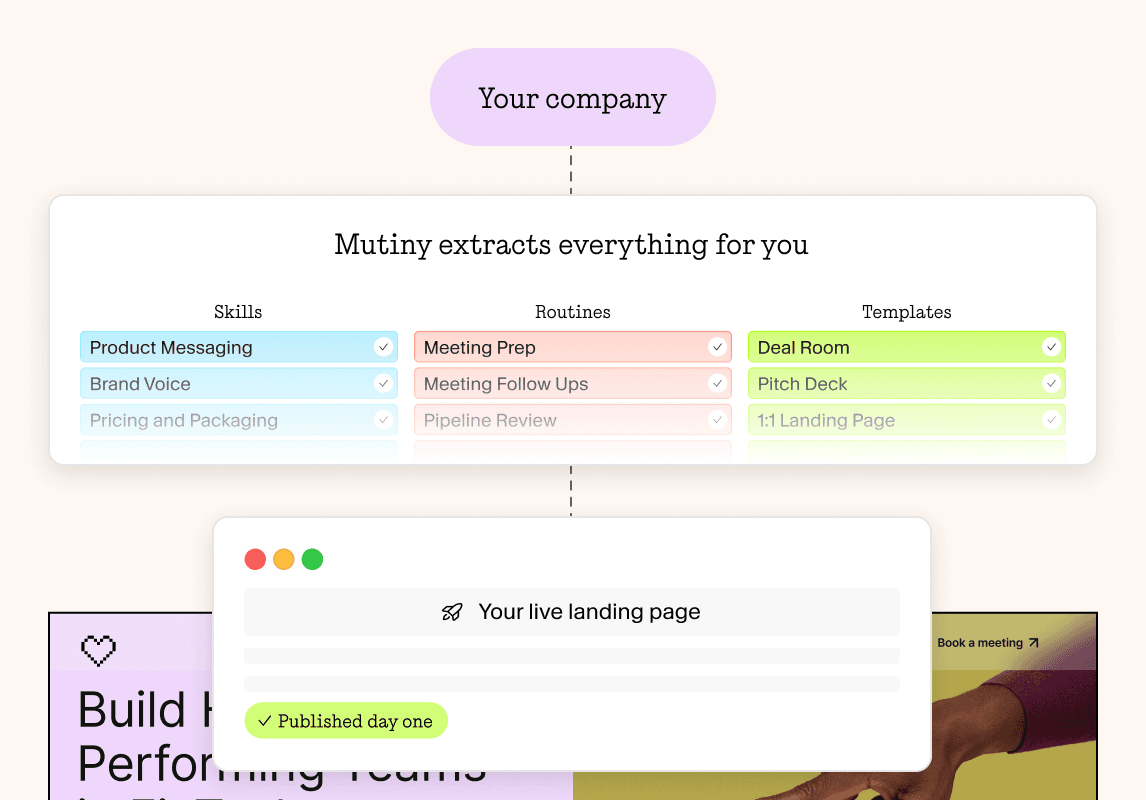
In June 2026, Mutiny announced automation and collaboration around that creation layer. Connected email, calendars, CRM records, call recordings and Slack can supply context. Skills and routines support meeting preparation and follow-ups; deal rooms and CRM records can update after calls. The company reported 3,000 organizations using Mutiny, including Rippling, Snowflake, Uber and GitLab. That usage count does not establish how many pay.
03 / Twenty minutes is a better argument
Consider Netic, an AI revenue company selling into essential services. Its account executives had enterprise-selling experience, but a small marketing and design team. In Mutiny’s customer case study, Nolan Matura described collecting emails, Gong recordings and prospect research before laying out personalized decks. The old process took three to four hours.
The reported replacement took 20–30 minutes. At several decks a week, Netic estimated roughly ten hours saved per rep. These are customer-reported results in a vendor case study. They are useful because the task is concrete: prepare the material a buying committee needs. They do not prove every deployment will save the same time or close more business.
Netic’s reported ranges. Bar lengths use upper endpoints; this is a time comparison, not a revenue forecast.
The competitive field is consequently awkward to draw. General-purpose assistants such as Claude and ChatGPT can help draft content. A sales-enablement library can help someone find existing material. Manual design offers control. Mutiny’s wager is that teams will pay for an integrated route from account evidence to a finished, branded asset. The last mile is the market.
04 / A meter on the creative department
The business model has changed too. Instead of requiring every interested team to begin with a sales conversation, Mutiny offers a free plan. The current pricing page lists Business from $50 a month at the displayed 50-credit selection and Enterprise from $40,000 a year. The enterprise tier adds Salesforce integration, SSO and dedicated support.
Credits meter the agent’s work. September 2026 documentation gives approximate examples: a single-line edit costs 0.35 credits; a simple page with minimal context costs about 1.5. More context and larger outputs consume more. Those examples are estimates, not a fixed price for every request. Repeated revisions belong in the purchasing calculation.
05 / Copy the experiment, keep the judgment
A sensible trial starts with one recurring task: the proposal that always needs rewriting, or the executive deck that always lands in marketing’s queue. Feed it approved messaging and actual account evidence. Time the first draft and the review. Compare the finished result with the previous method. Check whether the buyer can make a better-informed decision.
That experiment needs reliable context and someone qualified to review the claims. Thin CRM records, stale pricing or invented customer proof would make attractive output dangerous to trust. Teams needing the old website testing product should also recognize that today’s assistant serves a different job. The value depends on the work you actually need.
Mutiny’s reset makes the same question unusually visible on both sides of the sale: what is consuming the attention needed for the next useful thing? For a founder, it might be an established business. For a seller, it might be moving boxes around a slide. The latter is a rather cheaper place to begin.