A marketer can ask an AI model for an account-specific campaign before the coffee cools. Then the old world returns: open a web ticket, locate the approved logo, negotiate with legal, make six versions, connect the form, test the tracking and discover that sales cannot see who lingered on the pricing section. The copy took four minutes. The campaign took three weeks.
Folloze has arranged its business around that absurdity. The privately held company, founded in 2013 and now based in San Mateo, California, gives B2B marketing and sales teams a no-code system for building digital destinations - personalized microsites, campaign pages, event hubs, content centers and deal rooms - then watching how accounts use them. Its argument is not that companies need another machine to write adjectives. It is that someone must turn the draft into a governed experience, distribute it, identify the visitors and send useful signals back to the revenue team.
That is a narrower claim than “AI will transform marketing,” and a more interesting one. Folloze now lets customers bring content from ChatGPT, Claude, Gemini, an internal model or its own agents. The model can change. Folloze wants to remain the execution layer beneath it.
It started with the board, not the robot
Chief Executive Etai Beck and Chief Product Officer David Brutman came from enterprise technology and marketing. Public company databases also name Zvika Menachemi as an early co-founder. Their first useful object was the Folloze “board,” a visual collection of sales content that a seller could assemble, send and track. It answered a plain question: instead of attaching five files and hoping, why not give the buyer one tidy place to explore?
The board proved expandable. Customers used it for account-based marketing, then for demand generation, events, partner campaigns, training, proposals and digital sales rooms. That enthusiasm exposed the first thing that failed: bespoke customization. Every new use case wanted richer design, but one-off builds were slow, off-brand and difficult to measure. Beck later wrote that it was not scalable to keep customizing each experience separately. The company changed its mind about the size of the product.
In 2020, Folloze launched an AI-powered Personalized Marketing Platform. In 2022, Buyer Experience Platform 3.0 added a no-code experience designer, brand controls and deeper behavioral analytics. The humble board was becoming a buyer-experience canvas. By 2023, GeneratorAI could draft campaign content. By 2025, Folloze described a small campaign department of agents - generator, translator, personalization and video. In 2026, it opened another door through MCP and APIs so outside AI systems could hand work directly to Folloze.
“Engaging by education” rather than “engaging by persuasion.”David Brutman’s stated product philosophy
What the customer actually buys
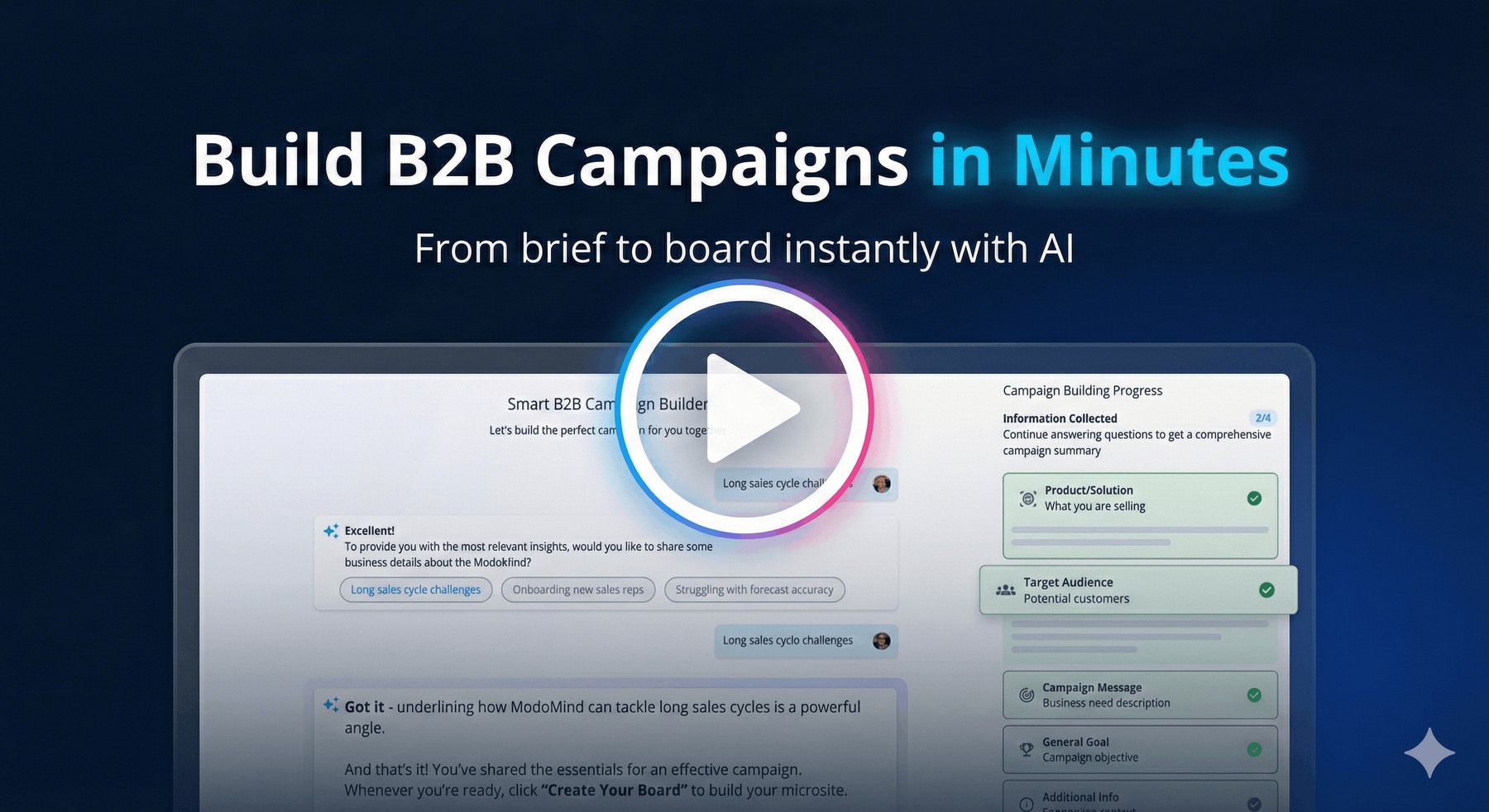
The interface divides the job into three verbs: build, activate, signal. Build turns a campaign brief into on-brand pages, emails and ads. Activate personalizes those assets by account, segment, role or behavior and coordinates their release across web, email, events, ABM and sales. Signal records more than a click: which use case a visitor explored, what content held attention and whether several people from the same buying group appeared.
Folloze does not try to evict the rest of the stack. It connects with Salesforce, Marketo, HubSpot, Eloqua, Demandbase, 6sense and Outreach. That location matters. Demandbase or 6sense may decide which account looks ready; Folloze changes what that account sees. Marketo or Outreach may carry the message; Folloze hosts the destination and returns engagement. Salesforce remains the ledger. Folloze is the shop window with a surprisingly observant clerk.
Customers include large technology and industrial brands such as Cisco, Autodesk, ServiceNow, RingCentral, Google Cloud and Cloudflare. The users are usually demand-generation, ABM, field-marketing, marketing-operations and sales teams. The subscription is enterprise and quote-based, with onboarding, technical setup, success support and a customer academy. There is no cheap self-serve button for a solo newsletter writer. This is software for organizations where the web queue and the buying committee are both long.
The useful failure happened inside the company
Folloze’s most instructive recent campaign is its own. The company’s revenue team had unreliable segmentation, weak intent data and fragmented workflows. It was spending money without a clean view of which accounts deserved attention. The team made the uncomfortable choice to pause all top-of-funnel paid media for two months while it rebuilt the motion around 6sense segments, Folloze experiences and connected actions in LinkedIn, Outreach, Marketo and Qualified.
The pause is the important bit. Software companies typically publish case studies in which nothing goes dark and every chart climbs to the right. Here, the first move was to stop. When campaigns returned, Folloze reported reaching an average 56 percent of its ideal-customer accounts, up from 2.5 percent before launch. It said qualified-account volume rose 192 percent and first-half pipeline grew 43 percent year over year while paid-media spending fell 52 percent.
Those are vendor case-study numbers, not audited financial results, but the operating lesson travels well: if the segments are bad, faster personalization multiplies waste. The team did not need more pages first. It needed a more trustworthy definition of “who.” Only then did the page builder become leverage.
The bet, the rivals and the bill
Folloze occupies a crowded seam. PathFactory, Hushly, Uberflip and Userled compete directly in content experiences and personalized microsites. Demandbase and 6sense reach down from ABM intelligence. Marketo and HubSpot reach across from automation. Seismic, Highspot and Showpad approach from sales enablement. A competent internal web team can reproduce much of the visible output.
Its difference is the bundle: no-code construction, account-level variants, brand governance, content recommendations, persistent identity and granular first-party engagement in one workflow. The open-AI position is sensible because it refuses to make a moat out of whichever model writes a paragraph this quarter. The defensible material, if Folloze can keep it, is the institutional plumbing and the behavioral history.
The cost is not posted as a menu. Prospects request a quote, and plans are designed for scale with broad user and board access plus custom traffic capacity. That makes the buying decision less about a seat and more about replacing web-development hours, disconnected point tools and campaign delay. Folloze cites a customer benchmark of roughly one hour to build a board versus about 20 hours of web development. The arithmetic works only if a team ships enough governed experiences to justify an enterprise platform - and if sales acts on what the system learns.
What to copy - and when not to
A company does not need Folloze to copy its best idea. Replace the giant campaign with a loop. Write one modular brief. Create a destination from approved components. Personalize only the parts that change the buyer’s decision. Track meaningful consumption, not decorative clicks. Send a compact signal to the person who can act. Then use that evidence to choose the next message. The clever move is not mass-producing 5,000 pages; it is making the fifth interaction smarter than the first.
Target accounts are defined, the content library is usable, brand rules are explicit and sellers have a routine for acting on engagement.
Segmentation is guesswork, personalization means swapping a logo, nobody owns follow-up or the team publishes faster than it learns.
Pause a noisy channel long enough to repair its data and handoffs. Speed after clarity is leverage; speed before clarity is confetti.
AI can make every vendor’s builder faster. Folloze must prove its signal, identity and integrations remain harder to replace than its canvas.
There is also a cultural clue in Brutman’s preference for education over persuasion. A buyer experience should help someone understand a problem on their own schedule, not merely corner them with a calendar widget. That sounds gentle, but it is operationally demanding. It requires useful content, restraint and a sales team willing to treat reading behavior as context rather than surveillance.
Folloze has raised several rounds of equity funding since 2015 and added a $6 million senior credit facility from SG Credit Partners in 2023. It remains a relatively small company - roughly 50 people by current public counts - selling to organizations many times its size. Its scale claims are company-reported: more than 300,000 campaigns, $11 billion in influenced pipeline and 92 percent retention. The numbers describe reach; the next test is durability. If every enterprise brings its own AI, the winning layer may be the one that remembers the brand, knows the account and can prove what happened after “generate.”
Keep exploring
Website Platform Customer stories Company blog LinkedIn X Demos & interviews