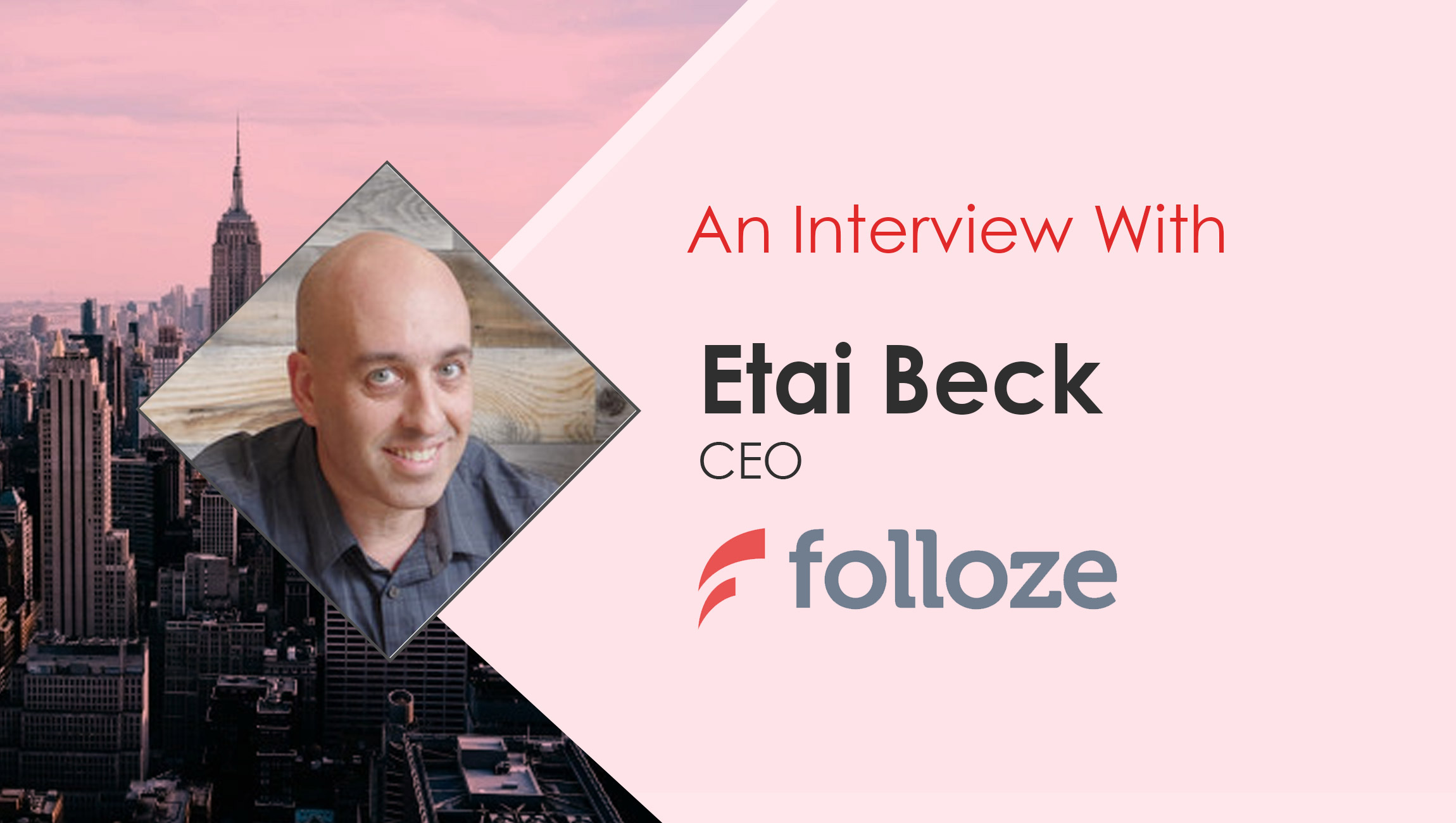
The strangest customer in enterprise software is the one who never arrives. No demo request. No webinar registration. No polite visit to the pricing page. They ask an AI assistant what to buy, compare a shortlist in private, and appear only when most of the decision has already happened. For Etai Beck, co-founder and CEO of Folloze, this invisible buyer is not a plot twist. It is the latest version of a problem he has been circling for years: companies organize themselves around campaigns, products, and departments, while buyers organize themselves around questions.
Beck's career has crossed an unusual amount of territory without losing that thread. He trained in electronics and computers at the Technion, graduating with honors, then earned an MBA from Tel Aviv University. He worked at Kagoor Networks, the Israeli-American VoIP company whose session border controllers helped carriers manage internet voice traffic. When Juniper Networks acquired Kagoor in 2005, Beck entered a much larger machine and learned what happens after the exciting part of a deal: technologies must be integrated, teams reorganized, customers reassured, and promises turned into releases.
At Juniper, he moved through general management, product line management, marketing, and strategy. Eventually he led strategy work for the Campus and Branch division, an operation Folloze describes as producing $800 million in annual revenue at the time. It was an enviable corporate climb. Beck has also said that, although he liked it, something was missing. He wanted to make a larger impact. The itch was not for a more impressive title. It was for a problem he and a small circle of collaborators could own.
A lightbulb in the hobby aisle
The founding insight came from somewhere delightfully uncorporate. Beck and his collaborators were examining the awkwardness of B2B buying: too many stakeholders, too much content, and too little continuity from one interaction to the next. A friend asked whether they had looked at hobby-sharing sites. People who cared about a craft or pastime naturally selected material, arranged it, explained it, and passed it along to others. They were curators because the subject mattered to them, not because a quarterly target demanded another landing page.
That behavior suggested a product. What if a seller could gather the most useful material for a particular buyer, present it in context, let the buyer share it with colleagues, and understand what drew attention? The idea mixed the warmth of a recommendation with the instrumentation of software. Folloze was born in late 2013, with Beck as CEO, David Brutman as chief product officer, and Zvika Menachemi as chief technology officer.
The early company also carried the familiar geography of Israeli enterprise technology. Folloze was headquartered in Palo Alto, while its development operation sat in Modi'in, Israel. Beck already understood the bridge. Kagoor had paired a San Mateo presence with Israeli engineering, and Juniper had used the acquisition to establish an Israeli research and development center. Building across an ocean requires a taste for translation: between time zones, technical teams, commercial teams, and the customer vocabulary that gives all of them a common destination.
“In lean times, relationships are everything.”Etai Beck, 2022
The company initially sat near sales enablement and account-based marketing. Those labels were useful, but Beck's ambition was broader. A campaign might begin with marketing, pass through a salesperson, become an event follow-up, and continue after a contract was signed. To the buyer, it was one relationship. Inside a company, it was often a relay race conducted by teams holding different maps.
The product kept widening
As customers stretched Folloze into new uses, the company widened the frame. Teams built landing pages, event hubs, digital sales rooms, training sites, partner campaigns, and responses to proposals. Custom work could make each one handsome, but it was slow and difficult to govern. In 2022, Folloze introduced its Buyer Experience Platform 3.0 with a no-code builder, reusable design tools, richer behavioral data, automatic content tagging, and interest maps based on what accounts and people engaged with.
The shift is a useful lesson in product positioning. Folloze did not abandon the original act of curation. It moved outward from the content to the room containing it, then to the hallway connecting rooms. Beck's recurring five-part prescription for marketers captures the architecture: simplicity, personalization, consistency, integration, and attention to the complete customer lifecycle. None is glamorous alone. Together they describe an experience that does not make a buyer pay for the vendor's organizational chart.
The operating loop: from attention to action
This is also where Beck's engineering background shows. The human language is trust, attention, and relevance. Beneath it sits a systems problem: collect better signals, connect them across touchpoints, and shorten the distance between observation and action. In 2024, Folloze's Impact Dashboard added account engagement scores and analysis of first-party behavior. Instead of treating an email open or a page visit as a complete story, the model considers patterns such as time spent, repeat activity, content consumption, calls to action, and the number of engaged people.
The company says its platform has powered more than 300,000 campaigns and influenced $11 billion in pipeline. Those are company-reported figures, and the more revealing number may be the span of the product itself. A tool that began with curated content now touches design, identity, recommendation, analytics, and orchestration. The expansion follows the buying experience rather than a neat software category.
When the funnel goes quiet
Generative AI has made Beck's old concern sharper. Buyers can now research a market inside ChatGPT, Claude, Gemini, or another assistant. They may never click the search result that used to feed a marketing dashboard. A brand can disappear from consideration without seeing the person who dismissed it. Beck's 2025 writing argued that AI was not simply changing content production; it was changing discovery itself. In early 2026, he put it more bluntly: “AI did not just disrupt software. It changed how buyers buy.”
Folloze's answer has been a suite of Generator Agents for creating microsite copy, personalizing experiences for accounts and audiences, translating material while preserving structure, and producing short videos. The company has also moved toward Model Context Protocol, or MCP, so AI workspaces can connect to Folloze capabilities. Beck sees the emerging pattern as an LLM at the front, where a marketer expresses intent, and specialized tools behind it, where campaigns are deployed, personalized, measured, and revised.
“It is crucial that marketers meet buyers where they are.”Etai Beck, 2022
There is a tempting contradiction here. Folloze sells more machinery in response to a world already groaning under software. Beck's defense is that the machinery should make the experience simpler for the person on the other side. AI, in his telling, assists marketers and salespeople rather than replacing them. It handles speed and variation so people can spend more energy on judgment, substance, and the relationship. That promise is easy to print on a slide and hard to keep in a product.
His public writing gives one clue to the standard he applies. He has warned marketers about the dangers of generative AI and argued for emotional intelligence, ethical use of data, and content that creates value instead of exploiting attention. He also returns to trust during economic stress. When budgets contract, he argues, the existing customer relationship matters even more. Personalization without respect becomes surveillance in a nicer shirt.
The useful thing to steal
Founders often tell stories in which the future appeared fully formed. Beck's is more instructive because the original insight was modest: hobbyists had discovered a better way to share material. The work was to translate that behavior into enterprise software, survive the compromises of real customers, and keep enlarging the product without losing the buyer at its center.
The idea worth borrowing is a method. Begin with the irritation you know firsthand. Look outside your industry for people who have solved the human part of it. Build around their behavior. Then follow the user's journey even when it drags the product across category lines. Beck moved from network plumbing to product strategy to digital experiences, but the motion has always been toward the edge where a person decides whether technology is useful.
That edge is moving again. The buyer is asking questions in a private chat window, and the familiar funnel may register only silence. Beck's bet is that the response is not louder marketing. It is a better answer, delivered with enough context to be worth finding. The buyer may never knock. The door still has to open.