The campaign was about food scraps. This was Minneapolis in the first years of citywide organics recycling, when a banana peel had somehow acquired the emotional complexity of assembling Swedish furniture. Residents liked the idea. They simply suspected it would be messy, confusing and one small domestic chore too many. Level Mpls did not answer with a grand environmental sermon. Its team went to a neighborhood conference, auditioned actual participants, filmed them at home and let them explain their own little systems. The resulting campaign earned 4.4 million impressions, 18,025 clicks and, more important, 892 new sign-ups.
That sequence is the most useful introduction to Level Mpls. It is a Minneapolis advertising agency founded in 1986, now led by owner and CEO Lois Dirksen alongside president and chief client officer Kim Thelen and chief operating officer Erin Gwiazdon. The agency offers the familiar full-service list: research, strategy, identity, content, websites, digital marketing, media planning and buying. But lists flatten companies. The portfolio tells a sharper story. Level is a translator for institutions with important things to say and audiences with excellent reasons not to listen.
Its clients include government departments, health systems, banks, colleges and agriculture programs. These are not easy categories. They come with regulation, acronyms, complicated eligibility rules and the occasional request that somebody schedule a colonoscopy. The competition is not merely another agency. It is inertia, suspicion and the stack of official-looking mail on the kitchen counter.
“We live to make the complex simple.” It reads like agency copy. In Level's portfolio, it behaves more like a production rule.
The first thing to fail is usually the explanation
Consider three assignments. Old National Bank wanted to promote mortgages, refinancing and home-equity products in underserved communities. North Dakota wanted health-care graduates to consider rural practice. MNGI Digestive Health wanted more Black Minnesotans to take control of a screening gap. The institutional version of each brief is thick with policy and procedure. Level searched instead for the first false belief or emotional barrier.
For fair lending, the barrier was not a shortage of product language. It was a shortage of possibility. Level studied majority-minority census tracts, filtered for people likely to be interested in the lending products, then built “Get To A Better Place” around scenes of lives that could open up through homeownership or improvement. The campaign reported 19 million impressions, 72,896 visits and 504 loan applications. Those numbers do not prove that advertising solved housing inequality. They prove something more specific: a regulated offer can be made relevant without being reduced to a disclaimer.
For the rural workforce problem, interviews with providers changed the pitch. What they loved was not an abstract shortage statistic. It was the chance to matter in a welcoming community. Level wrote the campaign as a love letter: “Love You to Stay.” Streaming audio, video and social media generated more than 2.7 million impressions, 53,001 view-throughs and 115 apply-for-loan actions. Research did not decorate the idea after the fact. It changed what the agency believed the idea should be.
A colonoscopy, but make it a declaration
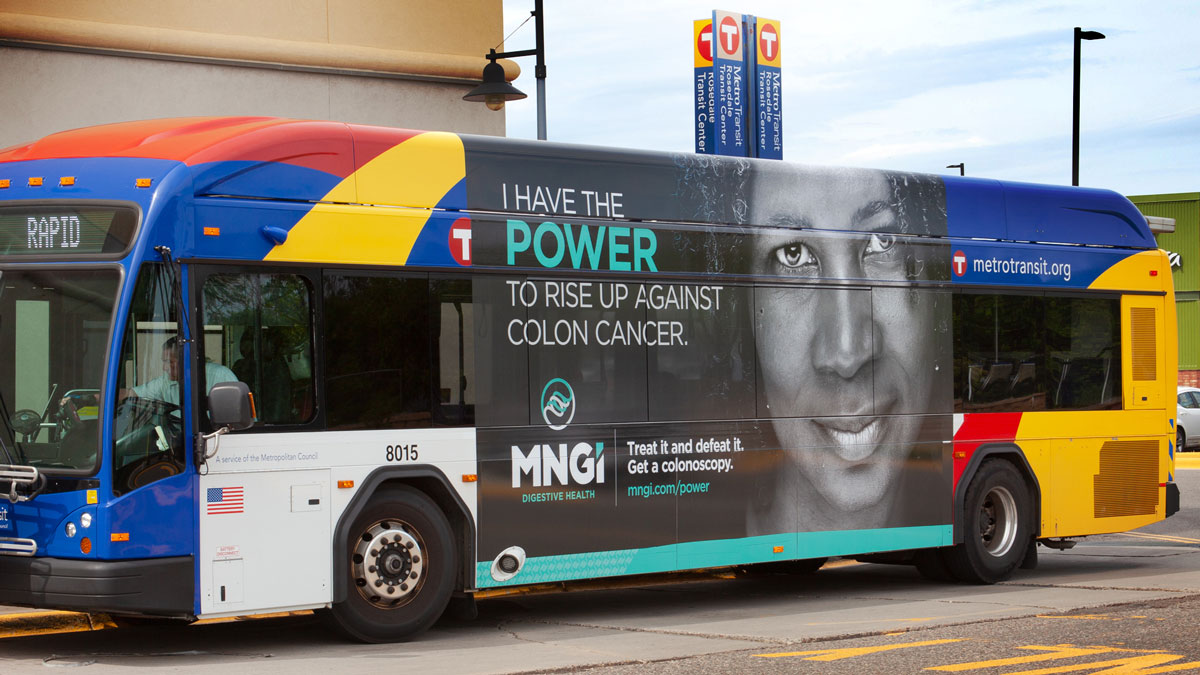
The MNGI work is where Level's method becomes visible from across the street. Minnesota's Black communities faced a higher colon-cancer risk and a lower screening rate. A conventional campaign might have reached for fear: the frightening statistic, the stern physician, the command to act now. Level chose an empowering line - “I have the power to rise up against colon cancer” - and carried it through television, social, digital display and Twin Cities transit. The TV used rhyme, improvisation and spoken-word cadence. During the Timberwolves playoff run, the media plan placed the message inside a moment already holding people's attention.
This is where the agency separates itself from a shop that sells only identity or only media. One team can investigate the audience, frame the position, make the assets and decide where they should live. Level's six advertised offers range from market expansion and brand development to competitive disruption, employer branding and digital innovation. In practice they overlap. KNOWTIFY, a North Dakota health-information hub, required a name, visual system, landing page, content framework, launch campaign and even a short sound mnemonic. The product was not a logo. It was a recognizable container for trustworthy information.
Start with the belief blocking the behavior, not the message the institution wants to broadcast.
Homeownership becomes possibility. Rural practice becomes belonging. Screening becomes personal power.
Carry the idea through identity, content, digital products and paid media so each channel reinforces the next.
Track visits, applications, view-throughs and sign-ups, not just the pleasant fog of awareness.
The useful idea has to survive the last mile
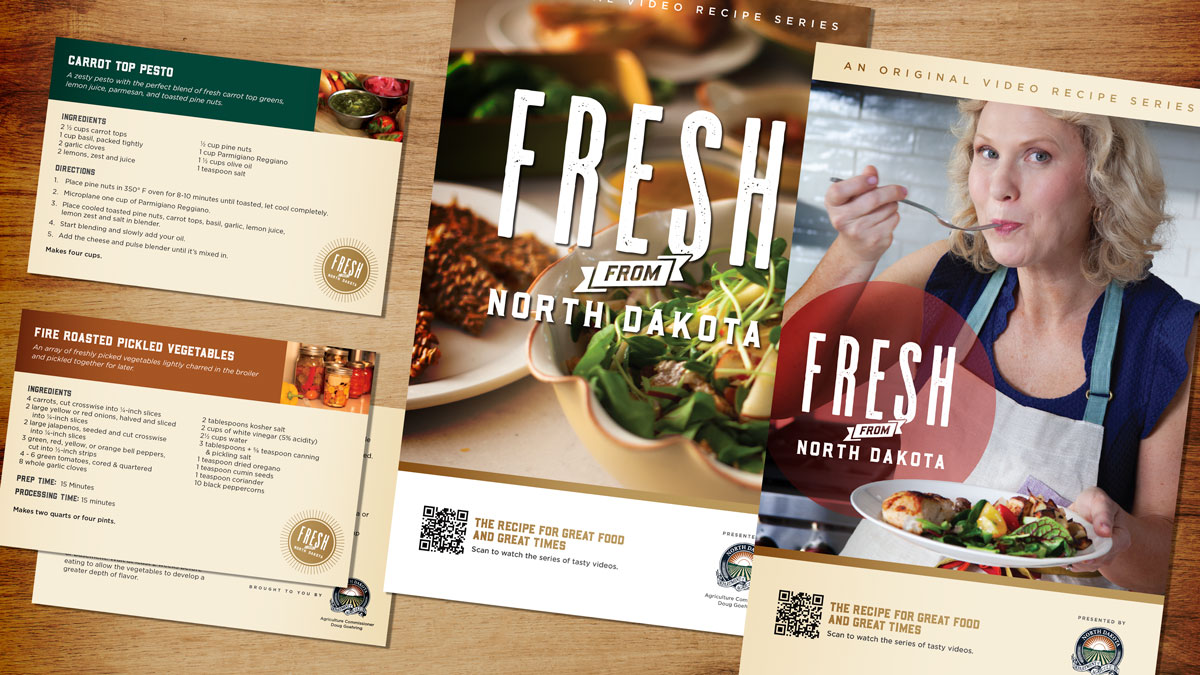
Level's North Dakota agriculture work began with specialty crops and ended with an ecosystem. The agency found on-camera cooks with North Dakota roots, developed seasonal recipe episodes, made a rustic identity and turned the recipes into printed tool kits and posters for farmers markets. The move from video to recipe card matters. A video can create appetite. A card can sit beside the cutting board. The agency followed the message all the way into the moment somebody might use it.
The same practicality appears in an urgent-care launch for INTEGRIS Health. The clinics were still under construction, but the campaign needed a believable care environment. Using layout plans, Level and its production crew reconstructed the setting for the shoot. This is less romantic than a brand epiphany and more revealing. Agencies are often paid to make an unfinished thing feel coherent before the world sees it.

Level's structure helps. It is privately held, independent and WOSB-certified. Its public company profile places it in the 11-to-50 employee range, although outside datasets vary. The leadership team are owners and operators, and the agency emphasizes direct collaboration rather than a relay race between strategy and execution. Its likely alternatives are larger integrated firms, specialist public-health communicators and in-house teams. Level's bet is that senior attention and a connected service line can deliver big-agency range without big-agency distance.
Do not begin with “What do we need to say?” Begin with “What does the audience currently believe?” The method works when research can reach real people, the offer can support the promise and the team can measure a meaningful next action. Remove those conditions and the same friendly storytelling becomes decoration.
What the numbers do - and do not say
The agency publishes campaign results, not a universal return-on-ad-spend formula. Impressions are not applications, and an organics sign-up is not comparable to a health-worker recruitment action. That is precisely why the strongest case studies name both. They show the large top of the funnel and the much smaller human act at the bottom. The gap between them is where marketing becomes honest.
Project fees are not public. Nor should a reader pretend that the clever phrase alone produced the result. These campaigns depended on clients with real services, access to audience information, media budgets and the operational ability to receive the response. A bank must process the application. A city must collect the scraps. A clinic must have an appointment available. Communication can remove friction; it cannot manufacture the underlying service.
Still, the portable lesson is unusually clean. Find the mistaken belief. Listen until the motive changes. Give the idea a form people can recognize. Put it where attention already exists. Then measure the thing a person did, not the adjective somebody used in the creative review. Level Mpls has spent decades in the unglamorous gap between an institution's language and a person's life. That gap turns out to be a perfectly good place to build an agency.