There is a wonderfully suspicious sentence on the website of a Dallas advertising agency called Firehouse: “Our time is not for sale.” This is suspicious because time is what an agency appears to possess. There are people, there are hours, there is coffee, and then there are more hours. Yet Firehouse argues that billing for the hour rewards an agency for taking longer. Its clients, the firm says, should pay for successful deliverables, not the visible motion of people being busy.
This is not merely a pricing opinion. It is a clue. Firehouse is a privately owned, full-service shop founded in 1997, with strategy, consumer research, advertising, media buying, search, social, influencers, identity, content and analytics under one roof. It works largely for national consumer brands - Lennox Residential, Toyota, Texas Dairy Queen, Interstate Batteries and the National Cheerleaders Association among them. The agency is small enough to list its leaders with jokes. CEO Steve Smith is also the unofficial bartender. President and chief creative officer Tripp Westbrook restores old Land Rovers, then, according to his company biography, pays someone else to restore them correctly.

The comedy makes the serious part easier to miss. Firehouse is selling judgment. The useful agency hour is not the one spent polishing an answer. It is the one spent discovering that everyone has been answering the wrong question.
The $78 answer to a 61-year-old problem
Consider Baxter Auto Group. In 2019, the family-owned dealership business was 61 years old, spread across 19 dealerships in three states and represented nine different automakers. Its first problem was not obscure: people commonly regarded buying a car as a cousin of dental surgery. Its second problem had arrived in a vending machine. Digital-first sellers such as Carvana were teaching customers that dealerships, not car buying, were the nuisance.
A familiar campaign would have promised better service. The difficulty was that every dealership already promised better service. The category had worn the phrase smooth. Firehouse and Baxter instead spent four months collecting data, interviewing stakeholders and talking to consumers. Then came a multi-day workshop. The work produced a brand promise the agency called “radical service,” but the important word was not in the slogan. It was in the verbs.
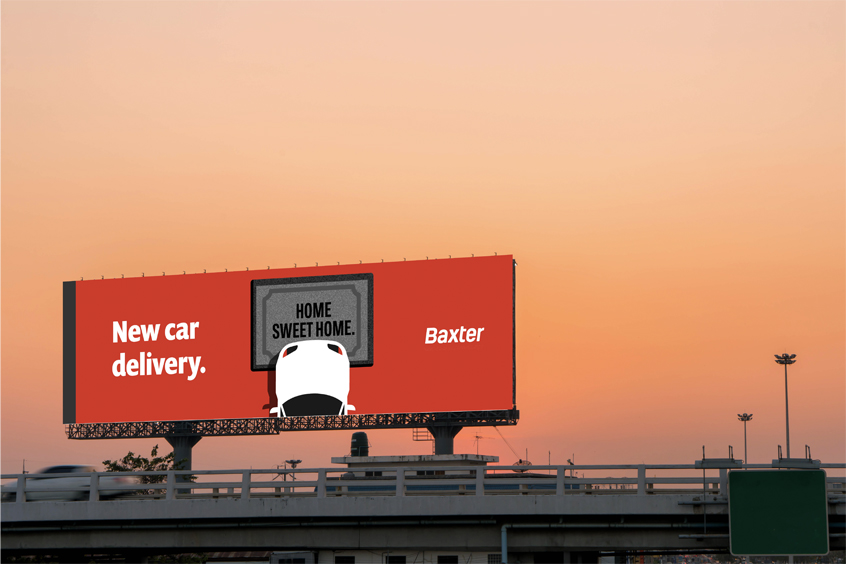
Firehouse recommended new dealership practices, gathered them with useful things Baxter already did but rarely advertised, and built “Car Buying on Your Terms.” Test drives could come to the customer. A purchased car could be delivered. Buyers had a seven-day return option. The campaign was not asking the public to admire an adjective. It was handing them a different procedure.

Then the pandemic arrived. Car retail lurched into remote work before many dealers had a remote experience worth naming. The new Baxter services, devised before COVID-19, suddenly looked less like a flourish and more like infrastructure. That was the thing Firehouse had changed its client's mind about: the brand promise could not live only in the advertisement. Baxter had to behave differently first.
Firehouse reported that customer satisfaction increased three percentage points. The cost per vehicle sold fell 48 percent from 2019, to an all-time low of $78, which the agency calculated as $2.87 million in savings. Baxter sold 39,977 vehicles in 2020. That was 8 percent below its record 2019, but 9 percent above 2018, and eight points better than the 16 percent decline Firehouse cited for U.S. dealership sales.
The project fee is not public, so there is no honest answer to what Baxter paid Firehouse. There is, however, an unusually precise answer to what the marketing cost at the point of sale: $78 a vehicle. In the foggy language of agency case studies, a unit cost is a small lamp.
“Our time is not for sale.”Firehouse's compensation principle
First, find the tired rule
The Baxter case reveals the Firehouse method. Start with the rote behavior in a category. Car dealers boast about service. Battery advertisements discuss battery function. Cheerleading is reduced to glitter and bows. HVAC advertising talks in temperatures and equipment. Then look for the human tension those habits ignore.
For Interstate Batteries, Firehouse moved the conversation from the battery to dependability - the people and moments for which a driver needs to “Be There.” For the National Cheerleaders Association, it portrayed cheerleaders as serious athletes and gave them the line #TheWorkIsWorthIt. For Lennox, its work moved beyond the strictly functional vocabulary of heating and cooling toward what comfort feels like. The point is not to be contrary on command. It is to break the convention that blocks the more resonant truth.
Sometimes that instinct costs money. In one account reported by Dallas Innovates, a prospective client offered a pitch stipend that would also buy ownership of 12 speculative campaigns. Firehouse countered that it would pitch for free if it kept the intellectual property. The prospect refused. So did Firehouse. That is the less glamorous side of positioning: eventually, someone asks whether you meant it.
List the promises every competitor makes. Interview customers about the behavior that would make one promise believable. Change that behavior. Give it a memorable name. Only then buy attention. This works when the organization controls the experience and leaders will fund the operational change; it weakens when marketing is asked to disguise a product, policy or service nobody is allowed to fix.
The agency that reworked itself
Firehouse did not begin with its present model. Founder Mark Hall opened the company in 1997, and Smith has said it was operating largely as a promotional agency when he arrived as director of strategy in 2006. Smith had worked across copywriting, accounts and planning. He combined planning, media, public relations and social media into one strategy group. Westbrook arrived in 2007 after work at The Martin Agency, Riney, Fallon and GSD&M. In 2010, Ad Age named Firehouse Southwest Small Agency of the Year.
In 2020, Smith and Westbrook bought Hall's interest. The timing was instructive. With the business slowing during the pandemic, they invested in the organization: clearer career paths, ongoing conversations instead of old annual reviews, stronger benefits and greater transparency. By 2024, Firehouse was No. 1 in Ad Age's Best Places to Work category for companies with 200 or fewer employees, its third consecutive appearance on the list.
The perks have personality. Champagne Thursday celebrates contributions each month. Five years of service has earned a Four Seasons getaway; longer tenures have brought travel funds. Dogs may visit the office, though a calendar keeps incompatible colleagues on different shifts. The substance is less photogenic: salary transparency, paid parental leave, employee input on accounts and a DEIB group that reviews policy and creative work. In a 2025 internal survey published by the agency, 93.8 percent said they were proud to work there and 100 percent said people from different backgrounds collaborated effectively.
“We're not trying to become a bigger agency. We're trying to become a better one.”Firehouse, announcing Jason Niebaum in 2026
That is a tidy line, but it also identifies Firehouse's market position. It is an independent shop competing for national work against agencies with far more offices, layers and specialized departments. Its wager is that senior attention, integrated strategy and fewer incentives to inflate the clock can substitute for scale. The alternative for a client is a specialist for each channel, a large network agency, or another independent integrated firm. Firehouse's difference is clearest when the assignment crosses the border between communication and operations.
And that border matters. “Convention-breaking” can become its own convention, a mood board of rebellion applied to toothpaste, tires and tuition alike. Firehouse's better work avoids the trap because the surprise follows research. It is not different merely to be noticed. It is different because a familiar category script has stopped explaining what customers need.
The agency that says it does not sell time is therefore making a second, quieter promise: it will not confuse duration with value. Four months of Baxter research mattered because it found a behavior worth changing. The campaign that followed mattered because customers could try the promise in a driveway. The clock kept running, of course. It simply was not the most interesting thing being measured.