Three people sat in the back of a Navy aircraft trying to keep an entire battle picture straight. One was Jack Kennedy. Outside their E-2C Hawkeye, ships and aircraft needed different pieces of information at different moments. Inside, the crew worked with radar, communications and data links, assembling a picture that nobody else could see in quite the same way. Their job was to make that picture useful.
The aircraft had a conspicuous radar disc above its fuselage and rather less of the glamour associated with naval aviation. His account is frank about the work and the aircraft’s lack of glamour. A fighter needed one set of instructions; a warship needed another. Sending everything to everybody would hardly have improved matters. Someone had to decide what belonged where.
Decades later, Kennedy gave that old job a name borrowed from computing: a control plane. The phrase is especially satisfying when the original equipment was, quite literally, a plane. His August 2026 account brings a long career into focus. The co-founder and CEO of Platform Science keeps returning to the distance between having information and being able to act together.
That distance has taken him through the Navy, television, wireless technology and trucking. The business cards changed considerably. The question underneath them has proved more durable.
A television company changes the channel
Kennedy graduated from the United States Naval Academy and later earned an MBA at Harvard Business School. His military career included service on Senator John McCain’s staff and work as aide-de-camp to the vice chairman of the Joint Chiefs of Staff. Those appointments put him close to organizations in which decisions have to travel through other people before anything happens.
At News Corp, he held senior positions spanning Fox Networks Group, Fox Interactive Media and News Corp Digital Media. The entertainment business was confronting a change in how audiences could find and watch its products. A television schedule had once done a great deal of organizing on the viewer’s behalf. Broadband offered the viewer a competing arrangement.
Kennedy participated in the joint Fox and NBC Universal team behind the venture that became Hulu. It is an important distinction in his biography: he helped bring that collaboration into being, among a much wider cast of executives and organizations. The interesting part is that companies accustomed to competing could agree to build something together while their established businesses still mattered.
In his subsequent writing, he returns to Hulu as a case of leadership under changing conditions. Recognizing a shift early enough gives an organization choices. Waiting for the evidence to become irresistible may leave fewer of them. There is a quiet difficulty in asking people responsible for a working business to help construct its replacement. A spreadsheet can describe that difficulty without making the meeting any easier.
- Late 1980sNaval flight officer
E-2 Hawkeye - 2006 onwardFox and News Corp
The Hulu collaboration - 2013–14President
Qualcomm Enterprise Services - 2015Co-founds Platform Science
With Jake Fields - 2025Trimble telematics acquisition
Completed February 10
The cab becomes the next workspace
Kennedy next led Qualcomm Enterprise Services, the business associated with the fleet technology name Omnitracs. It gave him a close view of the equipment and information used to manage commercial vehicles. By then, he had worked inside both the media business undergoing digital change and the technology business serving trucks. Starting a company meant choosing a particular problem to carry forward.
In 2015, he and Jake Fields founded Platform Science in San Diego. Fields, the company’s co-founder and chief technology officer, brought experience building businesses in connected vehicles, remote device management and other technology fields. Kennedy brought executive experience across several industries. The partnership joined the work of building the software to the work of persuading an industry to adopt it.
Platform Science’s stated purpose is to make transportation smart. The more concrete ambition is to let fleets choose and manage the applications their work requires. A driver’s tasks, the information coming from a vehicle and the instructions arriving from the office should be able to fit into a shared environment. The fleet should have room to change that environment as its business changes.
Consider what the company name asks a customer to buy into. A single application can be judged by whether it performs a particular task. A platform has to accommodate tasks its creators did not anticipate, often supplied by other companies. Kennedy’s interest is in making that second arrangement possible. It requires a certain willingness to leave space for someone else’s useful idea.
“We’re trying to disrupt a system that nobody knew was a system.”
Jack Kennedy, 2021
That is a less tidy proposition than selling one device with one purpose. It also explains why the people around the company matter so much. Truck builders, carriers and developers have different reasons to participate. Kennedy needs enough of those reasons to point in the same direction.
The people on the other side of the table
The investor list offers a view of that effort. In April 2024, Platform Science announced $125 million in growth funding. Alongside financial investors were C.R. England, Cummins, Daimler Truck, PACCAR, RyderVentures and Schneider. These businesses occupy different positions around a commercial vehicle. Their participation put industry relationships into the financing itself.
Growth capital announced in April 2024, with truck manufacturers, carriers and other strategic investors participating alongside financial backers.
Money supported the plan to expand manufacturer partnerships and the applications available on vehicles. Kennedy described an ambition to let manufacturers themselves create more software services. That would give the platform another constituency with a reason to make it useful. The business depends on participation from people who have plenty of other things to do.
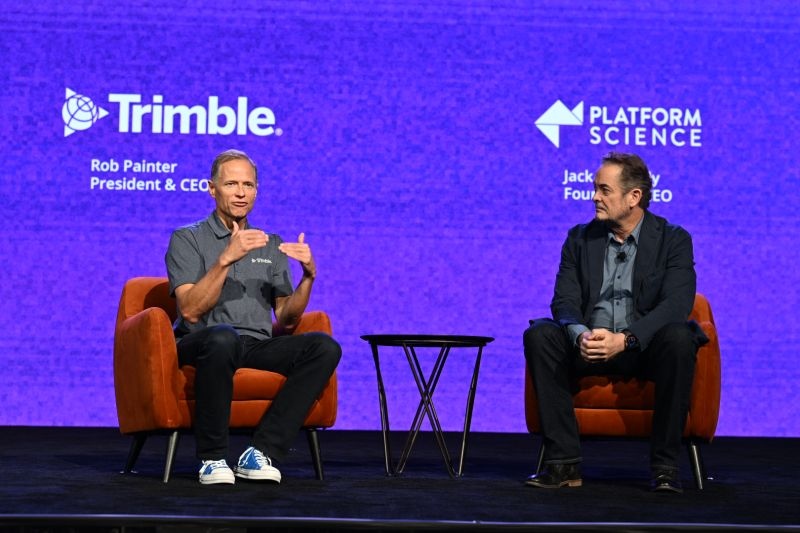
On February 10, 2025, Platform Science completed its acquisition of Trimble’s global transportation telematics business units. Trimble became a shareholder and received a board seat. The arrangement expanded Platform Science internationally while keeping the two businesses commercially connected. Customers were promised a wider choice of applications through Virtual Vehicle, the company’s connected-vehicle platform.
The transaction also changed the scale of Kennedy’s responsibilities. An argument about connecting separate systems now had to be carried through an expanded operating business. Existing customers, equipment and software do not become a coherent whole merely because a deal has closed. The work after the announcement is the work his career keeps circling: helping distinct parts function together.
Gravity gets a vote
Kennedy’s Navy service continued alongside his civilian career. He served on the founding team of DiUX, the Defense Department’s Silicon Valley initiative, and retired as a Navy Reserve commander in 2016. The chronology matters. His military experience was still developing while he was learning how corporate organizations respond to new technology.
In December 2025, he began publishing a newsletter called Gravity Kills. He traced the name to his first day in the Navy’s Strike Fighter Tactics Instructor program, better known as Top Gun. He recalls hearing the maxims about speed and altitude and suggesting a further reminder: gravity kills. Physics, in his telling, does not become more accommodating because the plan is attractive.
There is dry humor in the choice. It suits a writer who can move from an aircraft’s radar picture to connected machines and make room for flying burritos among his examples. More seriously, the newsletter gives Kennedy a place to examine the constraints beneath a business story. His subjects include Hulu, the smartphone industry and the ways established organizations respond when their surroundings change.
His September 2026 essay makes the control-plane idea more concrete. He identifies eight functions, from identity and permissions to billing and governance. Together, they describe the unglamorous work required when multiple participants share a system. Somebody needs to know who is present, what each participant may do and what happened when something changed.
Who gets to define the truck?
By October 13, 2026, Kennedy had sharpened the customer’s side of the argument. His essay Beyond the SDV: the User-Defined Vehicle separates improvements inside a vehicle from its ability to adapt to the business around it. Better computing architecture creates possibilities. The fleet still needs the freedom to turn those possibilities into useful work.
He uses the smartphone to explain the appeal. The manufacturer cannot foresee every application a customer will eventually need. Developers and users keep finding new purposes for the same physical device. Kennedy wants commercial vehicles to offer more of that flexibility, across brands, ages and equipment types.
His examples keep the argument grounded: a truck waiting in a loading queue, running empty or taking the wrong trailer somewhere. Intelligence inside the machine does not automatically resolve those problems. The vehicle needs enough context about the surrounding operation to make its capabilities useful. The owner, meanwhile, needs fewer improvised fixes to get through the working day.
This is where Kennedy’s aspirations become easiest to understand. The Navy crew had to interpret a larger picture for participants with narrower views. His current business concerns vehicles and software that must participate in a larger working network. The analogy has limits, as any analogy should. Its persistence helps explain why these apparently different jobs belong in the same career.
For Kennedy, the next question follows the truck beyond its own dashboard. What work is waiting? Who else needs to know? Who has permission to act? A fleet can buy a very capable machine and spend years discovering the answers. He would like those answers to arrive in time to be useful.