One revealing thing about Isabella Iglesias-Musachio’s career is that fungi were never merely an ingredient. They were a way of thinking. A fungal network grows quietly, builds structure before spectacle and turns whatever is nearby into the material for its next expansion. Her company, Bosque Foods, followed much the same pattern: years of private fascination, a small laboratory, patient experiments, then a network of scientists and engineers stretched across two continents.
In May 2026, after nearly six years, that network joined a larger one. Infinite Roots acquired Bosque, folding its solid-state fermentation expertise, process data and whole-cut product work into the Hamburg biotech’s industrial platform. Iglesias-Musachio described the journey as both challenging and rewarding. It read less like a victory lap than a careful handover. The intellectual property would continue. The years of R&D would keep moving. The organism had found a larger substrate.
Then, in August, she announced a turn that makes perfect sense only after you stare at it for a moment. She became Deputy Director of the Mirror Biology Dialogues Fund, an organization bringing scientists, policy specialists and public institutions together to consider the risks of hypothetical synthetic organisms assembled from molecular mirror images of familiar biology.
Dinner to biosecurity is a formidable change of menu. The operating problem, however, is strangely consistent: how do you build institutions around living systems whose consequences do not fit neatly inside one laboratory?
The hobby that waited twelve years
Iglesias-Musachio was born in New York. At Villanova University, she studied global interdisciplinary studies with a concentration in sustainable development and agriculture. Coursework in food systems gave her the question that would trail her for years: if conventional production carried such large costs, what could replace it without asking diners to abandon the rituals they loved?
She did not leap directly into a founder’s chair. First came nonprofit work connected to international affairs and sustainable agriculture. Then came the less romantic, more useful education of startup operations. At TechShop, she helped open maker spaces in France. At Berlin-based urban agriculture company Infarm, she worked on international expansion into markets including the United States, Canada and Japan. Laboratories, facilities, hiring, partnerships, new countries - the machinery of turning an audacious idea into a place where people can work.
Fermentation remained her side obsession. She has said it fascinated her for more than twelve years, long before the food-tech sector developed its current vocabulary. The appeal was old and almost domestic: living organisms transform one thing into another. The modern opportunity came from controlling that transformation with enough rigor to build new kinds of food.
“I got into my 30s and I was like, ‘If I don’t do this now, I never will.’”Isabella Iglesias-Musachio, on starting Bosque Foods
In April 2020, she started Kinoko Labs in Berlin. The name borrowed the Japanese word for mushroom. It was a charming laboratory name, but the company’s ambition soon demanded something broader. In 2022 it became Bosque Foods - “bosque” means forest in Spanish - signaling a move from biotech experiment to food company with biotechnology at its core.
Let the organism do the architecture
Bosque’s central idea was tactile. Most early meat alternatives had been designed as patties, sausages and nuggets. Whole cuts presented a nastier structural problem. Plant isolates do not naturally arrange themselves into the long fibers of a fillet. Mycelium does arrange itself. It branches, binds and builds a dense network. Bosque cultivated that network through solid-state biomass fermentation, imitating something closer to soil or a tree trunk than a steel tank full of liquid.
The elegance was to preserve what biology had already built. Harvest the mycelium. Keep the network intact. Add only what the final format required. “It’s really simple,” Iglesias-Musachio once said. “That’s the beauty of it.” Simple, in this case, meant the result of many difficult controls performed upstream.
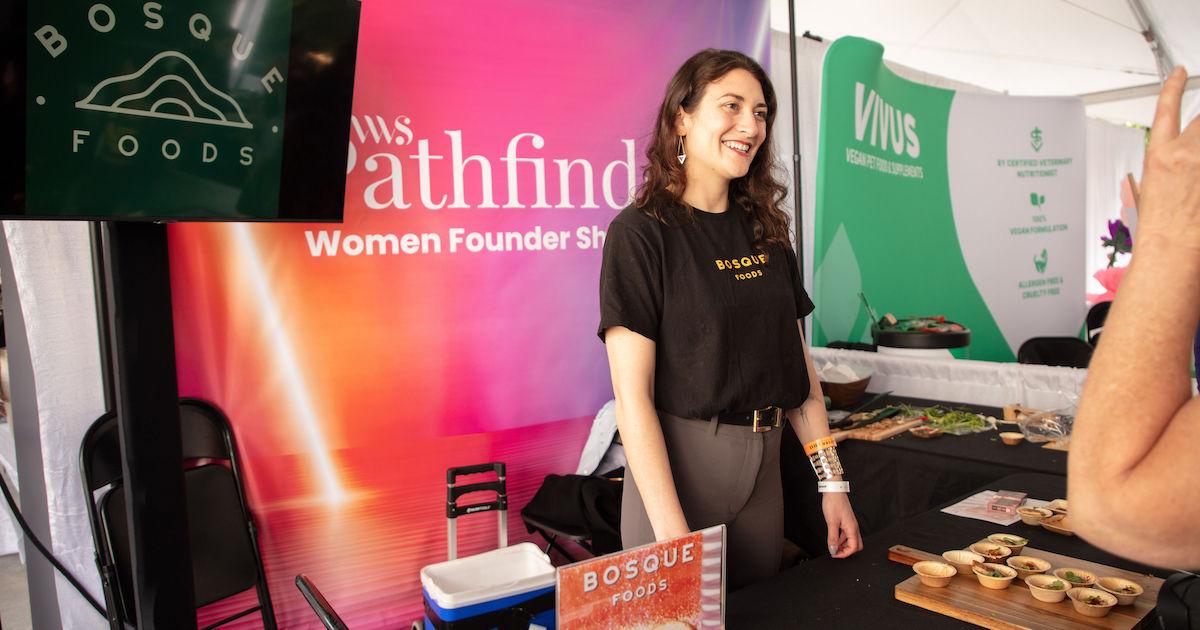
The company passed through IndieBio’s accelerator program, beginning in a small lab and building on both sides of the Atlantic. In 2022, Bosque announced a €2.8 million round backed by FoodLabs, Happiness Capital, SOSV, Blue Horizon, Blue Impact and angel investor Arman Anatürk. By 2023, Iglesias-Musachio was serving a chicken-style prototype at the Vegan Women Summit in New York. A year later, the team showed whole-cut chicken and chorizo at HackSummit in Lausanne.
Those tidy milestones conceal the period’s actual weather. Bosque was founded into a pandemic, then had to raise capital as enthusiasm for climate tech collided with a harsher funding market. Fermentation is also inconveniently alive. It responds to contamination, temperature, moisture, feedstock and scale. A process that behaves on a bench must behave again in a larger room, then again when somebody expects identical output every day.
Iglesias-Musachio’s answer to the strain was personal rather than theatrical. Love the work, she advised other founders, because every day supplies a new reason not to. She also credited the team as her daily motivation. That preference surfaced again in her acquisition announcement, which named the biotechnologists, microbiologists, engineers and food scientists before dwelling on the deal.
“Make sure you really, really love what you’re doing. Because you’re gonna be challenged every single day.”Her advice to aspiring entrepreneurs
An exit, without an ending
Infinite Roots did not buy Bosque simply to put another logo in the pantry. The deal joined complementary fermentation capabilities. Bosque brought solid-state cultivation, whole-cut texture development, intellectual property and years of process learning. Infinite Roots brought the platform and infrastructure to pursue industrial scale. In a field moving from proof-of-concept to reproducibility, the unglamorous assets - data, controls, regulatory work and learned judgment - become the point.
For a founder, that creates an odd kind of culmination. The company is proof of your will, yet the desired outcome is for the work to outgrow its dependence on you. Iglesias-Musachio said Infinite Roots offered the right home for Bosque’s technology. Pride appeared in continuity: the team’s work would not become an artifact.
A career moving closer to the frontier
The second biological frontier
Mirror life does not exist. It is a hypothetical class of organisms built from molecular components with the opposite handedness of natural life. The Mirror Biology Dialogues Fund exists because waiting for such a technology to mature before discussing boundaries would be a peculiar form of punctuality. It funds and co-organizes conferences, workshops and seminars where scientific evidence can meet policy and public judgment.
As Deputy Director, Iglesias-Musachio helps lead the organization alongside Executive Director James Smith. Her new colleagues span policy, governance and technical disciplines. She described the work as a global effort to understand possible risks and consider measures that might manage them. The brief is anticipatory by design: convene before consensus, create shared language before crisis and take a hypothetical seriously without pretending it is already real.
The move clarifies what her earlier career was rehearsing. Sustainable agriculture taught her to see a system rather than a product. TechShop and Infarm taught her to open new operations across borders. Bosque taught her to coordinate scientific specialists, investors and institutions around an uncertain biological platform. The acquisition taught her that responsible stewardship can mean finding a larger home for the work.
There is a practical continuity, too. Deep technology rarely moves at the speed of its pitch deck. A founder has to translate among people who use different clocks: researchers count experiments, regulators count evidence, investors count runway and the public counts tangible results. Bosque required Iglesias-Musachio to inhabit all four schedules at once. The mirror-biology conversation adds another clock, belonging to a technology that may be years away but whose rules cannot sensibly be drafted the afternoon it arrives.
Her path also complicates the familiar division between scientist and operator. Iglesias-Musachio has called herself a citizen scientist. Her formal training began in systems and agriculture; her authority as a founder grew through the work of assembling technical teams and learning what their discoveries required from an organization. She did not need to be the person holding every pipette to understand that the lab, the institution and the consequences belong to the same experiment.
There is also a pleasing reversal. At Bosque, the task was to persuade biology to grow something the public could see, cook and understand. At MBDF, the task is to help the public and its institutions reason about biology that remains unseen. One frontier needed appetite. The other needs foresight.
Iglesias-Musachio once predicted that new foods would change culinary traditions. Bosque’s own technology now continues inside Infinite Roots, where industrial execution will test that prediction. Her attention has moved further upstream, toward deciding how ambitious science should enter the world at all.
A founder’s story is often told as a line from insight to exit. Hers looks more like mycelium: branching, international, mostly built beneath the visible surface. The food company was one fruiting body. The network keeps growing.