At family celebrations in Vijayawada, India, young Uma Valeti liked the part everyone liked: music, dancing and a table crowded with food. Behind the festivities sat an image he could not file away so neatly. Animals were being prepared for the meal. Pleasure arrived with an awkward backstage. A child supplied a child's solution. He imagined meat growing on trees, ready to pick without the killing.
The tree never materialized. A more credible vessel did, years later, in a medical laboratory. Valeti trained as a physician and became a cardiologist, following a route that took him from India to Jamaica, then through American medical training and Mayo Clinic. He worked around research that asked cells to grow into tissue. The question from childhood returned wearing a lab coat: if biology could be guided to make tissue, why could it not be guided to make food?
It was a precise transfer of knowledge, not a fashionable pivot. He understood cells, sterile systems, patient scrutiny and the patience of regulated work. He also enjoyed eating meat. The combination spared him the easy answer of asking everyone else to change their appetite. He wanted to change production.
“I didn't want to look back 20 years from now and say, ‘Hey, I should have done it.’”Uma Valeti, on taking the founder's leap
A one-way ticket before the moonshot
Valeti's appetite for uncertain routes appeared well before UPSIDE Foods. After medical school, an attempt to continue training in the United States was blocked by visa rejection. A friend suggested Jamaica. His parents bought him a one-way ticket and gave him roughly $100. He knew no one there.
He kept visiting Jamaica's Ministry of Health to ask for work and eventually found a position at Kingston Public Hospital. The year widened his experience across several areas of medicine. It also introduced him to the woman he would marry. In retrospect, a door that looked decisively closed had redirected the entire corridor.
From Jamaica he eventually reached the United States, trained in internal medicine, and arrived at Mayo Clinic for cardiology, interventional cardiology and advanced imaging. He later practiced and taught in Minnesota. This was not a career he disliked or failed at. Leaving a profession he loved made the eventual choice more revealing: the cultivated-meat idea had acquired more pull than an accomplished life had inertia.
The company that had to invent its category
In 2015, Valeti founded Memphis Meats with Nicholas Genovese and Will Clem. The pitch landed in a conceptual no-man's-land. It was food, biotechnology and manufacturing at once. There was no tidy public market comparable, no mature regulatory playbook, and no proven path from cells in a vessel to meat at supermarket volume.
Valeti has said the first 100 people he approached would not invest. The refusal was rational enough. An investor had to believe the science could become a product, the product could become safe regulated food, the food could attract diners, and the diner demand could support factories no one had built. Every clause contained its own ways to fail.
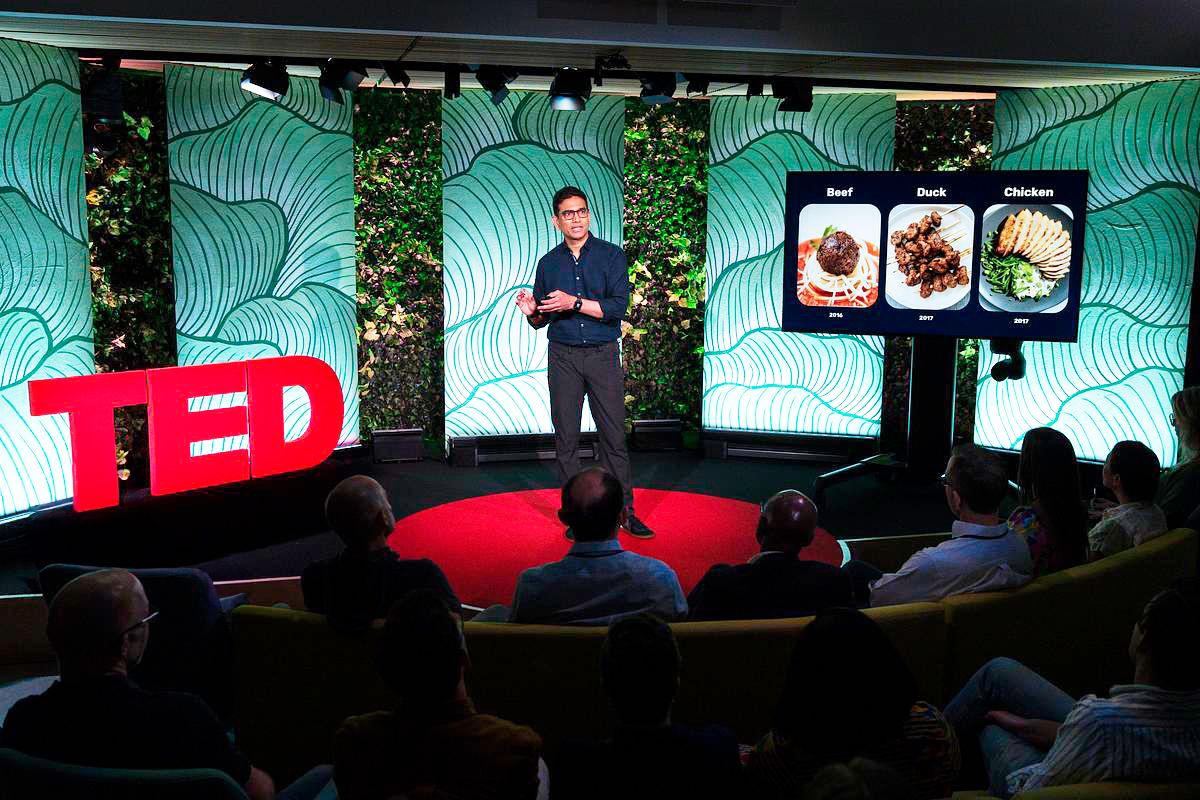
The small team began by making the abstract edible. In 2016 it presented a beef meatball cultivated from animal cells. Chicken and duck followed in 2017. These were demonstrations, not a supply chain, but they changed the quality of the argument. Skeptics could debate something that sizzled.
The company's name changed to UPSIDE Foods in 2021. The new word was sunnier and less tied to a place, but the serious work was becoming more physical. UPSIDE opened EPIC, its 53,000-square-foot engineering, production and innovation center in Emeryville. Stainless steel displaced metaphor. The company now had to connect cell biology with sanitation, food handling, repeatability and throughput.
Regulation turns fiction into food
The regulatory passage came in stages. In November 2022, the Food and Drug Administration completed its first premarket consultation for a human food made using animal-cell culture technology. After reviewing UPSIDE's submission, the agency said it had no further questions at that time about the company's safety conclusion. This was carefully worded regulatory language, not a blanket endorsement of every cultivated product.
The Department of Agriculture had a separate role over processing, inspection and labeling. Those steps were completed in 2023, allowing UPSIDE to sell its cultivated chicken in the United States. The distinction matters because a new industry is easily turned into a fairy tale. No single wand came down. Multiple agencies examined different parts of the journey.
Then came the plate. Chef Dominique Crenn served UPSIDE chicken at Bar Crenn in San Francisco. The first commercial service was intentionally rare and theatrical. It proved that cultivated meat could leave the facility, enter a professional kitchen and be ordered as food. It did not prove that a family could find it on a Tuesday grocery run.
“Something I've learned while building this company is the importance of building trust and building rapport.”Valeti, on creating a new industry
The cardiologist's second transferable skill
Valeti has compared company-building with earning the confidence of a patient and family before a complex procedure. The comparison is not about bedside theater. It is about the limits of expertise. Facts do not automatically quiet anxiety. Trust has to be constructed through clarity, consistency and an admission that the listener has something at stake.
Food makes that lesson acute. People are intimate with it and suspicious of anyone who says intimacy should be upgraded. “Cultivated” may sound clean to one diner and evasive to another. “Lab-grown” may sound honest or deliberately unappetizing. Valeti must explain a technical process without pretending the technical process is the only thing being judged.
His public style mixes missionary patience with meat-eater pragmatism. He talks about choice more often than purity. His ideal dinner, when asked, included UPSIDE chicken, beef or lobster, something sweet, spicy nuts, ice cream and coconut water. The menu is less a manifesto than a very cheerful tray.
The distance from “it works” to “it's ordinary”
Conceptual, not a production metric. UPSIDE has demonstrated a product and navigated federal review; broad, affordable availability remains the open operational test.
The hard course arrives after dessert
The public milestones were photogenic: meatball, facility, agency letter, chef, plate. Scale is mostly pipes, yields, schedules, input costs and capital discipline. Valeti calls the transition “first sale to formidable scale.” It may be his cleanest description of the decade ahead.
In early 2024, UPSIDE paused plans for a large Illinois facility and shifted attention toward expanding its existing Emeryville operation. The change came amid a more difficult funding environment for cultivated meat. It supplied a needed correction to the software language often applied to food technology. Biology does not scale because demand refreshes a browser. Every extra pound occupies a vessel, consumes nutrients, passes controls and moves through a physical plant.
Politics has added another constraint. Florida banned cultivated meat in 2024, and UPSIDE challenged the law in federal court, arguing that consumers should be free to buy federally inspected products. Valeti's task had widened again: scientist to founder, founder to manufacturer, manufacturer to public advocate. A category must survive not only indifference but symbolism.
Still, the essential question remains agreeably concrete. Can this food be made dependably, at a price ordinary diners will pay, in enough volume to matter? Regulatory clearance cannot answer it. A tasting cannot answer it. A handsome production center cannot answer it. Only production can.
Brick by brick
Valeti likes to say his first job was unpaid. His parents came from a farming family and built their home from the ground up. At eight or ten, he sat beside the mason and helped lay bricks. Later he helped with an aunt's house. The image is almost too convenient for a founder profile, except that he supplied it himself and remembers the labor rather than polishing it into destiny.
UPSIDE has been built in similarly visible units. One meatball. Three species. One facility. One regulatory process followed by another. One menu. The temptation is to call each brick the house. Valeti's advantage may be that he knows better. He has been candid that building the company was harder than medical training and that raising money for a nonexistent field was punishing.
His childhood solution placed meat on trees. His adult solution places cells in tanks. Neither changes the appetite at the center of the story. Valeti is not asking dinner to become virtuous and gray. He is trying to preserve the sizzle while removing a part of the backstage that bothered him decades ago.
If cultivated meat succeeds, its final achievement will be a kind of disappearance. The vocabulary will shrink. The novelty will fade. A diner will choose it without requiring a founder, a regulator or a TED slide to stand beside the plate. For now, Valeti remains there, explaining the science, defending the choice and trying to make enough chicken.