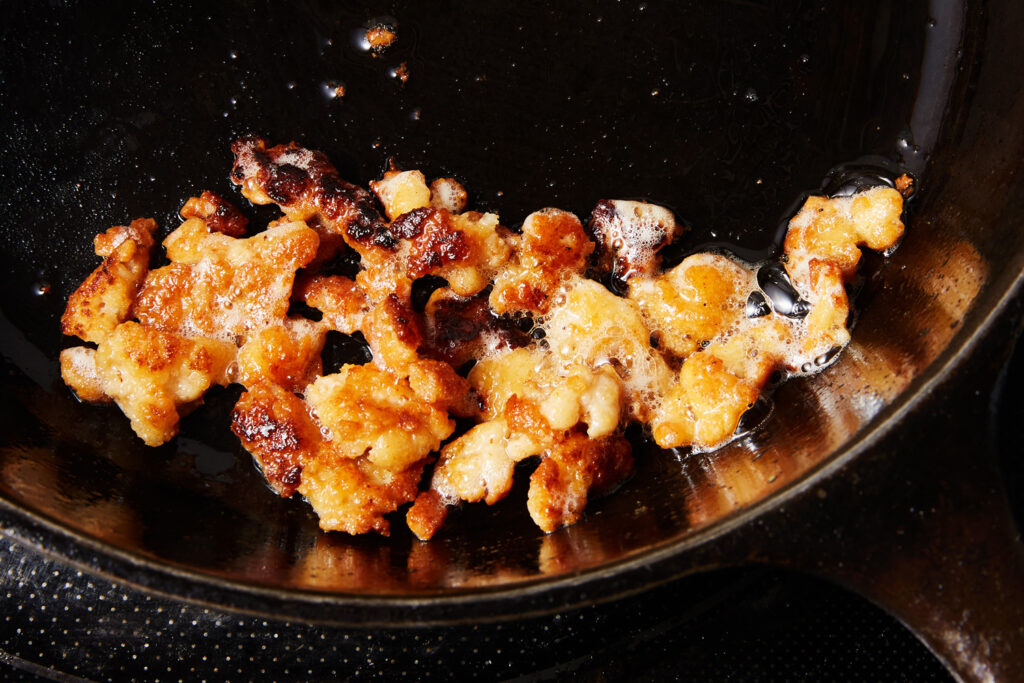
Walk into a low-slung building in Jersey City, a few blocks from the PATH train, and you will not find a barn. There is no smell of a farm, no fences, no animals at all. There are stainless-steel tanks, a clean room, and a small team in lab coats. Out of those tanks comes pork - actual pork, grown from pig muscle cells. This is Fork & Good, and the thing it makes for a living is meat that no animal had to become.
The company is small, around fourteen people. The ambition is not. Fork & Good is trying to answer a question the entire cultivated-meat industry has mostly avoided: not can you grow meat, but can you grow it for a price anyone will actually pay?
01 / THE PROBLEMThe number nobody wants to talk about
Cultivated meat has a public-relations problem and a math problem, and they are not the same problem. The public-relations one - "would you eat lab-grown pork?" - gets all the headlines. The math problem is quieter and far more dangerous: for years, growing a single pound of meat from cells cost more than a steakhouse dinner. Beautiful science. Terrible grocery receipt.
The world eats more than 100 million tons of pork a year, and it does not plan to stop. Conventional pork is cheap, fast, and entrenched. If a cultivated product costs ten times as much, it is a press release, not a competitor. Fork & Good understood this early. The enemy was never the pig. The enemy was the price tag.
Most cultivated-meat demos are priced like jewelry and served on tiny spoons. Fork & Good's whole pitch fits on a gas-station sign: $2 a pound.
02 / THE FOUNDERS' BETAn urban farmer and the man who started it all
Fork & Good was founded in 2018 by two people who came at the problem from opposite ends. Niya Gupta, the CEO, had already built ComCrop, a hydroponic urban farm in Singapore - a business about growing a lot of food in very little space. Gabor Forgacs, the chief scientific officer, is a biophysicist with a 30-plus year academic career who introduced cultivated meat to the public on the TEDMED stage in 2011. One knew how to scale farming into a footprint. The other helped invent the field.
Their bet was contrarian in a quietly technical way. Where many cultivated-meat companies chase stem cells - flexible, powerful, and notoriously fussy - Fork & Good chose to grow primary muscle cells directly. Less glamorous. Simpler. And, the company argues, cheaper to scale. In an industry fond of moonshots, they picked the unsexy path on purpose.
Gupta grew lettuce on Singapore rooftops before she grew pork in New Jersey. Forgacs has been telling people meat could come from cells since before "cultivated meat" was a phrase anyone used at dinner.
03 / THE PRODUCTA factory the size of an idea
After roughly four years in stealth, Fork & Good emerged in March 2023 with something most of its peers still only had on slides: a working pilot plant. The Jersey City facility is built around a patented bioprocess and custom bioreactors designed to grow cells at high density - more meat per tank, fewer tanks per pound.
The headline claim is spatial. The company says its approach can produce roughly six to ten times more pork per square foot than traditional farming, using far less water and with minimal impact on the surrounding land. A meat factory that fits in a city, rather than a feedlot that needs a county. The cells, importantly, are gene-edited to keep dividing - so the line keeps producing without returning to a live animal each time.
The whole company, in one bar
Approximate price per pound · lower is the entire point
Illustrative comparison drawn from public statements. The exact figure for "early cultivated meat" has historically run orders of magnitude above commodity pork; Fork & Good's stated goal is to close that gap to roughly farm price.
The product itself debuted not in a focus group but on a plate. The pilot plant launch came with actual cultivated pork dishes, and in early 2024 the company hosted what it billed as the first-ever tasting of hybrid cultivated meat at Davos. The verdict from the room was the one the company wanted least to be surprising: it tasted like pork.
How a pig-free factory got built
FORK & GOOD · A SHORT HISTORY OF SAYING "WHAT IF"
Co-founder Gabor Forgacs introduces cultivated meat to the public on the TEDMED stage - years before the industry exists.
Niya Gupta and Gabor Forgacs team up to make cultivated meat that competes on price, not just principle.
The company raises its Series A from True Ventures, Leaps by Bayer and others while staying largely in stealth.
Fork & Good unveils its Jersey City pilot facility, patented bioprocess and first cultivated pork dishes.
Hosts the first-ever public tasting of hybrid cultivated meat at the World Economic Forum.
Merges cultivated pork and beef into one global red-meat platform, adding operations in the UAE.
Earmarks Q2 2026 as an earliest target window for launch, pending US FDA review.
04 / THE PROOFMoney, mergers, and a first paying customer
Conviction is cheap; cap tables are not. Fork & Good has raised on the order of $30 million from a roster that takes the idea seriously - True Ventures leading, with Leaps by Bayer, Collaborative Fund, Firstminute Capital, Green Monday Ventures, Starlight Ventures and BBG Ventures along for the ride. Bayer's venture arm does not typically back novelties.
Then there is the least glamorous and most convincing milestone of all: revenue. Fork & Good reported earning its first money through a joint development agreement with an roughly $8 billion global food manufacturer. A real company paid a cultivated-meat startup to do real work. In a sector long on tasting menus and short on invoices, that line item matters.
In October 2025 the company made its boldest move - acquiring California's Orbillion Bio. Orbillion had scaled beef cell cultivation; Fork & Good had pork. Together they formed a single global red-meat platform spanning North America, Europe, Asia and the Middle East, complete with a new subsidiary in Abu Dhabi. The merged entity claims the largest intellectual-property portfolio in the cultivated-meat sector. Two startups, one platform, considerably more leverage.
Beyond the Orbillion merger, Fork & Good has worked with Nutreco on affordable feed inputs and Extracellular on scalable manufacturing. Cheap meat, it turns out, is a team sport.
05 / THE MISSIONLess land, less water, real meat
Strip away the bioreactors and the mission is plain. Conventional meat is one of the most resource-hungry things humans make - land, water, feed, emissions. Fork & Good's argument is not that people should eat less meat. It is that we could make the same meat with a fraction of the inputs, in a building that fits in a city instead of a footprint that swallows a forest.
That is a deliberately unromantic vision. No lectures, no guilt, no asking anyone to give up bacon. Just the same product, made a different way, at a price that makes the choice easy. The company would rather win on the receipt than on the sermon.
06 / WHY IT MATTERS TOMORROWThe regulator and the receipt
Two things stand between Fork & Good and a grocery aisle: a regulator and a receipt. The company has earmarked an earliest window around Q2 2026 for launch, pending US FDA review, and plans to file its dossier. Approval is a gate, not a guarantee - and the wider cultivated-meat industry has had a turbulent few years of funding squeezes and shaken faith.
But the receipt is the real test, and it always was. If Fork & Good can hold its line at something near commodity price, the question stops being "would you eat it?" and becomes "why wouldn't you?" That is the moment a curiosity becomes a category.
So return to that building in Jersey City, a few blocks from the train. The tanks are still humming. There is still no barn, no smell, no animal. What has changed is what comes out of them - not a demo, not a someday, but pork with a price tag and a customer. The pig-free factory was a strange idea once. Fork & Good is busy making it an ordinary one.
The future of meat may not be raised on a farm. It may be grown in a city, and sold for two dollars a pound.