Founder • CEO • Biotech
Fengru Lin
She went looking for a better glass of milk. She came back building a company to make it without the cow.
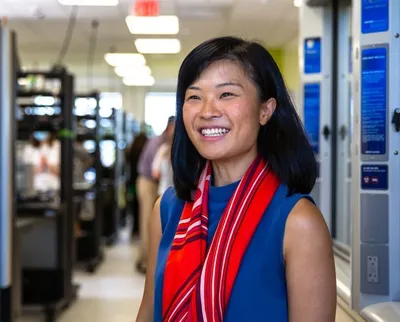
// Fengru Lin, on the floor where the cows used to be needed.
She went looking for a better glass of milk. She came back building a company to make it without the cow.
// Fengru Lin, on the floor where the cows used to be needed.
Fengru Lin runs a company that makes one of the most valuable proteins in milk, and there isn't a single cow on the payroll. TurtleTree, the biotech she co-founded in 2019 with Max Rye, grows dairy proteins using precision fermentation - microbes, tanks, and a recipe - rather than herds, hormones, and hay. The headline product is lactoferrin, a protein so scarce and prized that the industry nicknames it "pink gold."
Today the work is unglamorous in the best way: bioreactors, contracts, ingredient buyers. But the origin has nothing to do with laboratories. It starts with cheese.
Lin took up cheesemaking as a hobby. She flew to Vermont and upstate New York to learn the craft properly, then tried to bring it home to Asia. That is where the trouble began. To make good cheese you need good milk, so she went looking for it - to farms in Indonesia and Thailand - and found contract farming, hormones, and antibiotics instead. The romance of the artisan curd collapsed against the reality of the supply chain.
So she gave up on cheese. She kept her day job at Google. And then she met a man who wanted to talk about growing meat from cells, and the question rearranged itself in her head: if you can grow meat without the animal, why not milk?
"What business do you have running a biotech company? I'll invest in you when you guys have a Nobel laureate on your team."
// An early investor, as Lin remembers itThat line, delivered to a former sales professional with no science degree, could have ended things. It didn't. Lin took the opposite lesson from it. Not being a scientist, she decided, was a feature. She wasn't wedded to any one method or any one piece of lab wizardry. She could chase the product customers actually wanted to buy, and swap the technology underneath it whenever the math demanded.
The math demanded a lot.
TurtleTree began with the grand version of the dream: full cell-cultured milk, the whole white glass grown from cells. Ambitious, expensive, and slow. Lin, unsentimental about technology, read the economics and turned the ship.
The problem with recreating ordinary milk is that ordinary milk is cheap. Whey sells for a few dollars a kilo. Casein, more. To win, you don't start with the commodity - you start with the ingredient the market is desperate for and can barely supply.
That ingredient is lactoferrin. It sells for hundreds to well over a thousand dollars per kilogram, it's valued for immunity, digestion and iron regulation, and the world is short of it. Extracting it the old way takes enormous volumes of cow's milk. Brewing it with microbes changes the arithmetic entirely.
"Using microbes as tiny factories embedded with lactoferrin's unique recipe."
// Fengru Lin, on how it actually worksPick the protein where value is high and supply is thin, prove the platform there, then work down the ladder toward the cheaper stuff later. It's a jeweler's strategy, not a dairy farmer's.
// Why TurtleTree chose lactoferrin. Approximate market prices.
Same tank. Very different economics.
Graduates from Singapore Management University with a degree in Information Systems Management.
Corporate sales at Salesforce, then Google, in Singapore. Cheesemaking becomes a hobby that turns into an obsession.
Co-founds TurtleTree Labs with Max Rye to make milk with cell-based technology.
Wins The Liveability Challenge and a $1M Temasek Foundation prize. Named to EDGE's 35 Under 35. Closes an oversubscribed US$6.2M pre-A round.
Raises a ~$30M Series A led by Verso Capital. Named Her World Young Woman Achiever and a Gen.T honoree.
Sharpens focus on precision fermentation and lines up the market launch of LF+ lactoferrin.
Lin has been told, more than once, that a person without a lab coat has no business running a biotech company. She kept the insult and threw away the conclusion. Her answer is that distance from the science is exactly what keeps a founder honest about the product.
"We're not precious about any technology."
// Fengru LinIt's a small sentence with a large spine. A scientist can fall in love with a method. A founder can only afford to fall in love with something a customer will pay for. When full cell-cultured milk didn't pencil out, TurtleTree changed course without a funeral. That flexibility - the willingness to pivot from the romantic version to the profitable one - is the throughline of the whole company.
She's also spoken about leading and mentoring a team of scientists she didn't rise up through, which is its own quiet feat: earning the room's trust without having stood at their bench.
The entire company traces back to a failed attempt to make decent cheese at home. Bad milk, it turns out, is the mother of invention.
Lactoferrin is called "pink gold" - a nod to its rosy tint and its eye-watering price per kilo.
The spark came from a conversation about growing meat. She heard "meat without the animal" and thought "milk without the cow."
She flew to Vermont and upstate New York to learn cheesemaking properly - then couldn't find milk clean enough to do it back home.
Sources: TurtleTree, AgFunderNews, Green Matters, AsiaTechDaily, KrASIA, Wikitia. Prices and figures approximate and drawn from public interviews.