Breaking: FDA says "no questions" to world's first precision-fermented lactoferrinLF+ now cleared to commercialize in the U.S.~$43M raised since 2019Partners: MAD Foods - Cadence Coffee - Strive NutritionIt can take 10,000L of milk to extract 1kg of lactoferrinNamed to Fast Company World Changing Ideas 2024Breaking: FDA says "no questions" to world's first precision-fermented lactoferrinLF+ now cleared to commercialize in the U.S.~$43M raised since 2019Partners: MAD Foods - Cadence Coffee - Strive NutritionIt can take 10,000L of milk to extract 1kg of lactoferrinNamed to Fast Company World Changing Ideas 2024
Company Profile / Food Biotech
TurtleTree
The company brewing milk's rarest protein - without a single cow in sight.
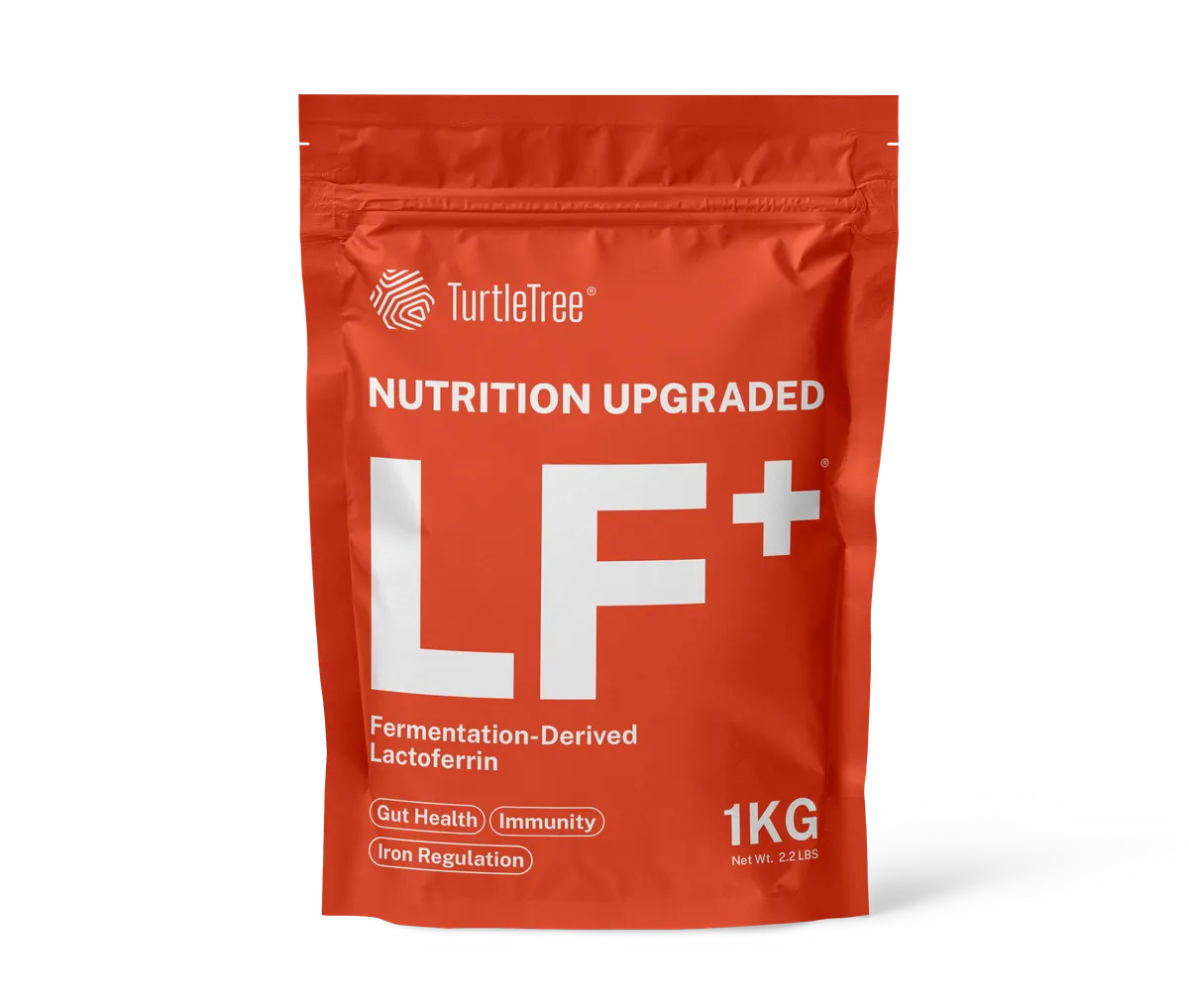
TurtleTree's LF+: a kilo of "pink gold" that never met a cow. The pack on the right took a fermentation tank, not a herd, to fill.
Who they are now
A milk company that owns no cows
Walk into a TurtleTree facility and you will not find a barn. You will find steel tanks, microbes, and a protein that the dairy industry has spent decades trying to squeeze out of raw milk a few grams at a time. TurtleTree makes lactoferrin - the bioactive milk protein prized for immunity, iron regulation and gut health - by fermentation. No herd. No milking parlor. No hormones in the water supply.
In May 2025 that approach stopped being a science project. The U.S. Food and Drug Administration issued TurtleTree a "No Questions" letter for its lactoferrin, LF+ - the first time any regulator on Earth had cleared a precision-fermented version of the protein. It was the kind of milestone that turns a startup from "interesting" into "supplier." Skeptics had spent years asking when. The answer arrived in a one-page government letter.
"To lead the way in sustainable nutrition and revolutionize the food system."
- Fengru Lin, Co-Founder & CEO, on TurtleTree's mission
2019
Founded
$43M
Raised
1st
FDA-cleared PF lactoferrin
LF+
Flagship protein
The problem they saw
Milk's best protein is also its scarcest
Lactoferrin is the protein nutritionists rave about and supply chains can barely deliver. It does real work in the body - regulating iron, supporting the immune system, helping the gut. The catch is supply. Lactoferrin exists in cow's milk in tiny concentrations, which means extracting a single kilogram can take something like 10,000 liters of milk. Rarity has a price, and for years that price hovered around a thousand dollars a kilo.
So the world ended up with a strange situation: a nutrient everyone agrees is valuable, locked behind a supply chain that depends on more cows, more land, and more of the exact farming practices a warming planet can least afford. The protein was good. The way we got it was the problem.
The protein was never the problem. The cow was the bottleneck.
- The case for fermenting lactoferrin
There is a certain irony here. To get a protein that helps human health, the old method leaned on an animal supply chain with a heavy environmental tab. TurtleTree's bet was that you could keep the molecule and lose the baggage.
The founders' bet
It started, improbably, with cheese
Fengru Lin wanted to make good cheese. That was the whole ambition. She learned the craft on trips to Vermont and upstate New York, then went looking for clean raw milk back home in Asia. What she found on dairy farms changed the plan: poor hygiene, cows on hormones, contaminated water - conditions that wrecked milk quality before it ever reached a cheesemaker.
The cheese idea died. Something larger replaced it. In 2019, Lin teamed up with technologist Max Rye and founded TurtleTree in Singapore - a country with, conveniently, almost no cows and no agriculture to defend. If milk's most valuable components could be made without the animal, why not start where there were no animals to begin with?
"It's just because of the cheese."
- Fengru Lin, on how a hobby became a biotech company
The least likely origin story in food tech: a founder who couldn't source decent milk decided to stop sourcing milk altogether.
The early company chased an ambitious target - cell-cultured milk, even human breast milk. Investors were, in Lin's own telling, skeptical and sometimes rude. The economics were brutal. So TurtleTree did the unglamorous, intelligent thing: it narrowed. Instead of recreating all of milk, it picked the single most valuable molecule in it and went all in. Cell cultivation gave way to precision fermentation. Lactoferrin became the whole company.
A pivot is just a strategy that finally admitted what it was good at.
- On TurtleTree's shift from cultured milk to a single protein
The road here
From cheese hobby to FDA clearance
2019
TurtleTree is founded
Fengru Lin and Max Rye launch in Singapore, aiming to make milk - including its rarest components - without animals.
2020
Seed and pre-Series A
Roughly $3.2M seed followed by ~$6.2M, backed by Green Monday Ventures, Artesian and others.
2021
$30M+ Series A
Led by Verso Capital - one of the largest cell-based / fermentation food rounds in Asia at the time, taking total funding to ~$40M.
2022 - 2023
World-firsts and self-GRAS
Debuts the first cultivated bovine lactoferrin, then secures the world's first self-affirmed GRAS for animal-free lactoferrin, clearing LF+ to commercialize in the U.S.
2024
World Changing Ideas - and a hard reset
Named to Fast Company's World Changing Ideas. Also restructures and trims headcount amid a tough fundraising climate; co-founder Max Rye departs.
2025
FDA "No Questions" + commercial launches
Receives the first-ever FDA "No Questions" GRAS letter for precision-fermented lactoferrin. Partners with MAD Foods on an LF+ coffee line.
The product
LF+ : lactoferrin, minus the herd
LF+ is the answer to the whole problem in one ingredient. It is lactoferrin produced at industrial scale by microbial fermentation - the first of its kind to reach the market that way. Functionally it behaves like the lactoferrin extracted from cow's milk: same support for immunity, iron regulation, digestion, endurance and muscle. The difference is upstream. There is no cow, no extraction from thousands of liters of milk, no farm in the supply chain.
Immunity
A bioactive milk protein associated with immune support and the body's natural defenses.
Iron Regulation
Helps manage how the body binds and absorbs iron - lactoferrin's signature trick.
Gut Health
Linked to digestive health, with relevance for both adult and infant nutrition.
Keep the molecule. Lose the cow. That is the entire product in five words.
- What LF+ actually is
TurtleTree does not sell coffee or protein shakes. It sells the ingredient that goes inside them. The business is B2B: brew LF+, hand it to brands, let them build the products consumers actually pick up off a shelf. It is a quieter position than a flashy consumer label - and a far more scalable one. Get designed into enough formulations and you become infrastructure.
The proof
Receipts, not just promises
A skeptic's fair question: does anyone actually buy this? The early answer is yes, in the form of commercial partners putting LF+ into real products. Cadence Performance Coffee built a functional espresso shot around it - TurtleTree's first commercial deal. MAD Foods, a Singapore CPG company, signed on for an LF+ coffee line. Strive Nutrition is co-developing a U.S. immunity beverage and a ready-to-mix sports protein powder.
How TurtleTree's funding stacked up
// Cumulative capital raised, by round (approx., USD)
Seed '20
$3.2M
Pre-A '20
$6.2M
Series A '21
~$30-33M
Total to date
~$43M
Source: Food Dive, Tracxn, AgFunderNews. Figures approximate and rounded.
Three partners, one FDA letter, zero cows. The proof is on the ingredient list.
- TurtleTree's commercial scorecard
None of this means the road was smooth. TurtleTree restructured in 2024, cut staff sharply, and was reported to be raising a ~$15M pre-Series B in a chilly market for food tech. Lin called the future "exciting" anyway - the kind of word founders use when the science finally cleared the regulator and the cash had to catch up.
The mission
Sustainable nutrition, made literal
Strip away the biotech vocabulary and TurtleTree's pitch is simple: take the most useful parts of milk and make them abundant, affordable and animal-free. Lactoferrin is the proof-of-concept, not the finish line. If you can ferment milk's rarest protein at scale and get a regulator to sign off, you have a template for liberating other high-value nutrients from the herd.
"We saw huge potential to disrupt the market."
- TurtleTree, on unveiling its world-first lactoferrin
The environmental math is the quiet engine underneath. Conventional lactoferrin rides on dairy's footprint - land, water, methane, the works. Fermentation swaps the barn for a bioreactor. That is not a slogan; it is a different supply chain with a different bill attached.
Watch
See it in the founder's words
Prefer the story straight from the source? Fengru Lin has explained the pivot, the economics and the science across several long-form interviews and podcasts.
Go back to that facility with no barn. A few years ago it was an argument - a founder insisting that you could make milk's best protein without the animal, while investors and regulators raised eyebrows. Today the eyebrows are down. The FDA has reviewed the science and had no questions. Brands are formulating with the result. The tanks are running.
TurtleTree has not solved the whole food system, and it would be silly to pretend a single Series A startup could. The funding climate is hard, the team is leaner, and scale is still the test ahead. But the central claim has held: lactoferrin no longer requires a cow. The barn that isn't there is the point. It is the whole company, fermented down to its essence and poured into a one-kilo pack of pink gold.
They set out to make better cheese. They ended up making milk obsolete - one protein at a time.