The first strange thing about Thomas Jonas’s second career is where it started: not in a laboratory, but on a beach in Hawaii. Jonas had spent years in packaging, rising through Pechiney and Alcan before running two MeadWestvaco businesses with 15 plants and more than $700 million in annual sales. The machinery was global, physical and familiar. The purpose had begun to itch.
Parenthood had made the itch harder to ignore. Jonas concluded that a career in plastic packaging belonged more to the environmental problem than its solution, so he took a sabbatical. A chance encounter on that beach led him toward Montana and Mark Kozubal, a geomicrobiologist working with an organism isolated from an acidic volcanic spring in Yellowstone National Park. The organism had endured heat, acidity and scarcity with unnerving composure. It was tiny, resilient and, as the pair would learn, unusually good at making protein.
Jonas did not arrive with a biology doctorate. He brought the scar tissue of an operator: factories, product development, multinational teams and the recurring question of whether an idea could survive contact with a production line. Kozubal brought the science. Their eventual company began as Sustainable Bioproducts and first explored the organism as a source of biodiesel. Fuel turned out to be the prelude. The more useful talent was sitting in the biomass itself.
“We have this big, complex problem about how we feed everybody, and some of the answers are out there and we just need to use science to figure it out.”Thomas Jonas
The pivot hiding in the petri dish
The fungus, Fusarium strain flavolapis, naturally forms a fibrous, protein-rich mat. It contains all nine essential amino acids. It can take savory or sweet forms because its base is relatively neutral. The business implication arrived slowly, then all at once: a microbe originally considered for engines might matter more at breakfast.
The pivot from biofuel to food is easy to praise in retrospect. At the time, it meant separating attachment to an application from belief in a capability. Jonas has described new knowledge as science’s currency, while noting that knowledge may or may not have economic value. His task was to ask questions that guided the discovery toward something customers could use. This was less a cinematic epiphany than a disciplined change of noun: not fuel, but protein.
The Fy loop · simplified
Nature’s Fynd developed liquid-air interface fermentation, growing Fy across stacked trays instead of relying only on the giant stirred tanks familiar to industrial fermentation. The organism likes acidic conditions that discourage common contaminants. In this cultivated world, a tray behaves like a field, except the weather is controlled and harvest does not wait for a season. Jonas has cheerfully called himself a farmer on that basis. It is a joke with an operating thesis tucked inside it.
A factory with a sense of irony
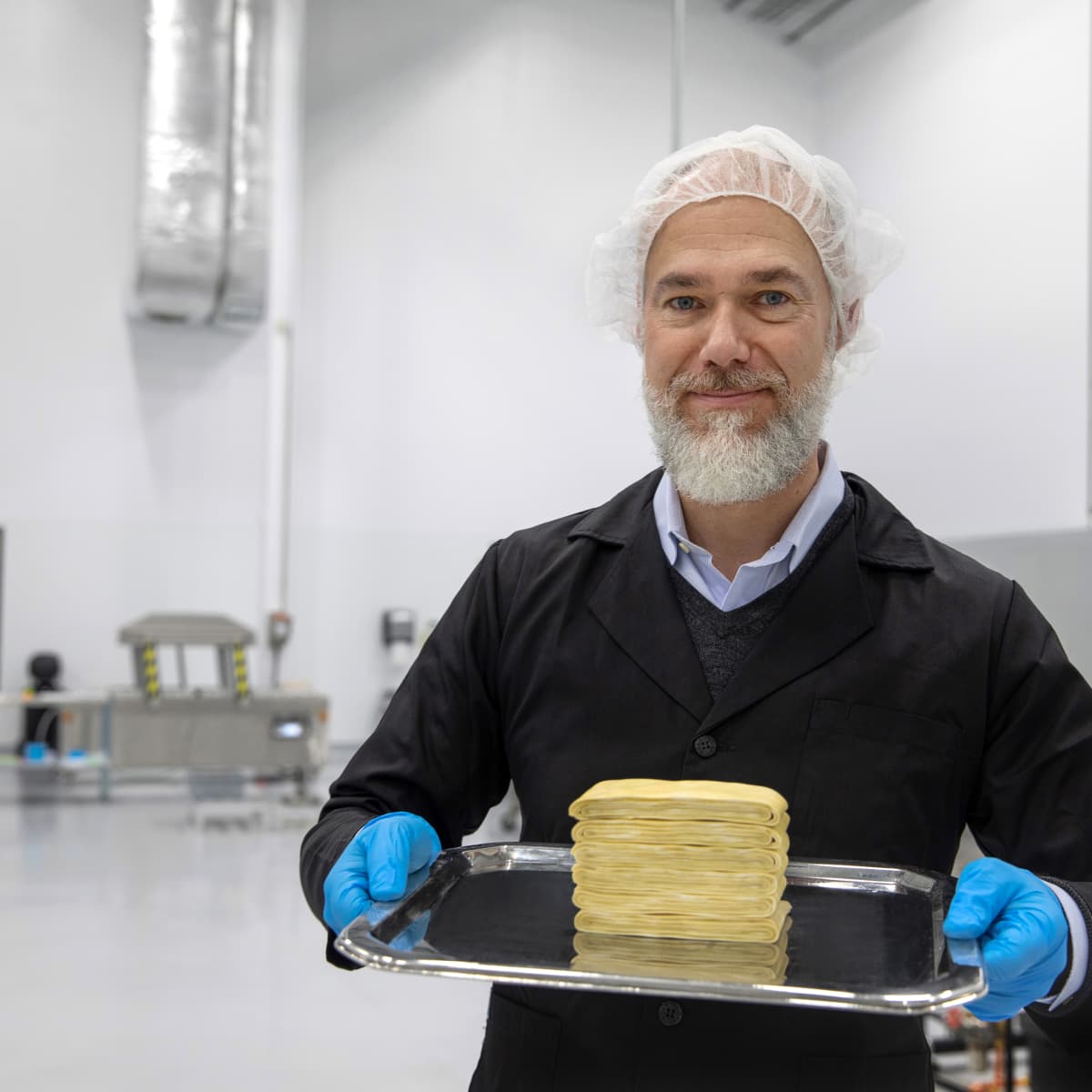
The company, renamed Nature’s Fynd in 2020, established production on Chicago’s South Side near the old Union Stock Yard. The location is almost too tidy as metaphor. This was once the industrial center of American meatpacking, a place whose scale changed how a country ate. Now a company nearby grows animal-free protein from a Yellowstone microorganism. Across the street, the old food economy has not vanished. It merely has a new neighbor.
Jonas appreciates the poetry but behaves like a manufacturer. Taste matters more than a handsome sustainability slide. During one tour of the company’s kitchen lab, he tried a dairy-free brie prototype, registered a slight bitterness and wanted it fixed. A novel food might win a first purchase through curiosity, he argued, but flavor determines whether anyone returns. When samples appear in meetings, he has noticed, people stop watching the presentation. For a food company, losing the room to the plate is a victory.
Nature’s Fynd launched meatless breakfast patties and dairy-free cream cheese, then pushed further into yogurt and snack bites. Strawberry Dairy-Free Fy Yogurt won a NEXTY Award in 2025, while Fy Bites appeared at Natural Products Expo West. These are ordinary grocery forms carrying an unordinary origin story. Jonas’s goal is not to ask shoppers to admire a microbe forever. It is to make the microbe disappear into an enjoyable habit.
The executive who asks the questions
Jonas grew up outside Paris in a middle-class family with two brothers and, by his estimate, roughly 10,000 books. His mother was a geologist. His father was a dentist, a national-level chess player and a provider of dental care to French astronauts. The family dinner table moved easily among science, art and strategy. Long before Yellowstone, Jonas had learned that curiosity could be a domestic atmosphere.
He graduated from HEC Paris in 1993 and served as an officer in the French Air Force. His commercial career took him through Hong Kong, luxury packaging and large manufacturing organizations. Those years left him with a useful humility about expertise. He compares a company to a sports team: everyone must play a position, and the leader should recruit people who can do what the leader cannot. At Nature’s Fynd, that means biologists, food scientists, cooks, engineers and specialists in industrial scale-up.
Curiosity is the common trait he says he seeks in hires. He also gives newcomers permission to fail, because machinery built for a new process does not arrive with a complete manual. When the factory’s rovers were delivered without adequate sealing, the team adapted them. The anecdote is wonderfully unromantic. Reinventing protein still involves fixing equipment.
“I never pretend to have all of the answers but I’m always asking questions because what we are doing has never been done before.”Thomas Jonas
His self-described operating traits are determination, optimism and a desire to leave things better than he found them. The optimism is not decorative. Climate conversations offer ample reasons for gloom; a company needs enough belief to keep translating a problem into experiments. Jonas’s preferred phrase, “do more with less,” doubles as the lesson of an extremophile. Life adapted to a hostile spring. The business is trying to adapt that efficiency to a crowded planet.
Breakfast, orbit and a silver bag
The platform has already escaped the refrigerator. In 2022, a Nature’s Fynd bioreactor traveled to the International Space Station and successfully produced Fy in microgravity. The research asks whether astronauts on long missions might grow protein with limited inputs rather than carry every meal from Earth. It also circles back to Jonas’s childhood in a manner a novelist might reject as heavy-handed: the dentist’s son who heard about astronauts at home now helps test space food.
A related collaboration supported by the Bill & Melinda Gates Foundation explored decentralized fermentation for communities in lower-income countries. The shared premise is location. If compact systems can grow useful protein throughout the year, production can move closer to the people eating it, whether the difficult address is remote, resource-constrained or in orbit.
NASA · Up
A compact bioreactor grew Fy aboard the International Space Station, testing the platform under microgravity.
Chicago · Here
Retail food production occupies the same city geography that once defined industrial meat.
Food security · Out
Decentralized fermentation research asks whether protein can be grown nearer to demand.
Hydefy · Beyond
The fungal platform became a material used in Stella McCartney’s Ryder handbag.
Then came fashion. Nature’s Fynd spent years developing Hydefy, a fungi-based material designed as an alternative to animal leather. Stella McCartney used it for a metallic silver Ryder bag unveiled in the Summer 2025 runway show. Food and handbags seem like unruly siblings, yet the underlying question is consistent: what useful structures can fermentation grow with fewer inputs?
For Jonas, the company remains early in that inquiry. He wants wider retail distribution, more places to grow Fy efficiently and partnerships that put the ingredient into formats beyond Nature’s Fynd’s own label. Bars and drinks are possible. So are applications no one has named yet. His aspiration is broad, but the daily work is concrete: improve the yield, repair the rover, remove the bitterness, earn the second spoonful.
There is a temptation to frame his story as a clean conversion from old industry to new. Reality is more useful. The packaging years taught Jonas how products, plants and supply chains behave at scale. He did not discard that first career; he reassigned it. The Air Force officer, the HEC graduate and the factory president all followed him into the fermentation room.
What changed was the object of the machinery. A successful executive took seriously the discomfort that his work no longer matched his values. A scientist took seriously a hardy organism most people would never notice. Together they stopped asking it to become fuel and let it become food. The lesson is less about fungi than attention: sometimes the better business is already growing inside the first one, waiting for someone curious enough to change the question.