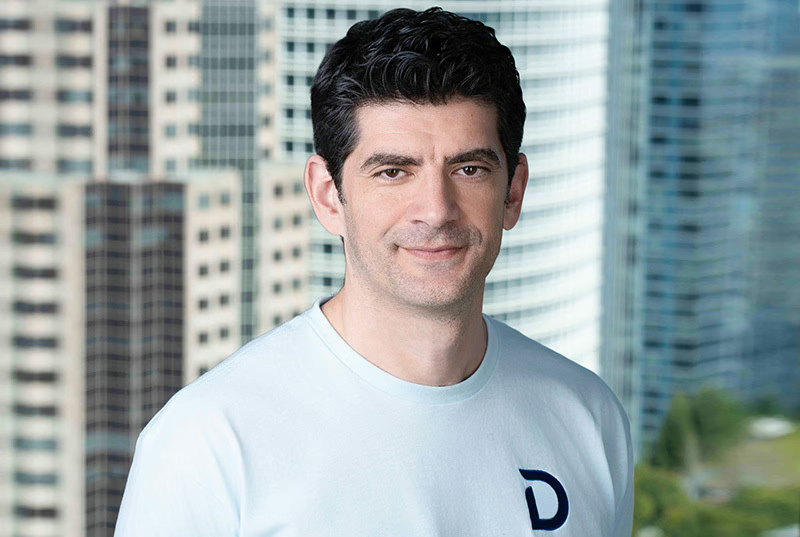
The Literature Major Running a $200M Tech Company
Brown University, 1994. Gabe Rogol is studying Comparative Literature and Russian Language and Literature. He reads Chekhov. He writes about Borges. He has absolutely no intention of going into sales. Fast forward three decades: he is CEO of Demandbase, the company that invented account-based marketing software, and he just broke $200 million in annual recurring revenue.
The path between those two points is not a straight line. After Brown, Rogol spent years at IDG - the tech media empire - running sales and marketing for its SMB division. He learned the machinery of B2B revenue not from an MBA program but from the trenches, managing customer relationships at a media company built on advertiser relationships and subscription data. When he joined Demandbase in 2012, the company was a young startup with a radical idea: instead of chasing individual leads, what if you targeted entire accounts? What if you knew which companies were in-market before they ever filled out a form?
That idea was called Account-Based Marketing. Demandbase didn't just adopt it - they built the category. And Rogol built the sales machine that proved it could scale.
"I am somebody who got a degree in comparative literature and Russian language and literature. The last thing I wanted to do was to go into sales. And then I became a CEO of a tech company."— Gabe Rogol
As Chief Revenue Officer, Rogol doubled sales productivity - a claim that gets made often in tech and rarely means much, but at Demandbase it meant something concrete. Customer spend on the platform ranges from $20,000 to $5 million annually. Getting the sales motion right for that range of deal sizes, at that level of complexity, is a genuine operational feat. When founder Chris Golec stepped aside in November 2019 to return to product and culture work he loved, the board didn't search externally. They looked at the person who had built the revenue engine and handed him the wheel.
Rogol's thesis as CEO has been consistent: account-based strategy is not a marketing tactic. It is your entire go-to-market, or it is nothing. He has argued this publicly and implemented it internally. Demandbase is a company run on its own product - using account intelligence, intent data, and buying group signals to decide where to invest in sales and marketing. That kind of dogfooding builds credibility with customers and keeps the product team honest about what actually works at scale.
The big move of 2025 is Agentbase - a suite of AI agents built on Amazon Web Services that automates GTM tasks that used to require entire teams of specialists. The Campaign Outcomes Agent delivers 40% higher click-through rates. The Filter Agent produces account segmentation ten times faster than manual methods. These are not demo numbers - they are production metrics from live customer deployments. Rogol calls Demandbase 4.0 an "open, flexible, AI-assisted GTM approach," which translates roughly to: the platform does the heavy lifting, and your team focuses on the decisions that actually require human judgment.
On the question of AI replacing sales development reps - a topic that generates enormous heat in B2B circles - Rogol is more measured than the hype cycle. He acknowledges automation can speed up outreach and reduce manual tasks, but argues that great SDRs rely on creativity, timing, and human touch that machines cannot fully replicate. Coming from someone who just launched nine AI agents, that's not a hedge. It's a product design philosophy: automate what is mechanical, preserve what is human.
The financial results under his leadership are credible validation. In 2024, Demandbase exceeded $200 million in annual revenue. It was the company's second consecutive year of profitability, with record EBITDA levels. Gross margins expanded materially year over year. Both gross and net ARR retention improved. In an era when many SaaS companies chose growth over profit, Rogol's Demandbase chose both - and achieved both.
Rogol's public argument - made repeatedly on podcasts and at industry events - is that B2B companies systematically underfund marketing relative to their revenue potential. "Stop underfunding marketing" is not a generic exhortation. It is a structural observation: when you cut brand spend and pipeline investment to hit short-term EBITDA, you mortgage future growth. Demandbase has done the opposite. The result is a company that grew into profitability rather than cutting its way there.
The Gartner Magic Quadrant has named Demandbase a Leader in ABM platforms for multiple consecutive years, most recently in 2025. Forrester named it a Wave Leader for B2B Revenue Marketing Platforms in Q3 2024. The company leads in 46 or more G2 categories. By any analyst measure, the bet on account-based everything paid off. The question Rogol is now answering is what the next version of that bet looks like - and his answer is AI agents doing GTM work end-to-end, at a speed and scale that no human team can match.
His CEO approval rating of 92 out of 100, placing him in the top 5% among similarly-sized companies, suggests he has managed to build an organization that believes in the mission and in the leadership. For a company whose product is about alignment between sales and marketing, running a company where people actually want to work is product-market fit for your culture.