A piece of tape is an unlikely destination for a career in advanced electronics. It has no screen to admire, no keyboard to master, and very little chance of becoming the object somebody places lovingly on a desk. Erik H. Volkerink has spent years working toward precisely that sort of disappearance. The co-founder and CEO of Trackonomy wants intelligence attached to the things people move, use, lose, and spend perfectly good afternoons trying to find.
His route there passes through semiconductor laboratories, Stanford, manufacturing, miniature electronics, and a Dutch school in Silicon Valley. Across those settings, a practical question keeps returning: how do you make something complicated useful to someone whose job is already complicated enough? At Trackonomy, the answer can be adhesive. Behind that modest surface sits a considerably less modest engineering and business undertaking.
The computer his parents put away
Long before the company, there was a Commodore 64. Growing up in Ommen in the Netherlands, Volkerink spent hours programming. In his recollection, his parents sometimes confiscated the computer; he found time for it at night. He also organized weekend gatherings with other programmers, making demonstrations and games and competing over the ingenuity of their work. Computing was a social pursuit as well as a solitary one.
At the University of Twente, his interests crossed electrical engineering, computing, business, and psychology. An internship at Hewlett-Packard took him to the United States. A job offer followed, along with an opportunity to pursue doctoral work at Stanford while employed. The transition required some decidedly unglamorous preparation: he remembered annotating his English textbooks with Dutch meanings beneath unfamiliar words.
That detail has more texture than the usual founder origin story. Before discussing how objects should communicate, he had to work through the language of the textbooks. The distance between a weekend programming gathering and a California laboratory was crossed word by word.
A laboratory education in what matters
Semiconductor testing became an important part of his working life. In 2005, Volkerink and Subhasish Mitra co-authored a paper on compressing the data produced when testing integrated circuits. They applied the technique to four industrial designs and reported reductions in test-response data volume of 26 to 60 times, without affecting test quality. The subject is technical; the underlying bargain is familiar. Preserve the information that matters while reducing the burden of handling it.
There is a useful distinction between making a circuit perform a clever trick and making the trick worth using in production. Testing sits directly at that junction. A manufacturer needs confidence that a part works, and needs that confidence at a cost and speed compatible with selling the part. An elegant method has to survive an accountant as well as an engineer.
Reduction in test-response data volume across four industrial designs in the paper co-authored with Subhasish Mitra. A research result, not a Trackonomy performance claim.
By a May 2008 engineering talk in Sunnyvale, his remit at Verigy included its laboratories network, research programs, university relationships, and intellectual property. He was also a consulting assistant professor in Stanford’s electrical engineering department and assistant director of its Center for Reliable Computing. His talk connected manufacturing trends to quality, throughput, and capital expenditure. The program described economics as a thread running through the discussion.
That combination helps explain the shape of his later work. University research, industrial testing, and business constraints were already sharing the same calendar. Trackonomy would eventually require all three to share the same small label.
Learning to shrink the machinery
Volkerink went on to hold chief technology officer roles at Verigy, Advantest, and Flex. At Advantest, he established a solid-state-drive business unit. His later executive roles included leading Liquid Interface Technologies and RF Digital, and serving as chief business officer of Heptagon. These were different businesses, but they kept him close to the problem of turning sophisticated electronics into products.
Flex added the perspective of manufacturing: designs must become physical things that other people can build, buy, and use. Heptagon added experience in miniature optical technologies. His formal training also spanned the technical and commercial sides, with an electrical engineering doctorate from Stanford and an MBA from Wharton.
A résumé can make each move appear inevitable after the fact. The more useful observation is narrower. By the time Trackonomy began in 2017 with fellow founder Ajay Khoche, Volkerink had worked in both the machinery that tests electronics and the organizations that bring electronic products to market. A tracking label would need to succeed in both worlds.
The ambition to become invisible
Volkerink’s shorthand for the next stage of connected devices was memorable. After working on wearable and ear-worn technology, he said, “what comes next must be ‘invisibles’”. Logistics offered an immediate place to try the idea. Goods already move through elaborate networks. Making their condition and whereabouts easier to understand could help the people responsible for those networks.
Trackonomy’s smart tape brings sensing and wireless communication into a form that can travel with an object. The company’s relationship with Koch Disruptive Technologies also provided access to industrial settings where applications could be tested with working equipment and experienced operators. The value of that connection extends beyond a cheque: an operating plant is an exacting audience.
The temptation in connected technology is to admire the device. Volkerink’s choice of word points attention elsewhere. If a worker can attach a label and get on with the job, the label has won a small but necessary victory. Every additional ritual competes with work that was there first. A parcel has never once delayed its departure out of respect for a software demonstration.
- 01 / ObjectA label travels with the item.
- 02 / SignalReaders relay observations.
- 03 / DecisionSoftware helps teams respond.
An airport is a demanding audience
In November 2025, Trackonomy’s work acquired a particularly visible setting. Delta Cargo launched Pulse, using Trackonomy technology to provide shipment information and alert operations teams to potential disruptions. The Sentient platform combines operational information with flight data and other inputs. Hardware around the airport supplies observations from the physical side of the journey.
For Volkerink, this moves the conversation beyond knowing that a tag exists. A useful observation arrives early enough for somebody to act. The distinction matters on a ramp, where an aircraft’s schedule imposes a rather firmer deadline than a product roadmap. The intended benefit is a better decision while a shipment is still moving through the system.
That same month, Jettainer announced a long-term tracking partnership with Trackonomy for its unit load device fleet. These are the containers and pallets used to move air cargo. The approach combines fixed readers with cellular-enabled units that can act as mobile readers, extending the network beyond places equipped with permanent infrastructure. Location and dwell-time information can help teams find equipment and understand how it is being used.
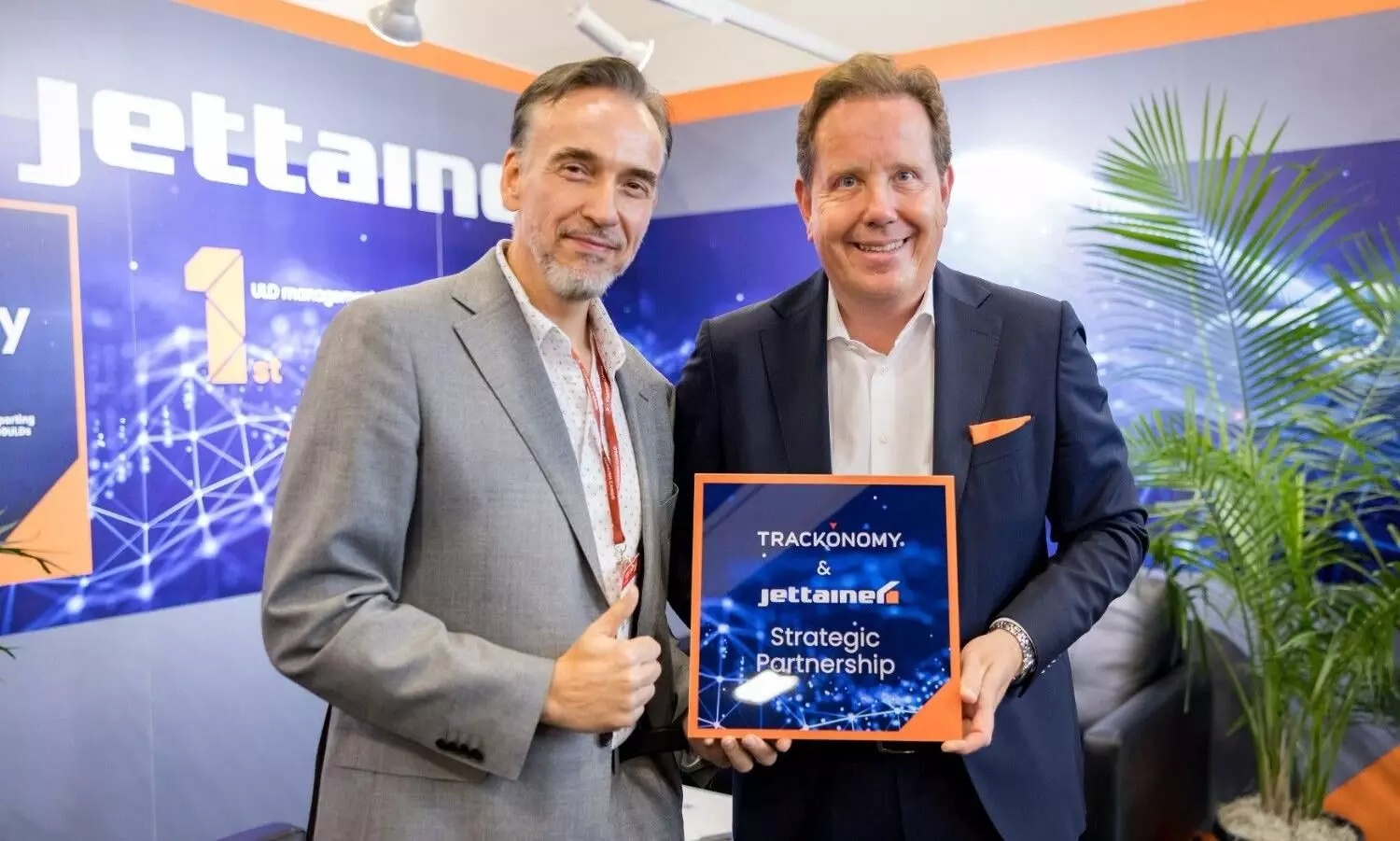
The partnership photograph shows the customary ceremonial sign and two executives. The interesting work happens after the photograph: equipment moving between locations, readers hearing signals, and an operator deciding where the next available container actually is.
Buying the parts behind the promise
During 2025 and 2026, Volkerink also moved further into the components and manufacturing behind connected labels. Trackonomy announced its purchase of InPlay in September 2025. InPlay develops Bluetooth Low Energy chips, including NanoBeacon technology for smart labels. The acquisition gave the company a position at the semiconductor level of the products it wanted to spread.
That makes the relationship between technical design and business design unusually concrete. Chip power consumption influences what a label can do. Cost influences which objects can justify carrying one. Production capacity influences whether an attractive pilot can turn into a routine purchase. Each sits upstream of the polished software experience a customer eventually sees.
In September 2026, Trackonomy completed the acquisition of Identiv’s IoT label business. The group described three businesses: InPlay for semiconductors, Identiv for labels, and Sentient for end-to-end solutions. Volkerink emphasized that the businesses would continue serving their own markets. His stated objective was “not to fold these businesses into one another.”
“Each will keep winning in its own market on its own merits.”
Erik Volkerink / September 2026
It is a structure with an interesting management requirement. The component businesses need outside customers and their own commercial judgment, while the group wants the advantages of their combined capabilities. Independence must coexist with coordination. For a founder trained to think about systems, the system now includes organizations with their own customers, priorities, and production schedules.
A different kind of connection
There is another institution on Volkerink’s résumé that deserves room beside the electronics companies. He helped establish the Dutch School Silicon Valley with Miriam Ringelestijn, a teacher who became his wife. The school offered Dutch-language education to children of families living in the area. His later roles there included founder and president.
It is a quieter example of building something around a specific need. Moving to California created opportunities, and also put a language and a community an ocean away. A school could help maintain that connection. Its place in his career gives the story a human scale that no shipment count can supply.
The Commodore gatherings, the laboratory collaborations, the school, and the smart-label businesses involve different kinds of participation. They should not be squeezed into a single theory of his character. Still, each shows him doing more than producing an isolated technical object. There are other people to bring into the arrangement.
At Trackonomy, the ambition is now spread across silicon, manufacturing, and software. Its practical test remains small enough to hold: a label attached to something that needs to arrive. Volkerink has spent much of his career making electronics fit into less space. The result asks for very little attention from the person carrying the box. Considering how much attention modern technology usually demands, that is a pleasing ambition.