Manhattan’s illuminated office towers are usually an invitation to look up. Tushar Dave and two fellow technologists saw a reason to look at the electricity bill. Walking through the city in 2009, Dave, Premal Ashar and Tanuj Mohan noticed buildings glowing long after most of their occupants had gone. The skyline was putting on quite a show for an audience that had already left.
The observation helped give rise to Enlighted, where Dave became co-founder and founding chairman and CEO. Its proposition was wonderfully specific: give commercial buildings enough information to stop wasting light. Years later, as CEO of FarmX, Dave is working with soil sensors, irrigation systems and autonomous machinery. The setting has changed from office ceilings to orchard rows. The recurring interest is easier to recognize: expensive physical operations that could make better decisions if they could see what was happening.
A chip designer’s route to the ceiling
Dave’s career began well before the smart-building pitch. He studied physics, earned a master’s degree in computer engineering at Syracuse University, and worked at Intel. His earlier companies included Arcus, Armedia and Vengines. By the time lighting became his business, he had already spent years in the less visible parts of the technology economy, where a product’s contribution may sit inside somebody else’s machine.
Armedia developed digital-video technology, with operations in Bangalore and California. In 1999, Broadcom announced its acquisition. The fit involved both intellectual property and engineering capability: video decoding on one side, broadband transmission on the other. Dave was Armedia’s president and CEO. This was an early example of a pattern that would recur in his career: build a useful component, connect it to a larger system, and give another business a practical reason to want it.
There was an international operating model here, too. Engineering across India and the United States was part of the company’s construction. Dave’s subsequent work would keep returning to that relationship between where a product is developed and where its customers buy it. The geography mattered because a technology company has to pay for its ambitions while it is still persuading customers to share them.
Before the light switch, a $50 million fund
In 2002, Dave and Vinod Dham launched New Path Ventures. Dham had led Intel’s Pentium development effort; Dave brought entrepreneurial and acquisition experience, including work at Broadcom. Their announced $50 million fund aimed to build hardware and system-design businesses linking India and the United States. It was a bet on products in a market strongly associated with software services.
The partners planned to take hands-on roles in the companies they backed. That detail helps explain Dave’s later combination of investor and operator. Financing a business and running one are different jobs, but his career repeatedly places them close together. The interesting question is often less about spotting a promising technology than assembling the people, product and customer relationships required to turn it into a company.
That history also makes Enlighted’s founding team more intelligible. Mohan, Ashar and Dave brought networking experience to lighting. An office building offered a different customer and a different installation problem, but it also offered a familiar engineering opportunity: distribute intelligence across many devices, collect useful signals, and make the whole system respond.
The light fitting becomes a listening post
Enlighted put sensors in light fixtures, combining information about occupancy, ambient light, temperature and power consumption. A light could respond to the space beneath it. Daylight arriving through a window, or people leaving a room, became information the system could act on. The ordinary ceiling fitting acquired a second occupation.
The financial argument was equally tangible. On April 18, 2013, Enlighted announced a $20 million Series C round led by RockPort Capital. It reported more than 10 million square feet under management, twice its footprint five months earlier. Customers named in the announcement included Google, LinkedIn, Hewlett-Packard and the City of San Jose. Those were company-reported milestones, with a date attached, rather than a promise about every future installation.
Enlighted’s reported footprint under management, doubled in five months.
A municipal installation supplied a more bounded test. At San Jose City Hall, Enlighted’s internal measurements showed lighting energy savings of 50 to 53 percent over three months. The system used one sensor per fixture, with software profiles for different spaces. Facilities staff had reduced maximum office lighting to 40 percent; with few exceptions, occupants either did not notice or wanted further dimming. Office lighting, it seems, does not always benefit from being the loudest participant in the room.
The building’s information could serve purposes beyond its lamps. Occupancy patterns help reveal how rooms and floors are actually used. That broadening from control to understanding became central to Enlighted’s appeal. A sensor installed for one immediate saving could produce information relevant to another operating decision.
The customer gets the first year
Dave’s own explanation of company-building is strikingly unromantic. In 2013, he described spending a new venture’s first year working with customers. Technical invention could be excellent and still miss the buyer’s requirements. His answer was to devote unusually large amounts of time to understanding the customer before that mismatch became expensive.
“Understanding the customer is the main thing”Tushar Dave, 2013
It is a useful counterweight to the glamour of the Manhattan story. An idea can arrive during a walk; an operating business requires prolonged attention from people who were never on that walk. Dave’s emphasis puts some of the work in the customer’s office, asking what would make a purchase worthwhile. The skyline may supply inspiration. It is unlikely to sign a purchase order.
In May 2018, Siemens announced it was acquiring Enlighted, with financial terms undisclosed. Joe Costello was chairman and CEO at that point. The platform Siemens described combined sensors, distributed computing, networking and software. Dave’s founding role belongs to the earlier chapter; the acquisition belongs to the continuing life of the organization he helped establish. Keeping those chapters distinct gives the achievement its proper shape.
Water supplies the next question
FarmX brought Dave into another business where observation and control meet a recurring resource bill. Founded in 2014, the company began with irrigation and water-management problems affecting California crops. Its early tools included a soil-moisture probe. Today, its team includes another familiar name: Enlighted co-founder Premal Ashar, FarmX’s chief operating officer.
Kubota’s investment history provides a concrete view of this chapter. In February 2022, the equipment manufacturer announced a second investment in FarmX and named Dave as CEO. It described a system drawing on local weather, crops, soil and irrigation data to support analysis, automated irrigation planning and yield management for specialty crops. For Dave, the customer had changed from a building operator to a grower. The business still depended on making a complicated physical system more legible.
The attraction of a sensor is easy to describe. The harder part is what happens after it measures something. An irrigation recommendation needs to be useful enough to influence an actual decision. A dashboard that merely reports an avoidable expense has supplied the opening sentence of a solution. There is still work to do before the ending.
A tractor that can read the room
In November 2022, FarmX announced its acquisition of AutoModality, a mobile-robotics navigation software company. The addition expanded its work into autonomous drones and ground vehicles. Dave described the appeal as giving growers a more complete view of their crops, from canopy to roots. The move connected information gathering with machines capable of moving through the field to collect it.
By the 2024 World Ag Expo, FarmX was presenting Perceptive Navigation, its approach to vehicle movement without dependence on GPS or connectivity during a mission. Sensors feed an onboard computing system that recognizes features such as trees, poles and vines. Under an orchard canopy, those surroundings are part of the navigation problem. FarmX’s approach makes them part of the answer.
The commercial progression was gradual. OrchardPilot launched in October 2024 with autosteer for existing tractors. Speed control, implement control and full autonomy were described as upcoming releases. In January 2025, FarmX reported trials on John Deere, CNH and Kubota tractors. This sequence matters: a useful steering retrofit can have a place in a grower’s operations before a larger automation program is complete.
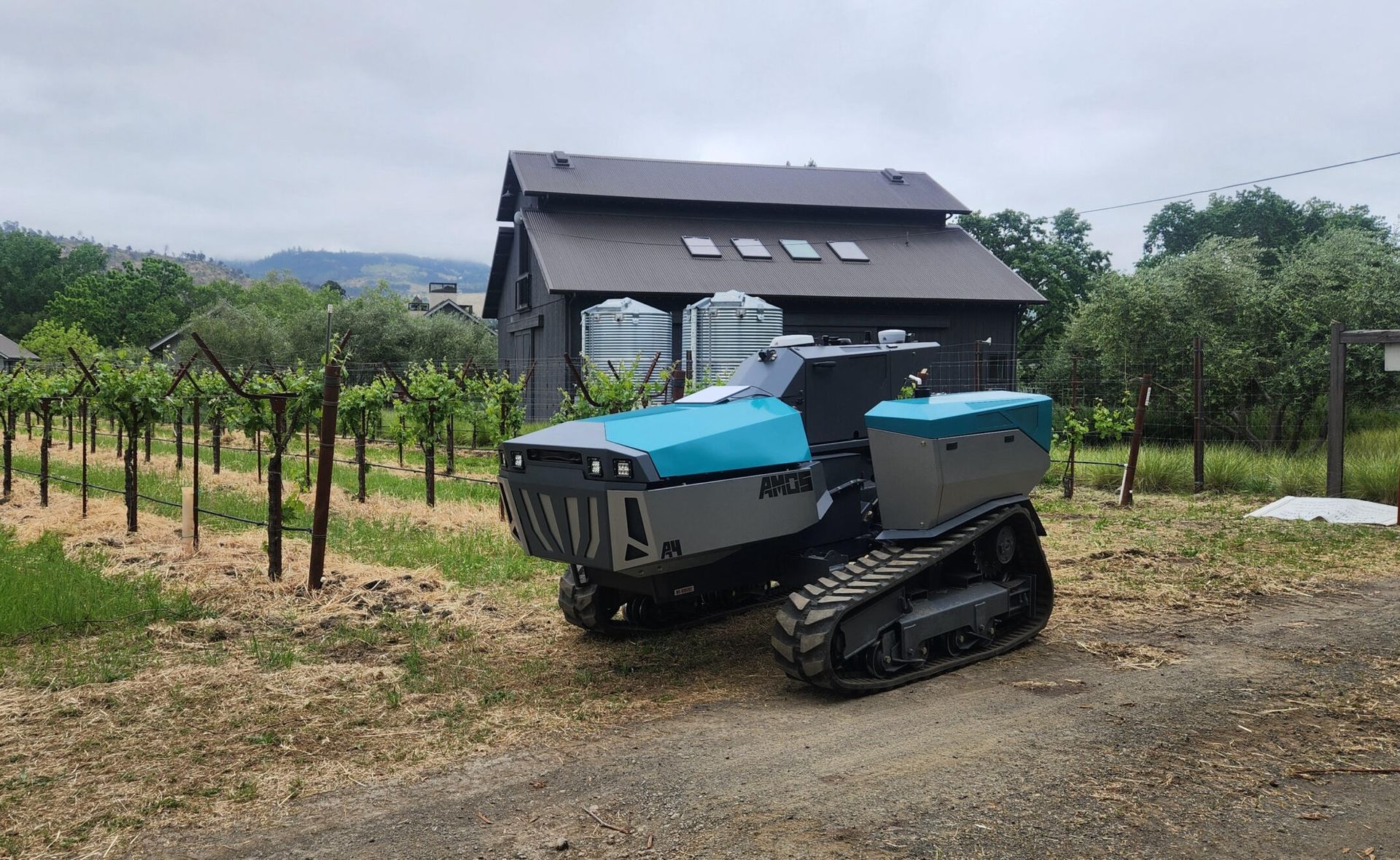
February 2026 brought another step. FarmX announced the acquisition of Amos Power, an electric autonomous tractor developer, alongside additional funding. The stated plan combined machinery with perception, software and crop analytics. Dave’s aspiration was a system that learns from field operations and adapts to changing conditions. The announcement described integrated production deployments beginning on a 2026 roadmap; it should be read as a development plan.
The bill is still part of the story
Across these businesses, Dave’s recurring subject is the distance between a physical resource and the decision that spends it. Light stays on. Irrigation runs. Machinery travels a row. Better information creates an opportunity to intervene, but customers still need an economic reason to install the equipment and change their routines.
That makes his move from buildings to farming less abrupt than the photographs might suggest. A ceiling sensor and a tracked tractor occupy very different amounts of space. Both belong to his continuing effort to make physical operations respond to what is happening around them. The practical question survives each change of scenery: can the equipment notice enough to do something useful, and will the customer find the result worth paying for?
Keep following the work
- FarmX
- Tushar Dave on LinkedIn
- Enlighted’s 2013 financing announcement
- San Jose City Hall case study
- Siemens’ 2018 acquisition announcement
- OrchardPilot: January 2025 update
- Amos Power acquisition: February 2026
- Watch: FarmX’s Redefining Autonomy
- Read the 2013 Dave interview
- New Path Ventures in 2002