Bob Swanson had a reasonable complaint. His applications engineers were helping a customer use a fifty-cent voltage regulator from Texas Instruments. Linear Technology, the company he had helped found, sold a dollar part. Why were his own people recommending the competition?
- High-performance analog chips turn physical signals into usable data and deliver controlled power.
- The premium covered circuit design, manufacturing know-how and help at the customer’s bench.
- Acquired by Analog Devices in 2017; its products and free LTspice software continue there.
The engineers had an answer: the customer already needed several of Linear’s more capable chips. This particular job only required the cheaper regulator. Pushing the dollar part would spend something harder to replace than revenue: credibility. In a 2015 interview, Swanson recalled being persuaded. The customer’s circuit mattered more than winning every socket on the board.
It is a small incident with an unusually large explanatory reach. Linear sold integrated circuits, but its appeal depended on judgment: where precision mattered, where it did not, and how much trouble an engineer could avoid by choosing correctly.
“Well, I reluctantly gave in to that.”Bob Swanson, on recommending the cheaper rival part
02The world refuses to be digital
A computer can process numbers. First, somebody has to turn a sensor’s voltage into those numbers. Somebody also has to deliver power without wasting too much as heat or burying a delicate signal in electrical noise. Linear worked in that territory: power management, data conversion, amplifiers, voltage references, interfaces and radio-frequency circuits.
Its buyers were equipment manufacturers and the engineers designing their boards. Industrial instruments, automotive electronics, communications infrastructure and aerospace systems all needed these functions. The business occupied the high-performance end of analog semiconductors, where a component’s behavior could matter more than its purchase price.
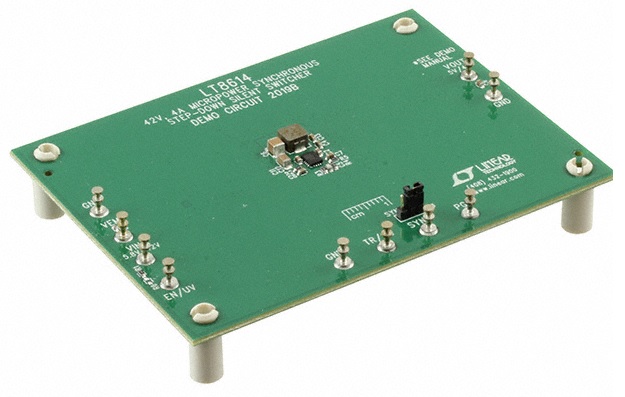
Consider the LT8614. This step-down regulator converts a higher supply voltage into a lower one. Its Silent Switcher architecture uses carefully arranged current paths to reduce electromagnetic interference. That is useful when the power supply must share a board with sensitive electronics. The LTM4600 attacked a different nuisance: its µModule package combined a switching controller, power devices, inductor and supporting circuitry into a compact power supply building block.
03A factory built around the specialists
Swanson and circuit designer Bob Dobkin left National Semiconductor and established Linear in 1981. Their oral history describes an organization in which analog projects struggled for manufacturing attention. Dobkin recalled using wine to persuade a line manager to move a mask through the queue. Their new company would give analog its own priorities.
That independence required money. A contemporary semiconductor startup directory records equity rounds of $5 million in 1981, $5 million in 1982 and $7 million in 1983, followed by a $24 million public offering in 1986. Manufacturing was part of the undertaking, alongside circuit design.
Linear’s expertise extended from the wafer process to packaging, testing and helping customers make circuits work. Its founders described hiring experienced designers as field applications engineers. These specialists could carry knowledge out of the factory and into a customer’s lab. For a buyer wrestling with an unfamiliar analog problem, that assistance was part of the product.
04When better stopped being enough
The strategy met a revealing limit in consumer electronics. By 2005, consumer products and cellular handsets represented 28% of Linear’s business, Swanson later recalled. Engineers had newer generations ready when competitors caught up. The trouble was that many customers were happy buying the older level of performance for much less.
What failed was the assumption that a technical lead would keep earning a premium. Linear decided around 2005 to de-emphasize those markets. A growing market could still be an unattractive place for its particular business.
The company also learned that good margins could not prevent a demand collapse. After the dot-com bubble burst, it closed its four-inch fabrication plant while supporting a larger facility. During the later financial crisis, reduced pay and factory shutdowns helped manage costs. Swanson acknowledged that a deeper sales decline would have required additional measures. Discipline bought room to respond; it did not abolish the semiconductor cycle.
05Give away the rehearsal
LTspice made another part of the proposition unusually accessible. Engineers could draw a circuit, simulate its behavior and inspect waveforms before assembling hardware. The software was free. Today Analog Devices still distributes it, with component models, demonstration circuits and tutorials.
LTpowerCAD tackled power-supply selection and design, including component values, efficiency estimates and feedback-loop behavior. Designs could then move into LTspice for further investigation. The commercial logic is easy to see: make a difficult component easier to evaluate, and give the engineer a practical route toward using it.
The route still ends on a bench. Linear’s demonstration-board documentation explicitly tells customers to verify operation in the actual application; layout and component substitutions can change performance. A simulation cannot excuse an overheated board. For readers building hardware, the copyable sequence is concrete: define the operating conditions, select a part, simulate, then measure a prototype.
06The price of staying focused
The model sold chips through direct sales and distributors. Arrow alone accounted for 34% of fiscal 2016 revenue, while no individual end customer exceeded 10%. That distinction matters: a concentrated distribution channel can still serve a spread of equipment makers.
In that final full fiscal year before the acquisition, Linear reported $1.424 billion of revenue and $633.6 million of operating income. Research and development cost $276.5 million, about 19.4% of revenue. The resulting operating margin was roughly 44.5%. Expertise was expensive to maintain, and the business left substantial profit after paying for it.
Analog Devices announced a cash-and-stock acquisition in July 2016 at an equity value of approximately $14.8 billion. It closed on March 10, 2017; final purchase consideration was about $15.8 billion. The announced rationale joined complementary analog and power portfolios. Linear’s independently traded shares disappeared, while its parts and tools entered a larger company.
By October 2026, ADI’s LTspice download page listed updated models and a Windows 26.1.1 release. The old name remains familiar on engineers’ benches. Its business lesson remains equally practical: choose problems where improvement changes the customer’s result, fund the people who understand those problems, and be willing to recommend the fifty-cent part when fifty cents will do.
On the workbench
Explore Linear’s legacy website and ADI’s product catalog; try LTspice or join its engineering forum.
Watch the founders’ oral history on YouTube and ADI’s LTspice 26 demonstration. Read Analog Dialogue and the acquisition announcement.