A fresh start is an attractive thing to promise a semiconductor company. The customers, inconveniently, still expect their chips on time. When Raghib Hussain became Altera’s chief executive in May 2025, he inherited both possibilities: an established business preparing to stand on its own, and the thoroughly unromantic obligation to make the next delivery dependable.
He had already helped build one chip company from the beginning. With Syed Ali, he co-founded Cavium in 2000, took it through a public listing and stayed through its acquisition by Marvell. His next assignment would require a different kind of founder’s instinct. Altera had a history, a product portfolio and customers whose plans extended well beyond the next change of ownership. Starting again meant carrying those people along.
In September 2025, as Altera emerged under majority ownership by Silver Lake, Hussain offered a plain description of the job: “We need to fully focus on execution.” There is little glamour in the sentence. There is also very little room to hide. A delivery date has an irritating habit of arriving whether the presentation was persuasive or not.
The mathematics of getting out
His path began far from the ownership negotiations. Hussain studied computer systems engineering at NED University in Karachi before earning a master’s in computer engineering at San Jose State. Mathematics had been his favorite school subject. A government-school education and a household with eleven siblings preceded the university years.
An early design-engineering job at Semi-Custom Logic in Karachi connected him with Silicon Valley and an opportunity for advanced training in the United States. The route ran through work and professional relationships. Years later, describing what NED had meant to him at an alumni gathering, he credited it with helping a geek become a more balanced person. It is an unusually affectionate assessment of an engineering education: useful circuitry, followed by some work on the operator.
That connection to his university continued as his career grew. In 2007, the year Cavium went public, he joined an entrepreneurship panel at a gathering of NED alumni in California. The subject was the journey from university to the stock market. At another entrepreneurship event that year, he discussed the possibilities and difficulties of building a business with an international reach. His experience was already becoming material that other engineers could use.
Eighteen years before the next chapter
Before Cavium, Hussain held engineering roles at Cisco and Cadence and belonged to the founding team at enterprise-security company VPNet. Networking and security became recurring subjects in his work. They also supplied the background for a company addressing the processing demands behind connected systems, rather than the devices people admired on their desks.
He and Ali founded Cavium in 2000. By Hussain’s account, the business eventually reached roughly $1 billion in annual revenue. Its 2007 IPO and subsequent growth gave the partnership a public-company chapter before Marvell completed the acquisition on July 6, 2018. He served as Cavium’s chief technology officer and chief operating officer along the way.
The acquisition joined portfolios spanning processing, networking, storage, connectivity and security. For Hussain, it also changed the scale of the assignment. A founder who had helped build a company now had responsibilities inside a combined organization. The work continued after the transaction, when the organizational diagram had to become a functioning business.
At Marvell, he became executive vice president and chief strategy officer, with responsibility for its networking and processors group. In April 2021, he was promoted to President, Products and Technologies. That progression matters because it places operating responsibility beside the founding story. His career did not end at an exit valuation; it continued through decisions about products, investment and direction.
His professional connections widened, too. He joined the Cirrus Logic board in September 2021, bringing experience in a different part of the semiconductor market. He has also served on the RAND Center for Asia Pacific Policy advisory board. Alongside those roles sits a technical record of more than 40 patents in networking and security. The engineering background remained part of the executive biography.
The freedom to choose, the obligation to deliver
When Intel announced Hussain’s appointment in April 2025, it also announced an agreement for Silver Lake to acquire a majority interest in Altera. Hussain succeeded Sandra Rivera on May 5. The transaction closed on September 12, leaving Silver Lake with 51 percent and Intel with 49 percent. A new chief executive arrived before the new ownership structure was complete.
Altera itself was decades old. Founded in 1983, it had become part of Intel in 2015. Its return to independent operations brought an old name into a new set of circumstances. Hussain’s challenge was to make independence useful to customers who needed products, tools and support, rather than another explanation of the corporate structure.
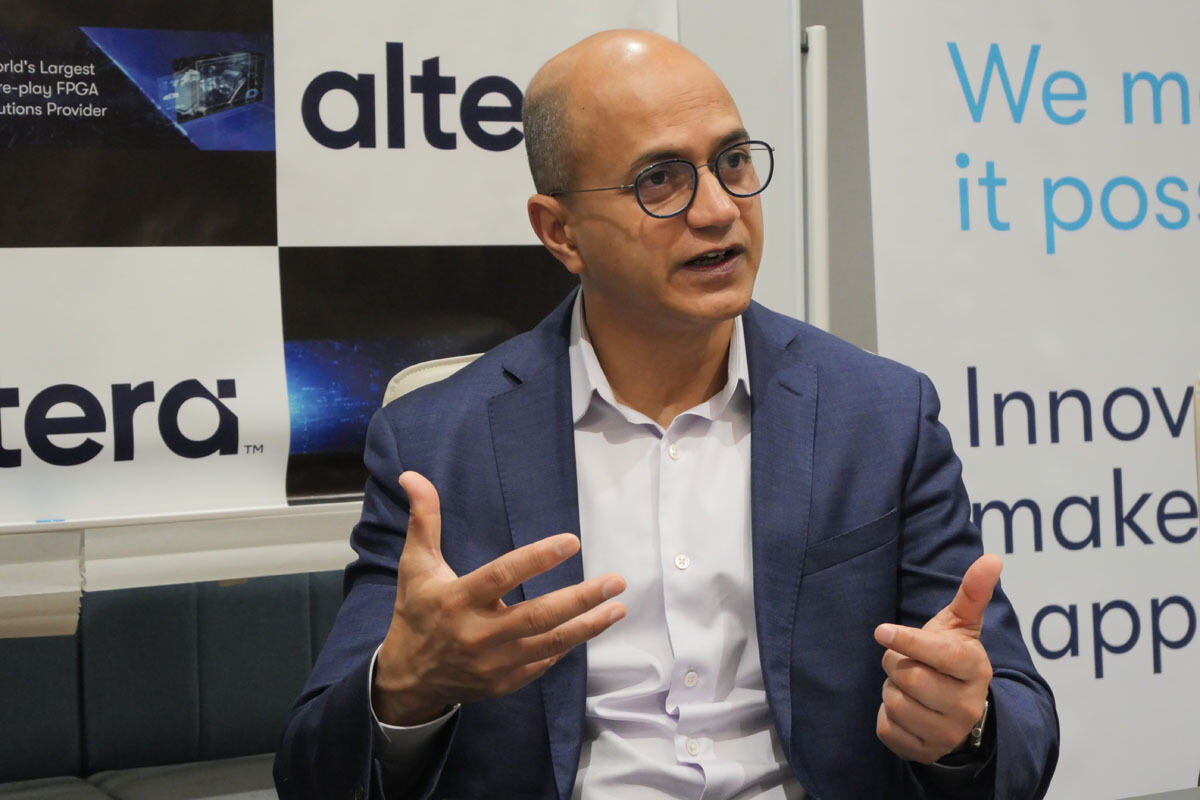
He described independence as freedom to make choices about manufacturing partners and markets. Altera could decide where to build its chips and pursue a broader range of applications. He also wanted a sales organization focused on FPGAs. These are consequential freedoms for a business whose customers choose a component as part of a larger system.
The company could move more quickly, he argued, because programmable logic would occupy its full attention. In interviews after the separation, he emphasized ownership of customer problems and the ability to compete for business. The argument puts an obligation alongside every new freedom. Once a decision belongs to the company, so does the result.
By May 2026, his first-anniversary reflection described work across engineering, operations, sales and marketing, as well as the finance, legal, IT and HR foundations needed for an independent business. He thanked employees, customers and partners. The next phase, he wrote, would involve scaling what the team had put in place. The sequence was practical: establish the organization, then ask it to do more.
A chip with a very long memory
One decision gives that operating philosophy a date far beyond a normal executive planning cycle. In April 2026, Altera announced planned lifecycle support through 2045 for its Agilex, MAX 10 and Cyclone V families, with stated exclusions and supply conditions. Agilex 7 devices with integrated HBM2E memory were excluded from the extension.
For customers in industrial systems, communications and transportation, that kind of horizon has practical value. Equipment may stay in use for decades. Replacing a component can require redesign and renewed certification. The promise concerns the life of the customer’s system as much as the life of a chip. Moving fast as a supplier has to coexist with staying available.
Planned support horizon for specified FPGA families. Device exclusions and supply conditions apply.
This helps explain why reliability keeps returning in Hussain’s public comments. A programmable device allows a system to evolve after deployment. The business supplying it must offer enough continuity for an engineer to make that choice confidently. Flexibility in the hardware creates its own demand for consistency in the organization behind it.
In September 2026, Altera announced board appointments involving Kirsten Spears and Sumit Sadana, followed later that month by Nishit Sahay’s appointment as chief information officer. Hussain emphasized complementary financial, technical and operating experience, then the importance of stronger internal infrastructure and better tools. The less picturesque parts of independence were still receiving attention. Even a fresh start needs someone to keep the systems running.
A nervous system for the next machine
Hussain’s larger opportunity lies in AI moving into systems that sense and act. FPGAs, or field-programmable gate arrays, contain hardware logic that developers can configure after manufacturing. They can work alongside processors and GPUs, handling tasks such as sensor capture, preprocessing, real-time control and data movement. That division of labor is central to his argument for Altera.
In a July 2026 interview, he compared GPUs with a brain and FPGAs with the nervous system. The analogy gives a familiar shape to a less familiar component. Intelligence must receive information and translate decisions into timely action. In a physical system, the path between sensing and acting becomes part of the computing problem.
“If GPU is the brain, the FPGAs are the nervous system.”
Raghib Hussain · July 2026
A simplified view of complementary jobs, rather than a specification for a particular product.
His account of Altera’s progress remains a chief executive’s assessment of a private business. In July, he reported growth of more than 20 percent in the preceding year, working prototypes of six new chips, and preparations for an eventual public listing. Those statements describe momentum and intent. A listing date was not announced.
As of October 22, 2026, another date is closer: an opening keynote scheduled for October 28 at Altera Innovators Day in San Jose. Its subject is empowering developers for the AI era. It is an appropriate audience for an executive who keeps returning to the relationship between the people building chips and the people building with them.
There is a continuity here, from the young engineer making professional connections in Karachi to the founder working with Ali, and from Marvell’s product organization to an independent Altera. Hussain keeps choosing work in the machinery behind other people’s inventions. The next beginning will be judged in that same place: where a customer takes delivery, opens the tools and starts building.